
There's a strange thing about hobby communities. The institutions that run them never make the rankings the communities actually use. Wine drinkers maintain vintage rankings that don't always match what the official critics published. Audio enthusiasts rank headphones with a precision the manufacturers don't advertise. Photographers compare lenses by metrics the companies didn't measure. And gaming communities, across genres and decades, build rankings for everything inside their games that the developers don't explicitly tell them about.
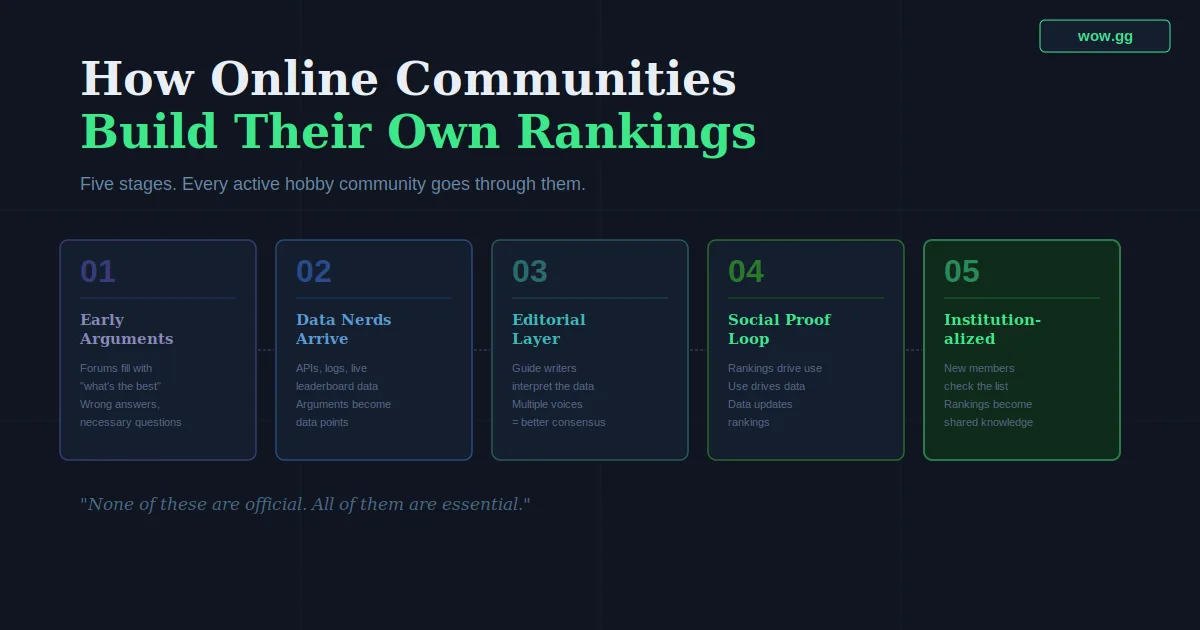
None of these are official. All of them are essential. The process by which communities build their own ranking infrastructure happens in roughly five stages, and the stages are visible if you know where to look.
Stage one: the early arguments
Every community starts with arguments. A product releases, the hobby attracts new participants, and two weeks in the forums fill with "what's the best version" and "is X worth it." The arguments are usually wrong. The sample sizes are too small. The information will change. The community knowledge base hasn't formed yet.
But the arguments are necessary. They generate the question that the rest of the ranking infrastructure will exist to answer. They identify the loud voices whose opinions will carry weight in the next stage. They reveal what the community actually cares about, which is often different from what the institutions think the community should care about.
In World of Warcraft's case, when the current expansion launched earlier this year, the early arguments were about whether a new specialization was overpowered, whether one tank had gotten too dominant, and whether the support specialization should exist at all. Those were the questions the eventual ranking systems would have to answer.
Stage two: the data nerds arrive
A few weeks into any new release, the data layer emerges. People with access to APIs, measurement tools, or just the patience to manually log results start producing actual numbers. Rankings stop being arguments and start being data points. The data isn't perfect — early data sets always over-represent dedicated enthusiasts and under-represent casual ones — but it's real.
This is where aggregator sites become useful. The wow.gg wow healer tier list is one example — it shows actual completion rates and rankings across thousands of runs, refreshed every few hours. The numbers settle arguments that opinion alone couldn't. Two competing favorites stop being a debate when the live data shows them tied within a handful of rating points.
The data nerds aren't usually the same people as the early-argument crowd. They're often quieter, more analytical, less invested in any particular outcome. But their work becomes the foundation everyone else builds on.
Stage three: the editorial layer
Pure data alone doesn't make a ranking system. Communities need someone to interpret the data — to say "this is top tier because of these specific reasons" rather than just "this scored X." The editorial layer is where guide writers, content creators, and analytical commentators come in.
This layer is opinionated by definition. Different writers approach the same data with different priorities — some emphasize top-end performance, others emphasize average-case viability, others emphasize how the option actually feels to use. None of them are wrong. They're all making editorial choices about which data to emphasize and how to interpret it.
The community generally benefits from having multiple editorial voices. A reader who checks three different rankings, all derived from the same underlying data, can triangulate the consensus position. Where they all agree, the ranking is reliable. Where they disagree, the subject is probably more situational than any single ranking captures.
Stage four: the social proof loop
Once data and editorial layers exist, the social proof loop activates. People use the rankings to make decisions. Their results validate or contradict the rankings. The next iteration of rankings incorporates those results.
This loop runs fast in active communities. Something ranked highly gets used more, generates more data, and either confirms its ranking or reveals weaknesses that lower it. Something ranked lower gets used less, generates less data, and stays low unless somebody publicly demonstrates that it's better than the rankings suggest. The system reinforces itself.
The interesting failure mode is when this loop creates rankings that don't match reality. If something is ranked low and nobody uses it, the data set stays small, and the ranking stays low — even if the thing being ranked is actually good. Nobody runs the contradicting experiment. This is rare but happens, usually with options that are excellent in narrow conditions that the broader community doesn't naturally explore.
Stage five: the institutionalization
After a few months, the rankings become institutional. New community members don't ask whether something is good — they check the established list. The community's collective opinion has crystallized into a reference. Disagreement still exists, but it happens within a framework where the established rankings are the baseline.
This institutionalization happens fast in active communities. Gaming communities institutionalize within weeks of major content releases. Tournament-driven communities institutionalize over competition cycles, sometimes lagging the actual state of play by months.
The institutionalized state isn't permanent. New releases reset everything. New community members keep arriving. The cycle restarts. But within a given window, the rankings stabilize and become the shared knowledge base the community uses to onboard new participants.
What this process gets right
The community ranking process produces better information than top-down ranking would. The data is aggregated from real use. The editorial interpretation is varied. The social proof loop self-corrects most errors. Compared to an official "this is the order" announcement, community rankings are more current, more honest, and more useful.
The process also makes mistakes. Early rankings often reflect first-impression biases. Editorial voices have blind spots. The social proof loop can entrench wrong rankings if nobody runs the contradicting experiments. Community rankings are better than nothing but not always better than they could be.
The honest read is that distributed ranking systems work because no single source is trusted absolutely. Members who check multiple sources, read multiple editorial voices, and form their own conclusions get better answers than those who pick one ranking and follow it blindly. The community infrastructure is a research aid, not an oracle.
Beyond any single hobby
This pattern isn't unique to one community. Restaurant rankings, university rankings, music charts, professional sports analytics — all of them follow some version of the same process. The community generates data, editorial voices interpret it, social proof loops reinforce or correct it, and the system institutionalizes around shared consensus.
What makes hobby communities interesting to watch is the speed and visibility of the cycle. A wine vintage takes years to develop a reputation. A game patch's rankings take weeks. The compression makes the dynamics visible in ways slower cycles obscure, but the dynamics themselves are the same.