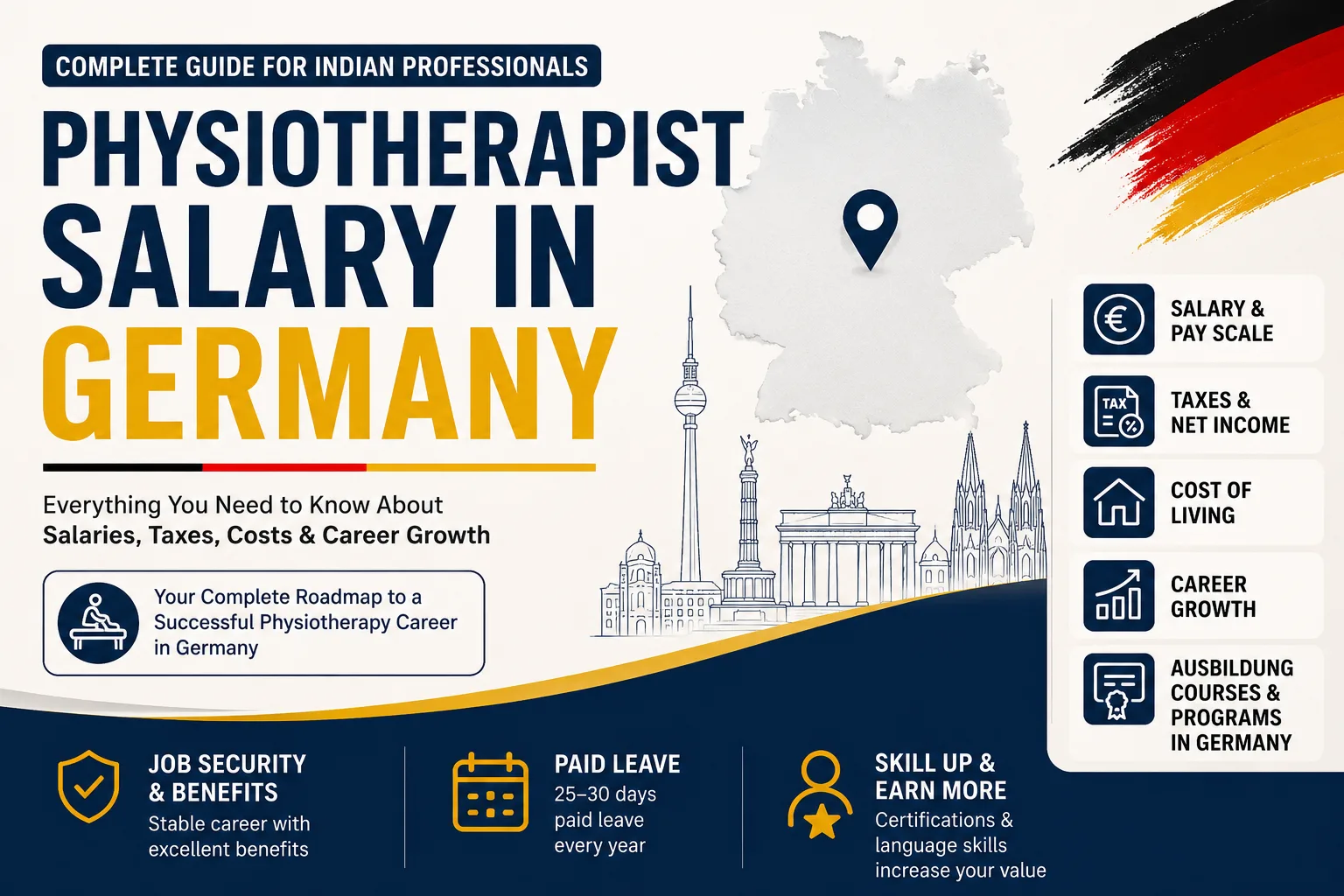
Introduction
Moving to a new country is a massive decision. Many Indian physiotherapists look at Germany for better career options. You might wonder if the financial reward matches the hard work. The internet has a lot of confusing numbers about German salaries. This article breaks down the exact salary you can expect as a physiotherapist in Germany. You will learn about starting pay, tax deductions and living costs. I will help you decide if this move makes financial sense for you. Many healthcare professionals also explore ausbildung courses in Germany and the ausbildung program in Germany as alternative pathways to build a long-term healthcare career.
Average Physiotherapist Salary in Germany
The salary for a physiotherapist in Germany depends heavily on your experience. A fresh graduate earns less than a senior therapist. The average gross salary is around 2,800 to 3,500 euros per month [1]. This is the amount before the government takes out taxes. You will see this number on your job contract. Your bank account will receive a smaller number. Many foreign workers feel shocked when they see their first paycheck. It is vital to understand this system before you move.
Here is a simple breakdown of average monthly gross salaries:
- Entry-level (0 to 2 years): 2,500 to 2,800 EUR
- Mid-level (3 to 5 years): 2,900 to 3,300 EUR
- Senior-level (5+ years): 3,400 to 4,000 EUR
Your exact pay will change based on your specific employer. Some regions pay more than others.
How Location Changes Your Pay
Germany has different pay scales in different states. Cities in the west usually pay more than cities in the east. States like Bavaria and Baden-Württemberg offer the highest salaries. Cities like Munich and Stuttgart have very strong economies. Medical facilities in these cities have bigger budgets. You will earn less in states like Saxony or Thuringia. However you must remember that living costs are also much higher in the west. You need to balance the higher pay with the higher rent. Finding a cheap home in Munich is almost impossible. A lower salary in a small town might actually give you a better lifestyle.
"A higher salary in Munich might leave you with less savings than a lower salary in Leipzig because rent eats up the difference."
Public Hospitals vs Private Clinics
Where you work changes how much you earn. Public hospitals follow strict government wage agreements. This system is called TVöD [2]. Working in a public hospital gives you very clear pay raises. Your salary goes up automatically as you gain years of experience. You do not need to ask your boss for a raise. The union negotiates these increases for you.
Private clinics work differently. A private clinic can offer a higher starting salary to attract talent. They have more freedom with their budgets. However private clinics might not give automatic yearly raises. You will have to negotiate your pay increases yourself. Some private clinics also offer bonuses based on the number of patients you treat. Working in a private clinic can be more stressful but it can also pay more.
The Reality of German Taxes
Looking at gross salary can be very misleading. Germany has a high tax rate to fund its social systems. These systems provide excellent public services. Your net salary is what you actually take home every month. The government deducts health insurance, pension contributions and income tax automatically [3]. You also pay unemployment insurance.
Your tax rate depends on your personal life. Germany places workers into different tax classes. A single person without children pays the highest taxes. They are usually in Tax Class 1. A married person with a spouse who does not work pays lower taxes. A gross salary of 3000 euros might result in a net take-home pay of around 2000 euros for a single person. You must calculate this net pay before planning your budget.
"Understanding the difference between gross and net income is the most important step before signing any job contract in Germany."
Cost of Living in Germany
You need to compare your net salary to your daily living costs. Rent is the biggest expense for everyone in Germany. Finding a cheap apartment in a big city is very difficult. A one-bedroom apartment in Munich can cost over 1200 euros per month. The same apartment might cost 700 euros in a smaller town. You usually have to pay a deposit equal to three months of rent.
Groceries and public transport are quite affordable. You can expect to spend around 200 to 300 euros on groceries every month [4]. Public health insurance covers almost all your medical needs. A monthly transport ticket costs 49 euros and works across the whole country. A single physiotherapist can live comfortably but you will not become rich quickly. Budgeting is very important during your first year.
How to Increase Your Income
You do not have to settle for the base salary forever. There are clear ways to earn more money as a physiotherapist in Germany. The best way is to get additional certifications. Manual therapy and lymphatic drainage are very popular specializations. Neurological physiotherapy is also in high demand. Employers pay higher salaries to therapists with these specific skills. They can charge insurance companies more money for these treatments.
Language skills are also extremely important. You need B2 level German to get your professional license [5]. Reaching C1 level makes you much more valuable. You can communicate better with patients and doctors. You can write patient reports much faster. Better communication leads to promotion opportunities. You could eventually become a clinic manager. Many international students first complete ausbildung courses in Germany or join an ausbildung program in Germany to improve their German language skills, gain practical healthcare experience, and build a long-term career in the country.
"Your German language ability is directly tied to your earning potential. The better you speak the faster you will advance in your healthcare career."
Working as a Freelance Physiotherapist
Some experienced professionals choose to work for themselves. You can open your own private practice after working for a few years. Freelancers can earn much more money per hour. You set your own schedule and choose your own patients.
This path also comes with high financial risks. You have to pay for your own clinic space and equipment. You also have to manage all your own taxes and insurance. Opening a clinic requires a lot of paperwork. You must follow strict rules from the German health authorities. Most foreign professionals work as employees for at least five years before trying to open a business. This gives them time to understand the system and build a local network.
Final Thoughts on Moving to Germany
Working as a physiotherapist in Germany is a very stable career choice. The healthcare system is strong and always needs new workers. The population is getting older and they need more physical therapy. The salary provides a good middle-class life. You get excellent job security and lots of paid vacation days. Most workers get 25 to 30 days of paid leave every year. You must be realistic about the taxes and the cost of living. Focus on learning the language and getting new certifications. This will guarantee your long-term success in the country. If you are just starting your journey, exploring ausbildung courses in Germany or choosing the right ausbildung program in Germany can also be an excellent pathway into the German healthcare sector before advancing your physiotherapy career.