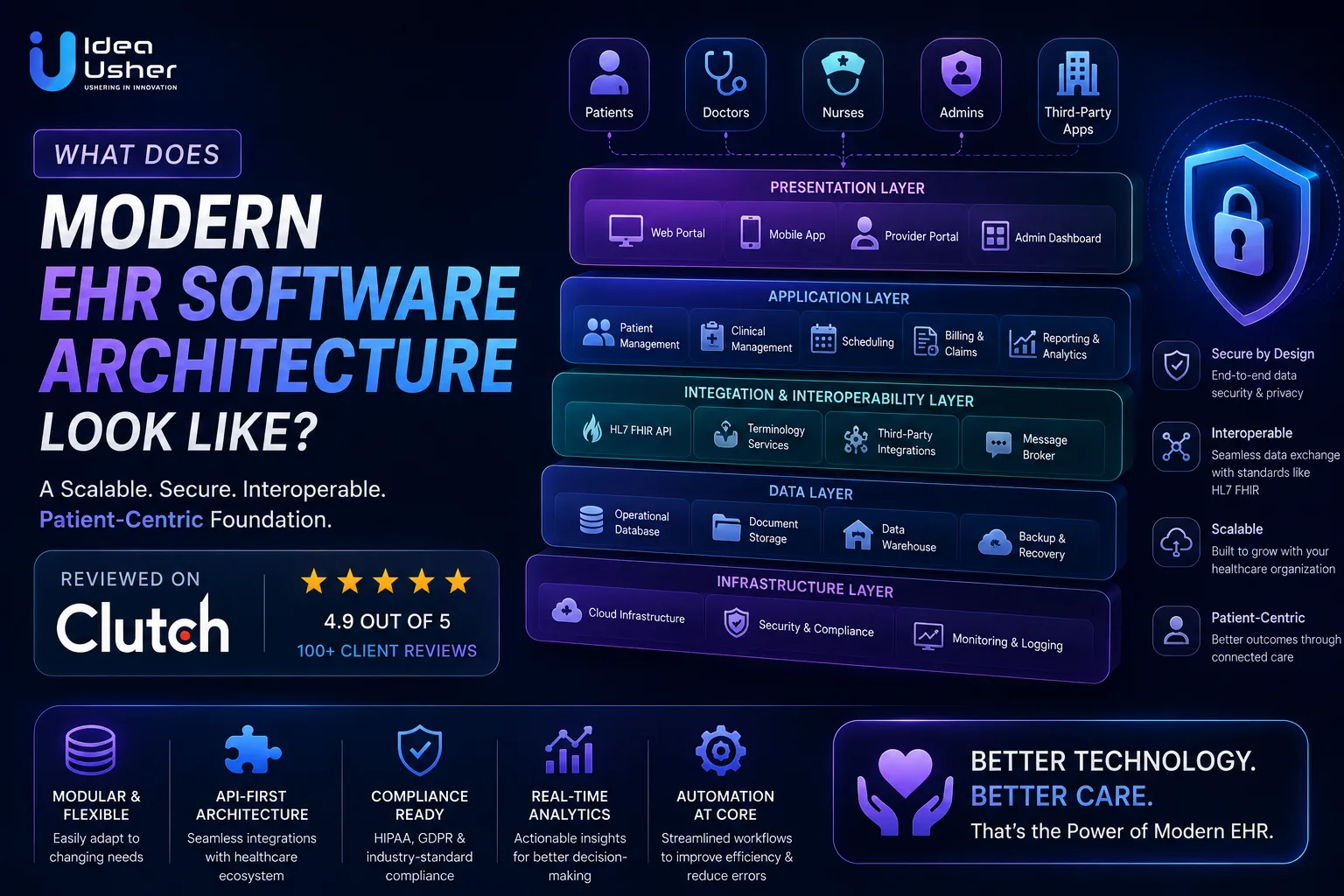
The healthcare industry is becoming increasingly connected, data-driven, and patient-focused. From hospitals and specialty clinics to telehealth providers and diagnostic centers, healthcare organizations rely on Electronic Health Record (EHR) systems to manage clinical information, streamline workflows, and improve patient outcomes. However, the expectations placed on today's EHR platforms are far greater than they were just a few years ago. Modern healthcare demands software that is scalable, interoperable, secure, and capable of supporting advanced technologies such as Artificial Intelligence (AI), cloud computing, and remote patient monitoring.
This shift has led many organizations to ask, what does modern EHR software architecture look like? Rather than being a single application that stores patient records, modern EHR architecture is built as a connected ecosystem of services that work together to provide healthcare professionals with accurate, real-time information. It is designed to support continuous innovation while ensuring that sensitive patient data remains secure and accessible whenever it is needed.
In this article, we'll explore the essential elements of modern EHR software architecture and why it has become the foundation of next-generation digital healthcare.
Why Healthcare Needs Modern EHR Architecture
Healthcare organizations face increasing pressure to improve patient care while managing rising operational costs and strict regulatory requirements. Legacy EHR systems often struggle to support these changing demands because they were designed for a different era of healthcare.
Some common challenges with older EHR systems include:
- Limited integration capabilities
- Slow system performance
- Difficult software upgrades
- High infrastructure costs
- Inconsistent user experiences
- Limited support for mobile healthcare
- Growing cybersecurity concerns
Modern EHR software architecture addresses these issues by adopting technologies that make healthcare platforms more flexible, reliable, and future-ready.
Cloud-Native Infrastructure
Cloud computing has become one of the defining characteristics of modern healthcare software. Instead of depending entirely on on-premise servers, healthcare organizations are moving EHR platforms to secure cloud environments that offer better performance and scalability.
Cloud-native architecture provides several benefits, including:
- High availability
- Automatic resource scaling
- Faster software deployment
- Secure backups
- Disaster recovery
- Reduced infrastructure maintenance
- Lower operational costs
Cloud platforms also enable healthcare organizations to support multiple facilities through a centralized technology infrastructure.
Modular Development with Microservices
Traditional EHR systems were commonly built as monolithic applications where every feature depended on the same codebase. Updating one component often required redeploying the entire application, increasing development complexity.
Modern EHR software architecture uses microservices to separate business functions into independent modules.
These modules may include:
- Patient registration
- Clinical documentation
- Appointment scheduling
- Billing and payments
- Pharmacy management
- Laboratory services
- Imaging integrations
- Authentication
- Notification services
This modular approach allows development teams to improve individual services without disrupting the rest of the platform.
Interoperability Creates Connected Healthcare
Modern healthcare depends on the ability to exchange patient information securely across different organizations and systems.
An effective EHR platform integrates with:
- Laboratory Information Systems
- Radiology Information Systems
- Pharmacy software
- Insurance providers
- Telemedicine applications
- Wearable medical devices
- Patient portals
- Mobile health apps
Standards such as HL7 and FHIR make these integrations possible, allowing healthcare providers to access complete patient information regardless of where care is delivered.
Artificial Intelligence Improves Clinical Efficiency
Artificial Intelligence is becoming an essential part of modern EHR systems.
AI-powered capabilities include:
- Clinical decision support
- Automated medical documentation
- Predictive patient risk analysis
- Medical coding assistance
- Appointment scheduling optimization
- Population health management
- Revenue cycle optimization
These features reduce administrative workloads while helping clinicians make faster and more informed decisions.
Security and Compliance by Design
Protecting patient information is one of the highest priorities in healthcare software development.
Modern EHR software architecture incorporates multiple security layers from the beginning of the development process.
Essential security measures include:
- End-to-end encryption
- Multi-factor authentication
- Role-based access control
- API security
- Audit logging
- Continuous threat monitoring
- Secure data backups
These measures help healthcare organizations maintain compliance with HIPAA, GDPR, and other healthcare privacy regulations while reducing cybersecurity risks.
Data Analytics Supports Better Decision-Making
Healthcare organizations generate valuable clinical and operational data every day.
Modern EHR systems include analytics capabilities that transform this information into actionable insights.
Organizations can analyze:
- Patient outcomes
- Clinical quality metrics
- Resource utilization
- Financial performance
- Hospital operations
- Readmission rates
- Population health trends
These insights help healthcare leaders identify opportunities to improve efficiency, reduce costs, and deliver better patient care.
Supporting Telehealth and Mobile Healthcare
The rapid growth of telemedicine has expanded the role of EHR platforms beyond hospital walls.
Modern architectures support seamless integration with:
- Virtual consultation platforms
- Remote patient monitoring devices
- Mobile healthcare applications
- Digital appointment scheduling
- Patient communication systems
These capabilities create a connected healthcare experience that improves accessibility while supporting hybrid models of care.
Building for Scalability
Healthcare organizations continue to expand their services, making scalability an essential architectural requirement.
Modern EHR platforms use technologies such as containerization, Kubernetes orchestration, distributed databases, caching systems, and load balancing to maintain consistent performance even during periods of high demand.
This ensures healthcare providers can continue delivering reliable services as patient volumes grow.
Future Trends in Modern EHR Software Architecture
Healthcare technology continues to evolve rapidly, and EHR systems must be designed with flexibility in mind.
Future innovations are expected to include:
- Generative AI for clinical documentation
- Voice-enabled physician assistants
- Internet of Medical Things (IoMT) integration
- Blockchain-enabled medical records
- Predictive healthcare analytics
- Personalized patient engagement
- Advanced automation for administrative workflows
Organizations with modern software architectures will be better positioned to adopt these innovations without major system redesigns.
Choosing the Right Development Partner
Developing a modern EHR platform requires expertise in healthcare regulations, software engineering, cloud infrastructure, cybersecurity, interoperability standards, and AI technologies. Working with an experienced healthcare software development company helps ensure the platform is secure, scalable, compliant, and capable of supporting future healthcare innovations.
A knowledgeable technology partner can also simplify system integrations, optimize platform performance, and reduce long-term maintenance challenges.
Conclusion
Understanding what modern EHR software architecture looks like is essential for healthcare organizations planning their digital transformation strategy. Modern EHR platforms combine cloud computing, microservices, interoperability, artificial intelligence, analytics, and enterprise-grade security to create highly connected healthcare ecosystems.
By investing in a modern software architecture, healthcare providers can improve clinical workflows, strengthen data security, support seamless interoperability, and deliver better patient experiences. As healthcare continues to embrace digital innovation, a scalable and future-ready EHR architecture will remain one of the most valuable foundations for long-term success.