Introduction
Ever wondered what truly powers India's heart? It’s the vibrant villages, spirited communities, and untapped potential of rural India. While cities continue to boom, rural India holds the key to sustainable and inclusive growth. Enter: MBA in Rural Development — a game-changing program that’s creating leaders for the land less traveled.
Understanding the MBA in Rural Development
What is an MBA in Rural Development?
Unlike a traditional MBA, this program focuses on developing skills to address rural issues — from poverty alleviation to sustainable farming, infrastructure development, and microfinance. It blends management principles with development theory.
Key Subjects and Curriculum Structure
You’ll dive deep into:
- Rural Marketing
- Development Economics
- Agribusiness
- Microfinance & SHGs
- Social Entrepreneurship
- Public Policy
Duration and Eligibility Criteria
This is typically a 2-year postgraduate course. You’ll need a bachelor’s degree (any stream), and most colleges require entrance exam scores (like CAT, XAT, or their own).
Why Rural Development Matters in India
Demographic Insights: Rural India in Numbers
Nearly 65% of India’s population resides in villages. That’s over 850 million people!
Rural Economy’s Contribution
Rural India contributes significantly to agriculture, manufacturing, and even services. It’s no exaggeration to say that our rural heartland fuels our economy.
Persistent Challenges
From lack of education and healthcare to inadequate infrastructure and unemployment, rural India is riddled with complex issues that need smart solutions, which is where rural managers step in.
The Evolution of Rural Management Education
Pioneering Institutions
IRMA in Anand pioneered rural management education in 1979. Since then, many institutions have followed suit.
Role of IRMA and IIRM College Jaipur
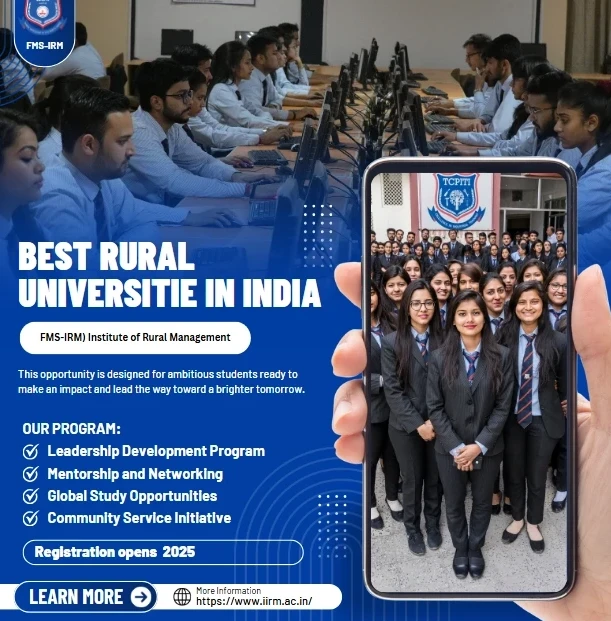
The list of Best Rural Universities In India may be legendary, however, IIRM College Jaipur has emerged as Rajasthan's premier college offering MBA in Rural Development as well as other courses. Its focus on practical exposure and research makes it a top choice for aspirants.
Growing Interest
As India embraces inclusive development, more students are exploring this field to make a tangible impact.
Core Objectives of MBA Rural Development Programs
- Bridge the urban-rural divide
- Promote sustainable and equitable development
- Encourage rural entrepreneurship
- Build leadership for village-level governance
Skills Developed During the Course
You won’t just memorize theories. You’ll gain:
- Leadership skills to run development projects
- Analytical skills to evaluate rural policies
- Communication skills to engage with communities
- Strategic planning abilities to manage resources efficiently
Top Colleges Offering MBA in Rural Development
Here’s where you can kickstart your rural revolution:
- IRMA, Anand – Gold standard in rural management
- IIRM College, Jaipur – Rajasthan’s leader in rural-focused MBAs
- XISS, Ranchi – Another great name with deep grassroots work
- TISS, Mumbai – Offers rural development with a social lens
Career Opportunities After an MBA in Rural Development
This isn’t a niche degree anymore. It opens doors to:
- NGOs like PRADAN, BAIF, SEWA
- Government programs (NREGA, NRLM)
- CSR departments of companies like Tata, ITC, and Reliance
- Microfinance institutions and rural banks
- Agritech startups and social enterprises
Impact Stories from the Grassroots
Let’s get real. Meet Sneha, an IRMA graduate, who helped digitize farmer cooperatives in Gujarat. Or Rajat from IIRM Jaipur, who developed a solar-powered cold storage system in Rajasthan villages. These aren’t just jobs — they’re missions.
How Rural MBAs are Driving Social Innovation
From mobile health vans to ed-tech for rural kids, these graduates are the brains behind some of the coolest innovations at the village level.
Tech Integration
Rural MBAs are leveraging:
- Mobile apps for farm advisory
- Blockchain in supply chains
- AI-based weather predictions for crop planning
Financial Inclusion
They’re also making banking accessible through digital kiosks, SHG lending, and micro-insurance.
Challenges Faced by Graduates
It’s not all sunshine. Working in rural India comes with:
- Connectivity problems
- Harsh living conditions
- Low initial salaries
But the job satisfaction and long-term growth outweigh these hurdles.
Role of Government and Policy Support
The Indian government supports rural MBAs via:
- Fellowships (like PMRD)
- Internship schemes with NGOs
- Funding for rural startups
- Incentives for CSR projects
The Road Ahead: Future of Rural Development Programs
Emerging Trends
- Rural tourism is taking off
- Renewable energy projects are booming
- Data analytics is being used for resource planning
AI & Sustainability
With AI-driven insights, even small interventions are becoming more efficient and scalable.
Why Students Should Consider This Course
You want a job that feels meaningful? One where you see the impact of your work firsthand? An MBA in Rural Development gives you just that — plus, it’s becoming a high-demand profession.
- Good starting packages (₹4–7 LPA)
- Fast career growth
- Chance to work globally in development sectors
Conclusion
India’s transformation lies not just in skyscrapers and startups but in clean water, educated children, healthy farmers, and empowered women — in its villages. MBA in Rural Development is not just a degree; it’s a mission to change lives, one village at a time. So, if you’ve got the passion to make a real difference, this path might just be your calling.
FAQs
1. What is the scope of an MBA in Rural Development in India?
The scope is vast and growing. From government schemes and NGOs to CSR and startups, opportunities span multiple sectors.
2. Which are the best colleges for an MBA in Rural Development?
IRMA Anand, IIRM Jaipur, XISS Ranchi, and TISS Mumbai are among the top institutions offering this course.
3. What kind of salary can one expect after the course?
Initial packages range between ₹4–7 LPA, with significant growth as one gains experience.
4. Is an MBA in Rural Development better than a general MBA?
If you’re driven by social impact and sustainability, this specialized MBA offers more satisfaction and unique opportunities.
5. What industries hire MBA Rural Development graduates?
Agribusiness, Microfinance, NGOs, Government agencies, CSR wings, and international development organizations.