Direct Answer
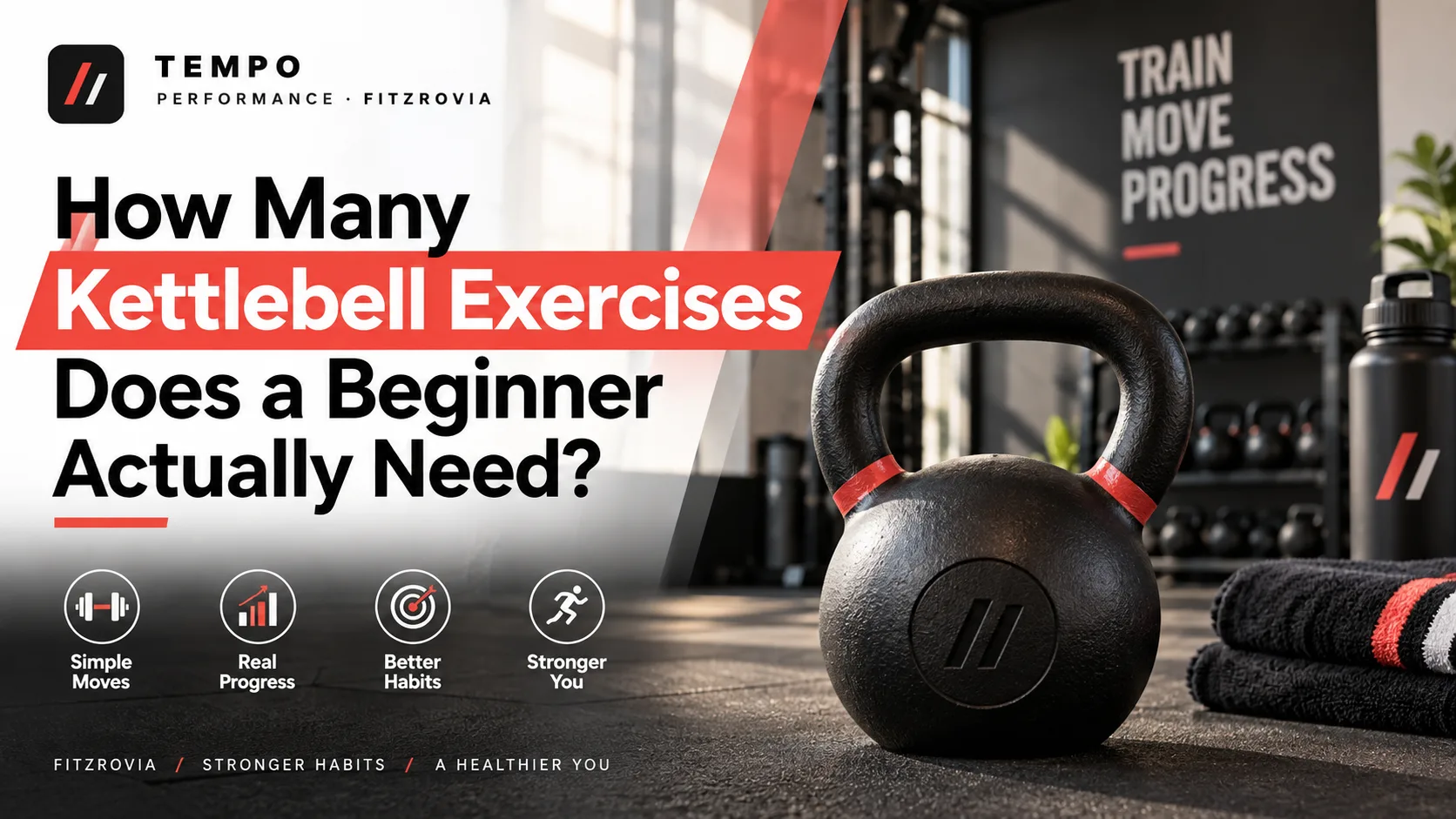
Kettlebell training for beginners does not need a long list of exercises. A beginner is usually better served by learning a small group of movements well, covering the main patterns they can perform safely and repeat consistently, rather than collecting variations before the basics feel controlled.
The exact number is individual because exercise choice depends on experience, mobility, available equipment and the goal of the session. The useful question is therefore not “How many exercises can I fit in?” but “Which movements give me enough practice without making technique deteriorate?”
Why Kettlebell Training for Beginners Should Stay Simple
Kettlebell training for beginners benefits from repetition because each exercise has a technical learning component. Constantly changing movements can reduce the amount of useful practice you get with any one pattern.
A compact session might be organised around a squat pattern, a hinge pattern, a press or push, a pull where appropriate, and a carry or trunk-focused task. That is an illustrative framework rather than a prescription. A Personal Trainer Fitzrovia can help decide which movements suit your current ability and training history.
Choose Movement Patterns Before Exercise Variety
Beginners often assume variety makes a programme more complete, but variety and completeness are not the same thing. Two exercises that train very similar patterns may add complexity without solving a real gap.
Start by identifying the purpose of each exercise. If one movement teaches a hinge and another develops a squat, they have clearly different roles. Once those patterns are comfortable, variations can be introduced for a reason rather than simply to make the session look different.
How Many Exercises Fit a Beginner Session?
There is no universal exercise count in the supplied brief, so a fixed number would be misleading. A better rule is to use only as many movements as you can practise with attention and consistent technique within the time available.
For an illustrative short session, that may mean a handful of exercises repeated across several weeks. If training remotely is more practical, Online & Virtual Training can provide a route to structured coaching without requiring every session to happen in person.
Progress Without Constantly Adding New Exercises
Progress does not have to mean adding another exercise every week. It can mean improving control, using a more appropriate load, completing better-quality repetitions, refining range of motion or becoming more consistent with the programme.
The same principle applies when training is part of a broader fat loss plan. Exercise selection should support the overall plan rather than becoming a competition to include the largest possible number of kettlebell movements.
Common Beginner Mistakes
Common mistakes include changing exercises too frequently, choosing technically demanding variations before simpler patterns are controlled, and treating fatigue as proof that a session was effective. Another is copying a routine without considering whether the movements suit your current experience.
Keep the programme understandable. If you cannot explain why an exercise is in the session, it may not need to be there yet.
Key Takeaways
- A beginner does not need a large kettlebell exercise library.
- Choose exercises by movement role, not novelty.
- Repeat core movements long enough to develop familiarity.
- Progress can come from execution and consistency, not just added variety.
FAQ
Do beginners need to learn kettlebell swings immediately?
No single kettlebell exercise is mandatory for every beginner. Exercise choice should reflect current ability, coaching, equipment and whether the movement can be performed appropriately.
Should a beginner use the same kettlebell routine every week?
Some repetition can help skill development, while the programme can still be adjusted when there is a clear reason. Changes should support progression rather than novelty alone.
Can kettlebell training be a full workout?
Kettlebells can be used within a broader training session, but whether a kettlebell-only programme is appropriate depends on your goals, experience and programme design.
Conclusion
Kettlebell training for beginners works best when the exercise list is small enough to practise properly and broad enough to cover the movements relevant to the programme. Start with purpose, technique and repeatability, then add variety only when it earns a place
Fitness Disclaimer
Fitness disclaimer: This article provides general fitness information only. Exercise selection and training load should reflect your experience, health and circumstances. Consider consulting an appropriately qualified professional before starting or materially changing a training programme.