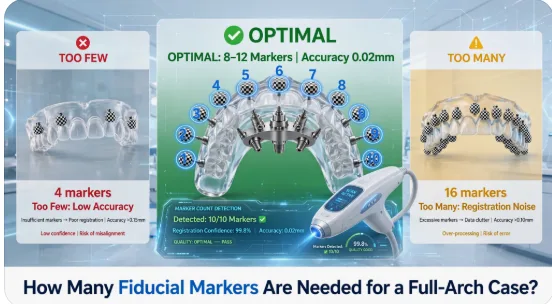
Quick Insight
Most published guidance recommends a minimum of two to three fiducial markers per arch for full-arch implant cases, though the exact number that matters most is not the total count but whether the markers are distributed well enough to give the registration or photogrammetry system a stable reference across the entire span. Adding markers beyond a certain point tends to produce diminishing returns rather than meaningfully better accuracy.
Why Marker Count Is a Real Question
It is tempting to assume more markers always means more accuracy, since more reference points should give a system more data to work from. The research on this does not fully support that assumption.
What actually determines the right number:
- Whether the markers are spread across the arch or clustered in one area
- The span and implant count of the specific case
- Whether the workflow uses photogrammetry, CBCT registration, or both
- The specific system or software's registration requirements
The Commonly Cited Minimum
A photogrammetry CE resource recommends placing a minimum of two to three fiduciary markers per arch, most commonly in the palate for maxillary cases where they will not interfere with the surgical procedure itself.
Why this minimum exists:
- Fewer than two or three points gives the system too little geometry to calculate a reliable spatial relationship
- Palatal placement in the maxilla keeps markers out of the surgical field
- The markers need to stay fixed in position from before surgery through the post-implant record, so placement has to survive the entire procedure undisturbed
Does Adding More Markers Improve Accuracy?
Beyond the minimum, more markers do not necessarily translate into better results.
A CBCT registration study tested registration accuracy across groups using three points, two points and one surface, one point and two surfaces, and three surfaces.
What the research found:
- Point-based registration outperformed surface-based registration overall
- CBCT image quality had a significant effect on accuracy regardless of point count
- Increasing the number of registration points beyond four produced no statistically significant reduction in deviation
How Many Markers Do Real Study Protocols Actually Use?
Published research protocols offer a useful reference point for what labs and researchers actually rely on in practice. A complete-arch scan accuracy study used a superimposition protocol based on three fiducial spherical markers, and the researchers noted this marker count did not negatively affect accuracy in their testing.
What this suggests in practice:
- Three markers is a commonly used baseline in published accuracy research, not just an informal recommendation
- A small, well-placed set of markers can perform reliably without needing to maximize marker count
- The specific number used in research protocols tends to sit close to the same two-to-three range cited in clinical guidance
Factors That Affect the Right Number for a Specific Case
The minimum is a starting point, not a fixed rule for every case.
Case-specific factors worth considering:
- Arch length: a longer edentulous span may benefit from markers distributed at both ends rather than clustered centrally
- Implant count: more implants spread across a wider area increase the value of well-distributed reference points
- Surgical protocol: guided, navigated, and freehand cases can have different marker placement considerations
- Photogrammetry versus CBCT-based registration: each has its own accuracy sensitivities to point distribution
Where Marker Design Fits This Question
Marker count and distribution only work as well as the marker hardware itself holds its position once placed. Digital Arches designs fiducial marker hardware with this consistency in mind, since a marker that shifts after placement undermines the benefit of correct marker count entirely.
The ArchTracer marker system is one example built for full-arch cases where marker placement needs to hold steady across the span of the arch.
Frequently Asked Questions
Is there a maximum number of fiducial markers that should be used? Research has not identified a strict maximum, but studies have found no significant accuracy benefit from adding registration points beyond about four, suggesting diminishing returns past that range.
Do all full-arch cases need the same number of markers? No. Arch length, implant count, and the registration or photogrammetry method in use can all affect how many markers are appropriate for a specific case.
Does marker placement matter more than marker count? Distribution across the arch tends to matter as much as, or more than, the raw number of markers used, since clustered markers give the system less separation to calculate from.
Can too few markers cause registration problems? Yes. Falling below the commonly cited minimum of two to three markers per arch gives the system too little reference geometry to calculate a reliable spatial relationship.
Final Takeaway
The honest answer to how many fiducial markers a full-arch case needs is a range, not a fixed number: two to three as a commonly cited minimum, with research suggesting little additional benefit much beyond four registration points. What matters more than hitting an exact count is distributing whatever markers are used across the arch, and using hardware that holds its position reliably once placed, since marker count alone cannot compensate for either poor distribution or a marker that shifts mid-procedure.