
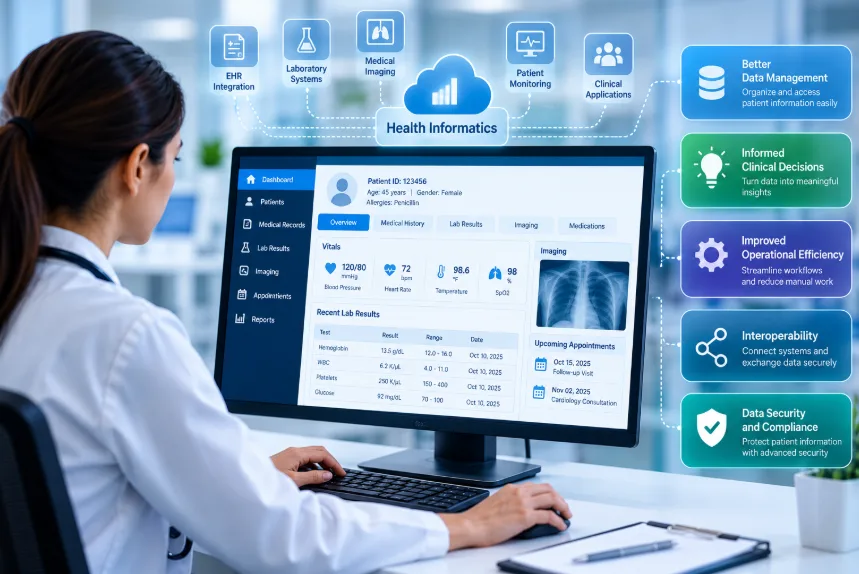
Healthcare organizations across the United States are increasingly using digital technologies to manage patient information, improve clinical workflows, and support better healthcare decisions. Health informatics brings together healthcare, information technology, and data analysis to make medical information more accessible, accurate, and useful. As providers face growing demands for efficient care and coordinated services, modern informatics solutions are becoming essential for delivering connected, data-driven healthcare.
Improving Patient Data Management
Healthcare providers generate large volumes of information through electronic health records, laboratory reports, medical imaging, prescriptions, and patient monitoring systems. When this information remains scattered across disconnected platforms, clinicians may struggle to obtain a complete view of a patient's medical history.
A well-designed Health Informatics Solution helps organize, manage, and exchange clinical information across healthcare environments. By connecting relevant data sources, healthcare organizations can reduce duplicate documentation, improve information accessibility, and support continuity of care.
Centralized access to accurate patient information also helps healthcare professionals review medical histories more efficiently and make decisions based on relevant clinical details.
Enhancing Clinical Decision-Making
Healthcare decisions often depend on identifying patterns in patient data, understanding clinical risks, and evaluating available treatment options. Informatics technologies help transform complex medical information into meaningful insights that clinicians can use during patient care.
Customized healthcare informatics can be designed around the specific needs of hospitals, clinics, specialty practices, and other healthcare organizations. Depending on the implementation, these solutions may incorporate clinical decision support, automated alerts, data visualization, and predictive analytics.
For example, an integrated system may help clinicians identify potential medication interactions, recognize abnormal laboratory values, or monitor changes in a patient's condition. These capabilities can support clinical judgment while allowing healthcare professionals to retain responsibility for care decisions.
Streamlining Healthcare Operations
Administrative inefficiencies can affect staff productivity, patient experiences, and the timely delivery of care. Health informatics can help healthcare organizations improve operational processes by connecting clinical and administrative information.
Modern Health Informatics systems can support appointment coordination, patient registration, documentation, reporting, and information exchange between departments. Automated workflows may reduce repetitive tasks and minimize the need to enter identical information into multiple applications.
Better access to operational data also enables healthcare leaders to monitor resource utilization, identify workflow bottlenecks, and make informed decisions about staffing and service delivery.
Supporting Interoperability Across Healthcare Platforms
Healthcare organizations often rely on multiple software platforms that must exchange information securely and consistently. Interoperability allows relevant patient data to move between authorized systems, reducing information gaps during referrals, transitions of care, and diagnostic workflows.
Advanced health informatics software solutions can incorporate application programming interfaces, standardized data formats, and healthcare interoperability standards such as HL7 and FHIR, where supported. Successful integration requires careful planning around data mapping, terminology alignment, system compatibility, and information quality.
These capabilities help organizations establish more connected technology environments while making clinical information easier to access across participating care settings.
Strengthening Data Security and Compliance
Healthcare information contains sensitive personal and clinical details. Protecting this information is essential as organizations expand digital access and connect more systems.
Reliable Health Informatics services can include system integration, implementation support, data management, workflow optimization, and ongoing maintenance. Security considerations may include encryption, role-based access controls, audit logging, secure authentication, and monitoring for unusual activity.
Healthcare organizations operating in the United States must also consider applicable HIPAA requirements and internal data governance policies. Regular security reviews and staff training can further support responsible information management.
Building a More Connected Healthcare Future
Health informatics helps healthcare organizations turn fragmented information into practical insights that support clinical care and operational efficiency. From improving patient data accessibility to strengthening interoperability and streamlining workflows, these technologies can help providers respond to evolving healthcare needs.
Successful implementation begins with clearly defined organizational goals, reliable data governance, appropriate integration strategies, and solutions that fit existing clinical workflows. As healthcare continues to become more data-driven, health informatics will remain an important foundation for coordinated, efficient, and patient-centered care.