In the rapidly evolving landscape of industrial automation and machinery, efficiency is not just a buzzword—it’s a necessity. Every component, from the largest frame to the smallest bearing, plays a crucial role in determining the overall performance, reliability, and cost-effectiveness of a system. Among these components, the Hollow Linear Shaft has emerged as a game-changer, offering unique advantages that directly contribute to enhanced efficiency in a wide range of industrial applications.
At Shandong Baokun Metal Material Co. Ltd, we have witnessed firsthand how the adoption of Hollow Linear Shaft technology is transforming industries such as robotics, packaging, automotive manufacturing, and precision engineering.
Understanding Hollow Linear Shaft: Construction and Core Principles
What Is a Hollow Linear Shaft?
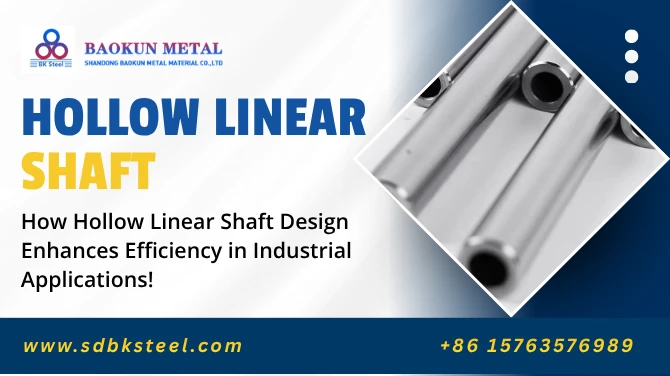
A Hollow Linear Shaft is a cylindrical shaft with a central bore running along its length. Unlike traditional solid shafts, the hollow design reduces weight while maintaining high rigidity and strength. These shafts are typically manufactured from high-grade steel and are often surface-hardened or chrome-plated to ensure durability and resistance to wear.
Key Features
- Reduced Weight: The hollow core significantly lowers the shaft’s mass compared to a solid shaft of the same diameter.
- High Rigidity: Advanced manufacturing techniques ensure that the shaft retains excellent stiffness, even with the hollow design.
- Corrosion Resistance: Surface treatments such as hard chrome plating protect against rust and wear.
- Precision Tolerances: Hollow Linear Shafts are produced to tight dimensional tolerances, ensuring smooth operation in linear motion systems.
The Science Behind Hollow Linear Shaft Efficiency
1. Weight Reduction and Its Impact
One of the most significant advantages of the Hollow Linear Shaft is its reduced weight. In dynamic systems, every gram counts. Lighter shafts mean:
- Lower Inertia: Reduced mass allows for faster acceleration and deceleration, improving cycle times in automated machinery.
- Energy Savings: Less energy is required to move the shaft, leading to lower operational costs and improved sustainability.
- Easier Handling: Installation and maintenance become simpler and safer, especially in large-scale systems.
2. Rigidity and Load-Bearing Capacity
Despite being lighter, a well-designed Hollow Linear Shaft can offer comparable or even superior rigidity to a solid shaft, especially when optimized for specific load conditions. This is achieved through:
- Optimized Wall Thickness: Engineers can tailor the wall thickness to balance weight and strength.
- Material Selection: High-strength alloys and surface treatments further enhance performance.
3. Vibration Damping
The hollow structure can also help dampen vibrations, which is critical in high-speed or precision applications. Reduced vibration leads to:
- Improved Accuracy: Essential for CNC machines, robotics, and inspection equipment.
- Longer Component Life: Less vibration means less wear on bearings and other moving parts.
Applications of Hollow Linear Shaft in Industry
- Robotics and Automation
- In robotics, every gram of moving mass affects speed, precision, and energy consumption. Hollow Linear Shafts are ideal for robotic arms, gantries, and pick-and-place systems, where lightweight yet rigid components are essential.
- Packaging and Material Handling
- High-speed packaging lines benefit from the reduced inertia of Hollow Linear Shafts, enabling faster throughput and more precise motion control.
- Automotive Manufacturing
- From assembly lines to inspection stations, Hollow Linear Shafts are used in linear guides, actuators, and conveyors, contributing to efficient, reliable operations.
- Medical and Laboratory Equipment
- Precision and cleanliness are paramount in medical devices. Hollow Linear Shafts, often made from stainless steel, provide the necessary performance while allowing for easy integration of wiring or fluids through the central bore.
- Printing and Textile Machinery
- In these industries, shafts must rotate at high speeds with minimal vibration. The hollow design helps achieve smoother operation and higher print or weave quality.
Design Considerations for Hollow Linear Shaft Selection
Material Choice
- Carbon Steel: Offers a good balance of strength and cost.
- Stainless Steel: Provides superior corrosion resistance for harsh or clean environments.
- Alloy Steel: Used for high-load or high-speed applications.
Surface Treatment
- Hard Chrome Plating: Enhances wear resistance and reduces friction.
- Nitriding or Induction Hardening: Further increases surface hardness for demanding applications.
Dimensional Tolerances
Precision is key. Ensure the shaft meets the required tolerances for diameter, straightness, and roundness to guarantee smooth operation.
Bore Size and Wall Thickness
The bore diameter and wall thickness must be optimized for the specific load and rigidity requirements of your application.
Mounting and Support
Proper support and alignment are essential to maximize the benefits of a Hollow Linear Shaft. Consider using linear bearings or pillow blocks designed for hollow shafts.
How Hollow Linear Shaft Enhances Efficiency in Industrial Applications?
1. Energy Efficiency
By reducing the moving mass, Hollow Linear Shafts lower the energy required for acceleration and deceleration. This translates into:
- Lower Power Consumption: Reduced energy bills and a smaller carbon footprint.
- Smaller Drive Components: Motors and actuators can be downsized, further saving costs and space.
2. Increased Throughput
Faster acceleration and deceleration enable higher cycle rates, boosting productivity in automated systems.
3. Improved Precision and Quality
Reduced vibration and inertia contribute to more accurate positioning and smoother motion, which is critical in applications like CNC machining, inspection, and high-speed assembly.
4. Simplified Integration
The hollow core can be used to route cables, pneumatic lines, or fluids, simplifying machine design and reducing clutter.
5. Lower Maintenance Costs
Lighter shafts put less strain on bearings and support structures, leading to longer component life and reduced maintenance requirements.
Case Studies: Real-World Benefits of Hollow Linear Shaft
- Robotics Assembly Line
- A leading automotive manufacturer replaced solid shafts with Hollow Linear Shafts in their robotic assembly line. The result was a 20% reduction in energy consumption and a 15% increase in throughput, thanks to faster robot arm movement and reduced wear on bearings.
- High-Speed Packaging Machine
- A packaging company upgraded to Hollow Linear Shafts in their high-speed carton erectors. The lighter shafts allowed for smaller, more efficient motors and improved the machine’s reliability, reducing downtime by 30%.
- Medical Device Automation
- A medical device manufacturer used stainless steel Hollow Linear Shafts to route pneumatic lines through the shaft, resulting in a cleaner, more compact design and easier maintenance.
Customization and Support from Shandong Baokun Metal Material Co., Ltd
At Shandong Baokun Metal Material Co., Ltd., we understand that every application is unique. That’s why we offer:
- Custom Diameters and Lengths: Tailored to your exact specifications.
- Material and Surface Options: Choose from carbon steel, stainless steel, and various surface treatments.
- Technical Support: Our engineering team can assist with shaft selection, design optimization, and integration.
- Quality Assurance: Every Hollow Linear Shaft undergoes rigorous inspection and testing to ensure top performance.
The Hollow Linear Shaft is more than just a lightweight alternative to solid shafts—it’s a strategic component that can unlock new levels of efficiency, precision, and reliability in industrial applications. By reducing weight, maintaining rigidity, and offering versatile integration options, Hollow Linear Shafts help engineers and manufacturers achieve faster, more energy-efficient, and lower-maintenance systems.
Frequently Asked Questions (FAQ)
Q1: What is the main advantage of using a Hollow Linear Shaft over a solid shaft?
A: The primary advantage is weight reduction without sacrificing rigidity. This leads to lower inertia, faster response times, and improved energy efficiency in dynamic systems.
Q2: Can Hollow Linear Shafts handle the same loads as solid shafts?
A: When properly designed, Hollow Linear Shafts can handle comparable loads to solid shafts, especially in applications where bending rather than torsion is the primary concern.
Q3: Are Hollow Linear Shafts more expensive than solid shafts?
A: While the initial material cost may be similar or slightly higher due to manufacturing complexity, the long-term savings in energy, maintenance, and system performance often outweigh the upfront investment.
Q4: What materials are available for Hollow Linear Shafts?
A: Common materials include carbon steel, stainless steel, and alloy steel. The choice depends on the application’s load, speed, and environmental requirements.
Q5: How do I select the right bore size and wall thickness?
A: Selection depends on the required load capacity, rigidity, and weight. Our technical team can assist with calculations and recommendations based on your specific needs.
Q6: Can I use standard linear bearings with Hollow Linear Shafts?
A: Yes, most standard linear bearings are compatible with Hollow Linear Shafts, but always check the manufacturer’s specifications for optimal fit and performance.
Q7: What surface treatments are recommended for Hollow Linear Shafts?
A: Hard chrome plating is common for wear resistance and low friction. Other options include nitriding or induction hardening for additional surface hardness.
Q8: How are Hollow Linear Shafts maintained?
A: Regular cleaning and lubrication are recommended. The reduced weight also means less wear on bearings, leading to lower maintenance requirements overall.
Q9: Can Hollow Linear Shafts be used in corrosive environments?
A: Yes, especially when made from stainless steel or treated with corrosion-resistant coatings.
Q10: Why choose Shandong Baokun Metal Material Co. Ltd for Hollow Linear Shafts?
A: We offer high-quality, customizable Hollow Linear Shafts, backed by advanced manufacturing, rigorous quality control, and expert technical support.