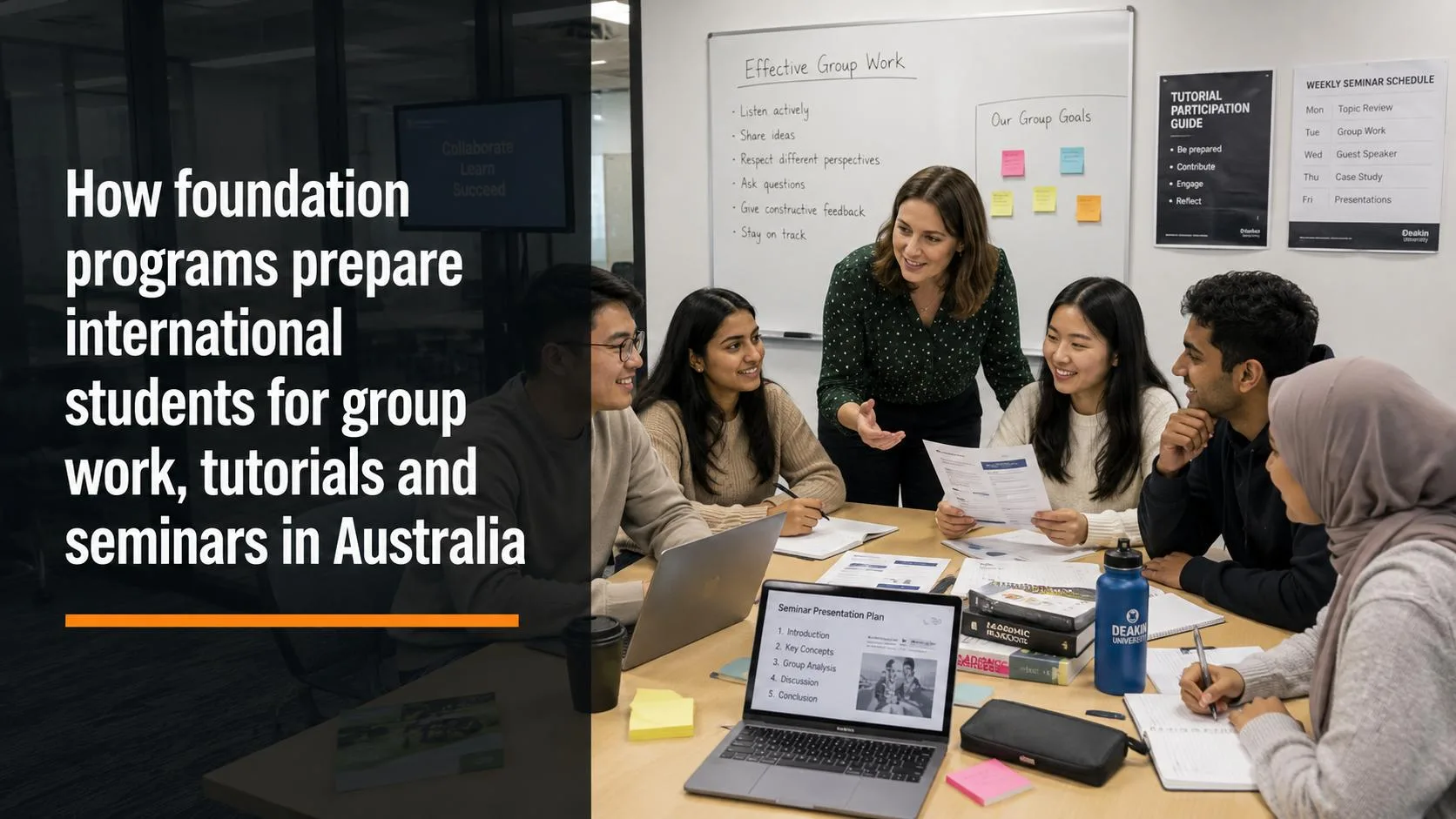
Foundation programs do more than help students meet entry requirements. In Australia, they also prepare international students for the way university actually works. That matters because Australian higher education often expects students to speak up, join discussion, ask questions, work in teams, and take part in small-class learning from the start. Foundation study gives students a safer place to practice those habits before they enter a degree.
For many international students, the hardest part is not the subject content. It is the class format. Tutorials, seminars, and group tasks can feel unfamiliar if a student is used to quiet classrooms or teacher-led lessons. Foundation courses reduce that shock by building the exact academic and communication skills students need later at university.
What foundation programs are
Foundation courses in Australia are pre-university pathway programs. The Australian Government explains that they are usually around one year long and are offered by most higher education institutions. They help students meet the academic entry level needed for university study. TEQSA also describes foundation programs for overseas students as nationally recognised courses that provide an academic entry pathway to first-year undergraduate study or its equivalent.
That pathway role is important, but it is only part of the story. Many foundation programs also teach students how to study in an Australian classroom. They cover academic English, research, reading, speaking, writing, and class participation. Some programs also include presentations, discussion, group work, reporting, and self-reflection. Those are the same skills students need once they move into a degree.
Why tutorials, seminars and group work matter so much
Australian university study often relies on active participation. A tutorial is usually a small discussion-based class led by a tutor. Students raise topics, ask questions, and work through lecture content in a more interactive setting. Seminars are similar in that they rely on organized discussion, but they are often more formal. Group work adds another layer because students must share tasks, manage deadlines, and present one result together.
This is where many international students feel pressure. They may understand the academic content but still feel uncertain about when to speak, how to disagree politely, or how to keep up in a fast discussion. Foundation programs help because they do not wait until degree level to train those habits. They build them early, in a lower-pressure setting, with more support and more repetition.
How foundation programs build speaking confidence
One of the biggest strengths of a good foundation program is language practice with purpose. Students do not only study grammar or vocabulary. They use English for real academic tasks such as discussing ideas, presenting a point of view, reading academic texts, taking notes, and responding in class. That makes the transition to university smoother because students are not hearing academic English for the first time in a degree classroom.
This matters because tutorials and seminars reward students who can respond clearly and quickly. A student who has practiced speaking in a foundation class is less likely to freeze when the tutor asks for an opinion. They also learn how to build a sentence under pressure, listen properly to classmates, and keep the conversation moving. That is a practical skill, not just a language skill.
How foundation programs prepare students for group work
Group work often causes the most frustration for new international students. It asks for more than subject knowledge. Students must divide tasks, agree on a deadline, write together, edit together, and keep the work consistent. UNSW’s guidance on group work shows that students need to divide writing, share feedback, monitor performance, and assign roles to keep the work on track. Foundation programs give students a chance to practice those same habits before the marks count at degree level.
A strong foundation course usually trains students in teamwork as part of the academic structure. UNSW College, for example, says its foundation program covers presentation and discussion, research and reporting, group work, annotated bibliography, and self-reflection. It also says that working with others improves teamwork, decision making, cognitive flexibility, and cross-cultural understanding. That is exactly the kind of preparation international students need before they step into a full undergraduate class.
How tutorials become easier after foundation study
Tutorials are not lectures in smaller rooms. They are active learning sessions. Students are expected to talk, answer questions, clarify ideas, and work through the material with a tutor. UNSW describes tutorials as small discussion-based class groups led by a tutor, with space to raise topics, ask questions, and explore ideas. That format can feel unfamiliar at first, but foundation study helps students get used to it early.
In practice, foundation classes often mirror the same rhythm. Students listen, respond, discuss, and complete short tasks in class. They learn how to take notes, ask for clarification, and speak without waiting for perfect English. Over time, that builds confidence. By the time they reach university tutorials, the format feels less like a surprise and more like a normal part of study.
How seminars feel less intimidating after foundation study
Seminars can feel even more formal than tutorials. Flinders University describes tutorials and seminars as organized discussion settings, with seminars often being more formal. That means students may need to contribute in a more structured way, follow a topic more closely, and show stronger preparation. Foundation courses help students get ready for that by giving them repeated practice in discussion, reporting, and presentation work.
This preparation matters because seminar participation is not only about speaking. It is also about listening well, responding with purpose, and showing that you have prepared. Foundation classes train students to read academic text, think about the topic before class, and explain ideas in a clear way. That makes seminar participation far less stressful later.
The hidden classroom culture students learn in foundation programs
A lot of the real adjustment in Australia is cultural, not academic. Many students arrive thinking university will be mostly about lectures and private study. In reality, they are often expected to be active in class, contribute ideas, and work closely with classmates. Foundation programs help students learn that classroom culture in advance. That is one reason they are so valuable for international students who want a smoother start.
Foundation study also helps students understand cross-cultural teamwork. In mixed classrooms, students may have different speaking styles, different views about deadlines, and different ways of giving feedback. A good foundation program gives students a low-risk place to work through those differences before they face larger, graded group projects at university.
Who should consider a foundation course in Australia
Foundation courses are a strong choice for international students who do not meet direct entry requirements, need more academic English, or want more support before entering a degree. They are also useful for students who already know their subject area but want extra practice in speaking, writing, discussion, and teamwork. Study Australia notes that foundation studies are part of the pathway system that helps students reach course entry requirements.
They are especially helpful for students who feel nervous about participation. If speaking in class, joining a group, or presenting in English feels stressful, foundation study gives time to build those skills in steps. That is often the difference between merely entering university and actually feeling ready for it.
How to choose the right foundation program
Not every foundation course is the same. Students should look at the subject stream, the duration, the English support, the assessment style, and the university pathway that comes after it. They should also check whether the course includes enough practice in presentations, group work, tutorial-style discussion, and academic writing. Those features matter because they affect how prepared a student feels in first year.
It also helps to choose a program that matches the target degree. A student planning to study business may need more group project practice, while a student heading into science or health may need stronger reporting, research, and presentation skills. The right foundation program should not only lead to admission. It should build confidence for the classroom that comes after admission.
Final take
Foundation courses in Australia for international students are not just entry routes. They are training grounds for university life. They help students build academic English, understand tutorials and seminars, and learn how to work in groups without feeling lost. They also make the cultural side of Australian study easier to handle. For many students, that is what makes the first year feel manageable instead of overwhelming.
FAQ section
Do foundation programs in Australia include group work?
Yes. Many foundation programs include group work, presentations, discussion tasks, and reporting as part of academic preparation.
Do foundation courses help with tutorials and seminars?
Yes. They help students practice speaking, asking questions, discussing ideas, and responding in a small-class format before university starts.
Are foundation courses only about getting into university?
No. They also train students in academic skills, English, teamwork, research, and class participation, which are all needed in first year.
Do foundation courses suit students who feel shy in class?
Yes. They give students a smaller and more supportive setting to build confidence before they face larger university classes.