
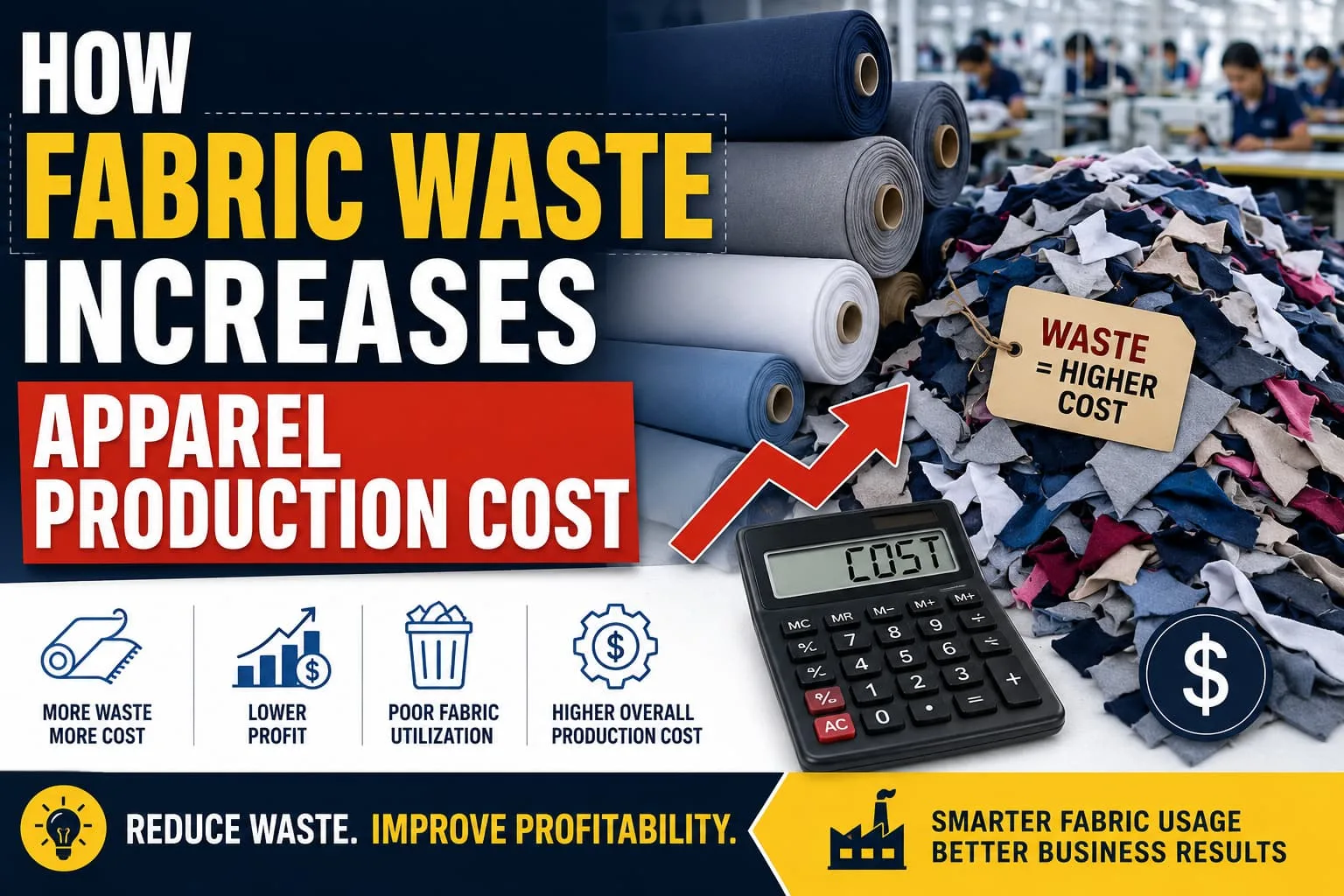
In Apparel Manufacturing, fabric is the single largest cost component, often accounting for 60–70% of total garment cost. While factories continuously invest in improving efficiency through better pattern design, optimized markers, and advanced fabric cutting machines, one critical area still remains under-controlled—the cutting department.

Despite improvements in planning and technology, fabric waste continues to silently increase production cost. The challenge is not always visible in reports, but it directly impacts profitability on the shop floor.
Why Fabric Waste Is a Cost Problem, Not Just an Efficiency Issue
Most factories measure efficiency through marker utilization or planning accuracy. However, the actual cost impact comes from how fabric is consumed during execution.
Fabric waste increases cost in three major ways:
- Uncounted Fabric wastage in terms of testing like; Shade, Shrinkage, Sample making etc
- Higher fabric consumption per garment; increasing cost per unit
- Uncontrolled leftovers and dead stock; blocking working capital
- Mismatch between planned vs actual usage; reducing predictability

This gap between planning and execution is where most losses occur—especially in the cutting department in the garment industry, where fabric is physically handled and processed.
Where Does Fabric Waste Actually Happen?
Fabric waste is not caused by a single factor. It is the result of multiple small inefficiencies across the cutting process.
1. Mismatch Between Roll Length and Marker Length
Fabric rolls come in varying lengths, while markers are fixed. This leads to leftover pieces (end-bits) that are difficult to reuse efficiently by Manual planning
2. Improper Roll Allocation
In many factories, roll selection is based on availability or operator experience, rather than data. This results in suboptimal usage of fabric or wastages and lots of end-bits.
3. Uncontrolled End Loss During Cutting
Although standard end loss per layer may be defined, actual loss often exceeds it on the cutting table—without any tracking or standard SOP’s.
4. Poor Utilization of Leftover Fabric
Leftover fabrics are often stored with the intention to reuse, but due to lack of visibility and planning, they remain unused or get scrapped. In our previous article in this series, we discussed how end-bits are costing the garment manufacturers.
5. Variations in Fabric Properties
Different types of fabric behave differently—shrinkage, width variation, and shade differences all impact utilization if not properly considered during cutting.
Read More - The Blueprint for Starting a Garments Business: A Comprehensive Bangladesh Apparel Production Case Study
The Role of the Cutting Department in Fabric Cost Control
The cutting department plays a critical role in determining actual fabric consumption. While earlier processes before cutting like pattern making, Shrinkage Grouping, Width Grouping, Marker based on CutPlan ratio define theoretical efficiency, the cutting floor decides real consumption as use of fabric totally depends.
Unlike planning systems, the cutting department deals with:
- Real-Fabric Roll width variation & Roll length
- Physical constraints
- Operator-level decisions
This is why improving efficiency only at the planning stage is not enough. Control must extend to execution.
Why Traditional Methods Fail to Control Fabric Waste ?
Many factories try to reduce waste through:
- SOP enforcement
- Manual tracking of leftovers
- Training cutting operators

However, these approaches have limitations. Without a system that connects fabric rolls properties like shade, shrinkage, width, length, markers, and cutting execution, decisions remain in silos. As a result, waste continues but it’s not predictable or accountable on the shop-floor.
Our Fabric Optimization Software OptaCut highlights this gap by connecting planning with real-time execution on the shop floor, enabling better control and visibility of production processes.
What Factories Can Do to Reduce Fabric Waste ?
Reducing fabric waste requires shifting focus from only planning to execution-level control. Using Jaza Software, Fabric Control & Optimization Software OptaCut factory can control:-
1. Testing Loss & Accountability:-
Aware on the usage of Fabric due to Testing purpose and clear accountability of every cm of fabric loss due to testing & sampling
2. Intelligent Roll Planning
Instead of random roll usage, factories will release fabric rolls based on:
- Width
- Shade
- Shrinkage
- Marker requirements
This ensures maximum utilization of fabric from each roll with minimal end-bits
3. Control End Loss During Cutting
Define acceptable limits for end loss and monitor them in real time. Any deviation should be immediately visible and actionable.
4. Plan Leftover Utilization in Advance
Leftovers should not be treated as waste after cutting. They should be planned as part of the process allocated to remnant markers and visibility of leftovers for parts replacement.
5. Use Data Instead of Assumptions
Replace experience-based decisions with data-driven insights. This brings consistency and reduces dependency on individuals.
6. Strengthen Visibility in the Cutting Department
Factories will have better visibility into:
- Actual fabric consumption
- Roll-level utilization
- Fabric leftovers
- Cutting performance
This is where digital tools and shop-floor systems become critical.
The Business Impact: Why This Matters

Even a small improvement in fabric utilization has a significant impact on overall cost.
A 2–5% reduction in fabric waste can:
- Improve margins directly
- Reduce raw material cost
- Reduce Sunk cost and inventory cost
- Improve Accountability.
In an industry with tight margins, this difference is not incremental—it is transformational.
Read More - The Hidden Cost of End-Bits: Why Leftover Fabric Is Costing You More Than CAD Can Save
Conclusion: Fabric Waste Is Controllable
Fabric waste is often treated as an unavoidable part of apparel manufacturing. In reality, it is a result of gaps in execution—especially within the cutting department.
By bringing better planning, visibility, and control to how fabric is used on the cutting floor, factories can significantly reduce waste and improve profitability.
Because in garment manufacturing, controlling fabric is not just about saving material—it is about controlling cost at its source.
Want to understand how fabric waste in your cutting room is increasing production cost? Let’s connect and analyze your data to identify improvement opportunities.
Source - How Fabric Waste Increases Apparel Production Cost ?