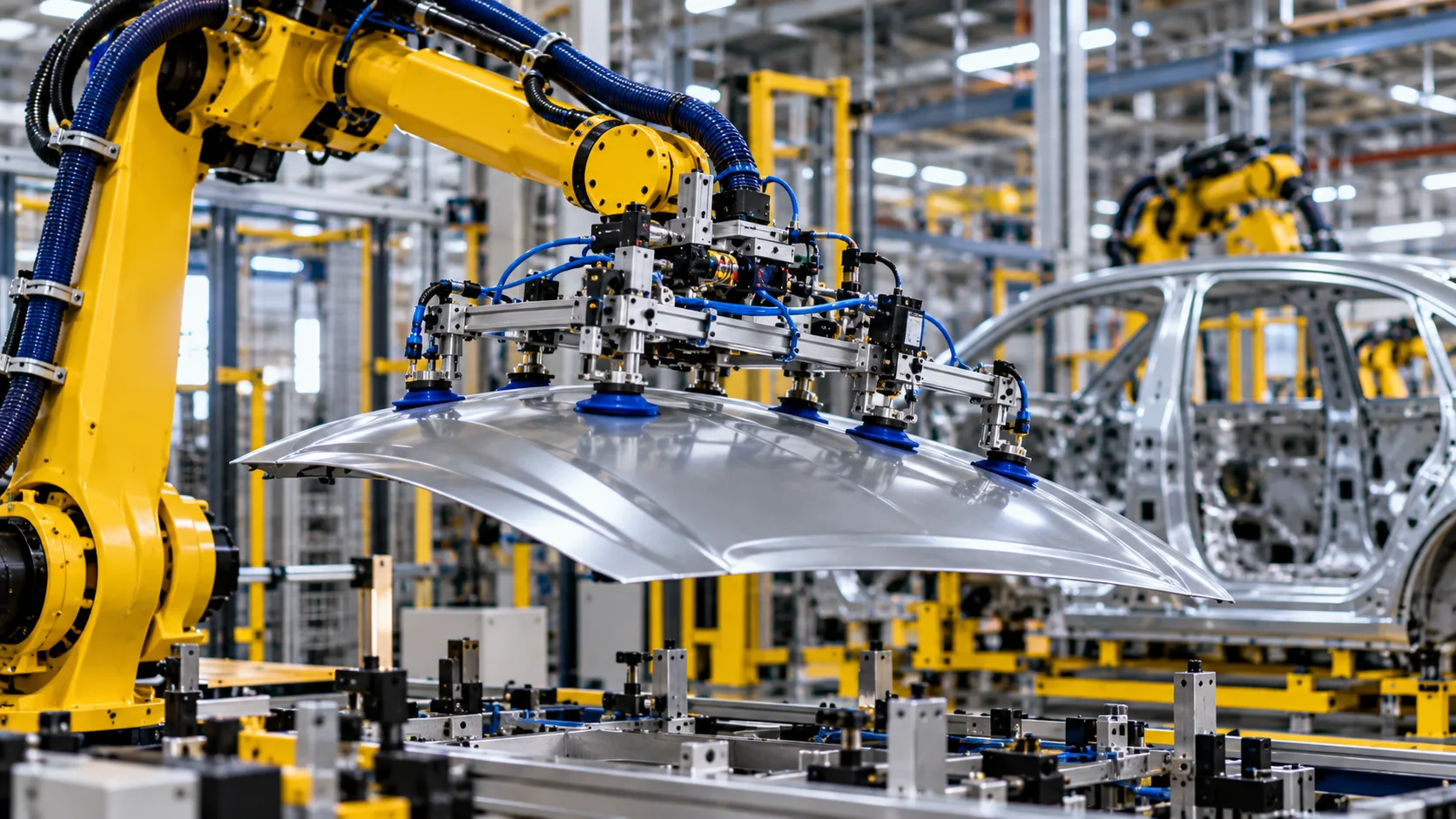
Automation plays a vital role in modern automotive manufacturing, helping vehicle manufacturers produce components more efficiently, maintain consistent quality and meet demanding production schedules. Industrial robots are used throughout automotive factories to handle materials, assemble components and carry out manufacturing operations with a high degree of repeatability. However, the robot itself is only part of the solution. The equipment fitted to the end of its arm is equally important.
Known as end-of-arm tooling (EOAT), these specialised devices allow robots to interact with components and perform specific tasks. Depending on the application, an end-of-arm tool might grip a sheet metal panel, lift a plastic component, position a battery pack or carry out a joining operation.
By selecting the appropriate tooling for each stage of production, automotive manufacturers can improve manufacturing efficiency, reduce handling errors and create more flexible automated production systems.
What Is End-of-Arm Tooling?
End-of-arm tooling refers to the equipment attached to the end of an industrial robot or automated handling system. Often described as an end effector, it provides the connection between the robot and the component or process with which it interacts.
Unlike a robot arm, which provides movement and positioning, EOAT determines how the robot performs its task. It can hold an object, apply force, manipulate a component or carry out a specific manufacturing operation.
There are several types of end-of-arm tooling used in automotive manufacturing, including:
- Vacuum grippers: Use suction cups and vacuum systems to lift and handle components, particularly sheet metal panels and other suitable surfaces.
- Mechanical grippers: Use jaws, fingers or clamps to hold components securely during handling and assembly.
- Magnetic grippers: Use magnetic force to handle suitable ferrous metal components.
- Processing tools: Include equipment such as robotic welding guns, screwdriving tools and other devices used to perform manufacturing operations.
- Specialist handling tools: Custom-designed systems developed for components with unusual shapes, delicate surfaces or demanding positioning requirements.
The choice of tooling depends on several factors, including the component's material, weight, geometry, surface finish and required handling accuracy.
In automotive production, where robots may need to handle everything from lightweight plastic trim to large stamped metal panels, selecting suitable EOAT is essential for dependable operation.
Handling Sheet Metal In Automotive Press Shops
One of the most important applications for end-of-arm tooling is the handling of sheet metal components in automotive press shops.
Vehicle body panels are commonly manufactured using stamping processes, which shape metal sheets into components such as doors, bonnets, roof sections and structural panels. Once formed, these parts need to be transferred between presses, inspection stations and other production equipment.
Robotic vacuum grippers are particularly useful for these operations. Multiple suction cups can be positioned across a specially designed frame to lift a panel securely while distributing the gripping force across suitable contact areas.
The robot can then move the component into the next press or transfer it to another stage of production. Automating this process reduces the need for manual handling and allows components to be transferred consistently at production speeds.
The design of the tooling is particularly important when handling large or thin panels. Poorly positioned gripping points can allow a component to flex, move or become damaged during transfer. Engineers must therefore consider the panel's shape, rigidity, surface condition and centre of gravity when designing the tool.
Vacuum monitoring can also help confirm that sufficient gripping force is available before the robot begins moving a component. These measures help reduce the risk of dropped parts and production interruptions.
Supporting Vehicle Body Assembly And Welding
End-of-arm tooling also plays an important role in body-in-white manufacturing, where multiple stamped metal components are assembled into the vehicle's main body structure.
During this stage, robots may need to pick up individual panels, position them accurately and hold them in the correct location while joining operations take place.
Mechanical grippers and vacuum-based tooling can be used to transfer components between workstations and present them to assembly fixtures. Some systems are designed to accommodate different gripping points or component configurations, allowing manufacturers to handle multiple variants using adaptable tooling.
Robotic welding equipment represents another important category of EOAT. A welding gun fitted to a robot arm allows the system to join metal components at programmed positions. The robot controls the movement of the tool, while the tooling and associated equipment provide the necessary contact and operation for the welding process.
In a typical automated body assembly cell, one robot might position a panel while another performs a joining operation. End-of-arm tooling helps ensure that components are handled and presented consistently throughout the process.
Accurate positioning is essential because dimensional inconsistencies can affect subsequent assembly stages. If body panels or structural components are incorrectly aligned, manufacturers may experience problems with fit, gaps and the positioning of other vehicle components.
By combining suitable EOAT with correctly designed fixtures and robot programmes, automotive manufacturers can improve the repeatability of body assembly operations.
Automating Component Assembly And Material Handling
Automotive factories contain numerous smaller components that must be transported, sorted and assembled throughout the production process.
These include brackets, fasteners, electrical components, interior fittings and parts used in vehicle systems. Although individual components may be relatively small, handling them manually can become time-consuming when performed repeatedly across a high-volume production line.
Robotic grippers allow these components to be picked up, transferred and positioned automatically. Depending on the task, the tooling may incorporate mechanical fingers, suction cups, sensors or other specialised features.
For example, an automated assembly cell may use a robot fitted with a mechanical gripper to collect a bracket from a supply station and position it within an assembly fixture. Once the component is correctly positioned, another process can secure it in place.
End-of-arm tooling can also support kitting operations, where the required components are gathered and delivered to an assembly station. This helps ensure that parts arrive at the correct location and can reduce the amount of manual handling required by production staff.
The tooling must be designed to grip components reliably without damaging them. This is particularly important for parts with delicate surfaces, small locating features or shapes that make them difficult to handle using standard gripping equipment.
Handling Plastic Components And Interior Trim
Modern vehicles incorporate numerous plastic components, including dashboard sections, door trims, centre consoles, instrument housings and decorative panels.
These parts often have complex shapes and visible surfaces that must remain free from scratches, dents and other damage. Consequently, the end-of-arm tooling used to handle them needs to balance secure gripping with careful contact.
Vacuum grippers with appropriately selected suction cups can be suitable for some plastic components, while mechanical grippers may be better suited to parts with accessible edges or dedicated gripping features.
Custom-designed tooling can incorporate several gripping points to support a component evenly and reduce unwanted movement during transport. Soft contact materials may also be used where appropriate to protect finished surfaces.
For example, a robot handling an interior door panel may need to lift the component from a moulding station, rotate it and position it for the installation of additional fittings. The EOAT must accommodate the panel's geometry while maintaining the correct orientation throughout the movement.
Careful tooling design helps reduce the risk of handling damage and supports consistent positioning during downstream assembly.
Supporting Electric Vehicle and Battery Manufacturing
The growth of electric vehicle production has created additional applications for end-of-arm tooling in automotive manufacturing.
Battery packs, electric motors and associated components often require carefully controlled handling during assembly. Their weight, geometry, electrical interfaces and manufacturing requirements can place specific demands on automated handling systems.
EOAT can be designed to lift, transport and position battery modules or other components at designated workstations. Depending on the application, the tooling may combine mechanical gripping, electric actuation, pneumatic systems and sensors to support precise handling.
Some battery assembly operations also require tools that position components consistently before fastening or joining processes take place.
The tooling must be designed around the requirements of the particular component and process. For example, engineers need to consider the permitted gripping locations, component weight, structural characteristics and any restrictions associated with sensitive electrical connections.
Safety is also an important consideration when handling heavy or potentially hazardous components. Suitable mechanical retention, monitoring and integration with the wider robotic safety system must be considered during the design process.
By providing controlled and repeatable component handling, end-of-arm tooling helps manufacturers automate demanding assembly operations in electric vehicle production.
Improving Efficiency Through Custom Tooling Design
One of the main advantages of end-of-arm tooling is the ability to tailor automated equipment to the task being performed.
A standard gripper may be suitable for a straightforward handling operation, but automotive production frequently involves components with specific gripping requirements. Custom tooling allows engineers to configure the layout, contact points, actuation mechanisms and supporting sensors to suit the application.
This can improve the speed and consistency of automated operations while reducing unnecessary movement and handling.
Tool weight is another important design consideration. A heavy end effector increases the load on the robot and can restrict acceleration or reduce the payload available for the workpiece. Lightweight tooling can therefore help improve performance, provided that the required strength, stiffness and durability are maintained.
Modular tooling systems offer additional flexibility. These systems use configurable components that can be assembled or adjusted for different applications, potentially simplifying modifications and reducing the need to manufacture an entirely new tool for every production requirement.
In automotive manufacturing, where model changes and production variants are common, adaptable EOAT can help reduce changeover times and make production lines more flexible.
Quality Control, Sensors And Tool Maintenance
Reliable end-of-arm tooling requires more than a suitable mechanical design. Manufacturers also need to ensure that the equipment continues to operate correctly throughout its working life.
Sensors can provide useful information during automated handling operations. Depending on the tooling, these may monitor vacuum pressure, gripping status, component presence or actuator position. The information can help a control system identify a failed grip or an unexpected condition before the robot continues its programmed movement.
These monitoring capabilities can improve process reliability and help maintenance teams identify developing problems.
Regular inspections are also important. Suction cups can wear or become damaged, gripper fingers may loosen, and pneumatic or electrical components can deteriorate with use. Contamination can affect gripping performance, while inaccurate sensor readings may prevent a tool from operating as intended.
A structured maintenance programme should include checking wear components, inspecting connections, verifying sensor operation and confirming that the tooling continues to meet the requirements of the application.
Safety must be considered throughout the design, installation and operation of robotic end effectors. ISO/TR 20218-1 provides guidance on safety considerations for robot end-effectors, including their design and integration.
By combining suitable sensors, preventative maintenance and appropriate safety measures, manufacturers can reduce the risk of unexpected downtime and maintain dependable automated processes.
The Importance Of End Of Arm Tooling
End-of-arm tooling is an essential part of automotive manufacturing because it allows industrial robots to interact with components and perform specific production tasks.
From transferring stamped metal panels and supporting body assembly to handling interior trim and positioning electric vehicle components, EOAT helps manufacturers automate a wide variety of operations with greater consistency and control.
The effectiveness of these systems depends on selecting the right gripping or processing technology, designing tooling around the component's characteristics and maintaining the equipment throughout its working life.
When integrated successfully with industrial robots, production fixtures, sensors and quality control systems, end-of-arm tooling can improve manufacturing efficiency, reduce handling damage and support more flexible automotive production.
As vehicle designs and manufacturing processes continue to evolve, appropriately designed EOAT will remain an important consideration for manufacturers looking to improve production performance while maintaining reliable, repeatable quality.