Technology has transformed nearly every industry, and residential property inspections are no exception. While experience and attention to detail remain the foundation of every quality inspection, modern tools now allow inspectors to evaluate homes with greater precision than ever before. Among the most valuable innovations is drone technology, which has become an important resource for inspecting residential properties throughout New York.
Traditional inspection methods continue to play a vital role, but certain areas of a property have always been difficult to examine safely and thoroughly. Steep roof slopes, fragile roofing materials, multi-story homes, and hard-to-reach exterior components can limit visibility during a standard visual inspection. Drones help bridge this gap by providing inspectors with a safe and efficient way to capture detailed images from angles that were once inaccessible.
For homebuyers, sellers, and homeowners, this technology offers an additional level of confidence by improving the accuracy and completeness of residential property evaluations.
Why Roof Inspections Are So Important
A home’s roof protects everything beneath it. It shields the structure from rain, snow, wind, sunlight, and changing temperatures throughout the year. Because the roof serves as the property’s first line of defense against the elements, even small issues can eventually lead to significant interior damage if left unaddressed.
Despite its importance, the roof is often one of the most difficult parts of a home to inspect thoroughly. Certain roof designs are too steep to walk safely, while some roofing materials may become damaged if inspectors attempt to access them directly. Weather conditions can also create safety concerns that limit physical access.
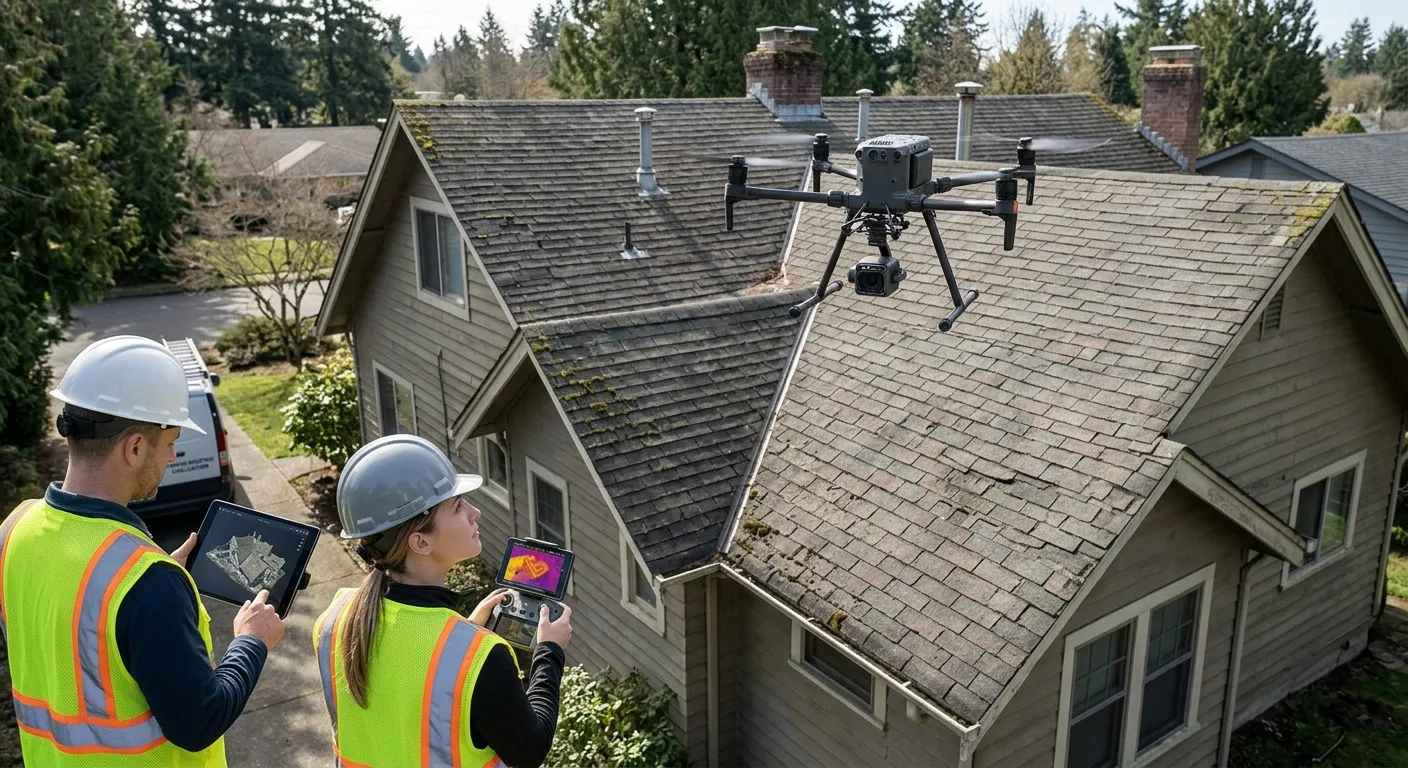
Drone technology allows inspectors to evaluate these areas without placing themselves or the roofing materials at unnecessary risk. High-resolution aerial images provide a clear view of roofing components, allowing inspectors to identify visible signs of deterioration while maintaining a safe inspection process.
Seeing More Without Increasing Risk
Safety has always been a priority during professional home inspections. Climbing onto steep or aging roofs presents risks that inspectors work hard to minimize. Drones significantly reduce those risks by allowing many exterior observations to be completed from the ground.
Using advanced cameras mounted on lightweight aircraft, inspectors can capture detailed photographs and video footage of roofing materials, flashing, chimneys, skylights, gutters, vents, and other exterior components. The resulting images often reveal conditions that would otherwise be difficult to observe from ground level.
This technology is particularly valuable for large homes, multi-story buildings, and properties surrounded by landscaping that limits visibility. Rather than relying on distant visual observations, inspectors can closely examine specific areas while documenting their findings with clear images.
Improved Documentation Benefits Buyers and Sellers
One of the greatest advantages of drone-assisted inspections is the quality of documentation they provide. Instead of simply describing roofing conditions in writing, inspectors can include high-resolution photographs that clearly illustrate their observations.
Visual documentation helps buyers better understand inspection findings because they can see the conditions for themselves. Whether the report identifies worn shingles, damaged flashing, clogged gutters, or storm-related wear, accompanying images provide valuable context that supports informed decision-making.
Sellers also benefit from detailed documentation. When inspection findings are supported by photographs, conversations regarding repairs or maintenance become more transparent. Both parties can discuss the property’s condition using objective visual evidence rather than relying solely on written descriptions.
New York Properties Present Unique Inspection Challenges
Residential properties throughout New York vary considerably in age, architectural style, and construction methods. Historic homes, modern residences, townhouses, and rural properties each present different inspection challenges.
Seasonal weather adds another layer of complexity. Heavy snowfall, ice accumulation, strong winds, and repeated freeze-thaw cycles gradually affect roofing systems and exterior materials. Over time, these environmental conditions may contribute to loose shingles, damaged flashing, clogged drainage systems, or accelerated wear.
Drone technology allows inspectors to examine these exterior components more thoroughly while minimizing safety risks. It is especially useful after severe weather events, when homeowners may want reassurance that their roof has not sustained visible damage.
More Than Just Roof EvaluationsAlthough drones are commonly associated with roof inspections, their usefulness extends well beyond shingles and gutters. Aerial imagery provides valuable insight into many other exterior features that contribute to a property’s overall condition.
Inspectors may evaluate chimney structures, siding transitions, drainage patterns, roof penetrations, solar panel installations, skylights, ventilation systems, and other elevated components. Larger residential properties can also benefit from aerial overviews that reveal grading issues, standing water, drainage concerns, or exterior conditions that may not be apparent from ground level.
By combining these observations with a traditional on-site inspection, professionals develop a more complete understanding of the property’s condition.
Technology Supports Experience—It Does Not Replace It
While drone technology provides remarkable visual access, it is only one part of a comprehensive residential inspection. The value of any inspection still depends on the knowledge and experience of the professional interpreting the findings.
Experienced inspectors understand how roofing systems function, recognize patterns of wear, and distinguish between normal aging and conditions that require further attention. High-quality aerial images are useful only when evaluated within the broader context of the home’s construction, maintenance history, and environmental exposure.
Technology enhances the inspection process, but professional judgment remains essential.
Modern Property Evaluations Continue to Evolve
Today’s homebuyers expect detailed information before making significant financial commitments. As inspection technology advances, property evaluations have become more comprehensive than ever before.
Many professional inspection companies now combine drone imaging with thermal imaging, sewer camera inspections, mold testing, indoor air quality assessments, wind mitigation inspections, and insurance-related evaluations. Together, these services provide buyers with a deeper understanding of both visible and hidden aspects of a home’s condition.
This comprehensive approach reduces uncertainty while helping buyers make well-informed purchasing decisions based on objective evidence rather than assumptions.
Choosing Professionals Who Embrace Advanced Inspection Methods
When selecting a home inspection company, buyers should consider more than experience alone. Companies that invest in advanced technology demonstrate a commitment to providing clients with detailed, accurate evaluations.
Professionals who integrate drone inspections into their services often produce more complete reports, particularly for properties with difficult-to-access roofing systems. This additional level of documentation supports better decision-making while helping buyers understand the property’s overall condition before closing.
Homeowners seeking advanced residential inspection services can benefit from modern evaluation techniques that combine experienced inspectors with technologies designed to improve accuracy, safety, and reporting quality.
Better Visibility Leads to Better Decisions
Every home contains areas that are difficult to evaluate using traditional inspection methods alone. Drone technology has transformed the way inspectors assess these challenging spaces, providing detailed aerial perspectives that improve both documentation and inspection accuracy.
For buyers, this means greater confidence in the information they receive before purchasing a property. For sellers, it creates transparency that supports smoother transactions. And for homeowners, it provides a clearer understanding of their property’s condition over time.
As residential inspections continue to evolve, drone technology will remain an important tool that enhances—not replaces—the expertise of experienced inspectors. Combined with professional knowledge and comprehensive reporting, it helps ensure buyers receive the detailed information they need to make confident, informed real estate decisions.