
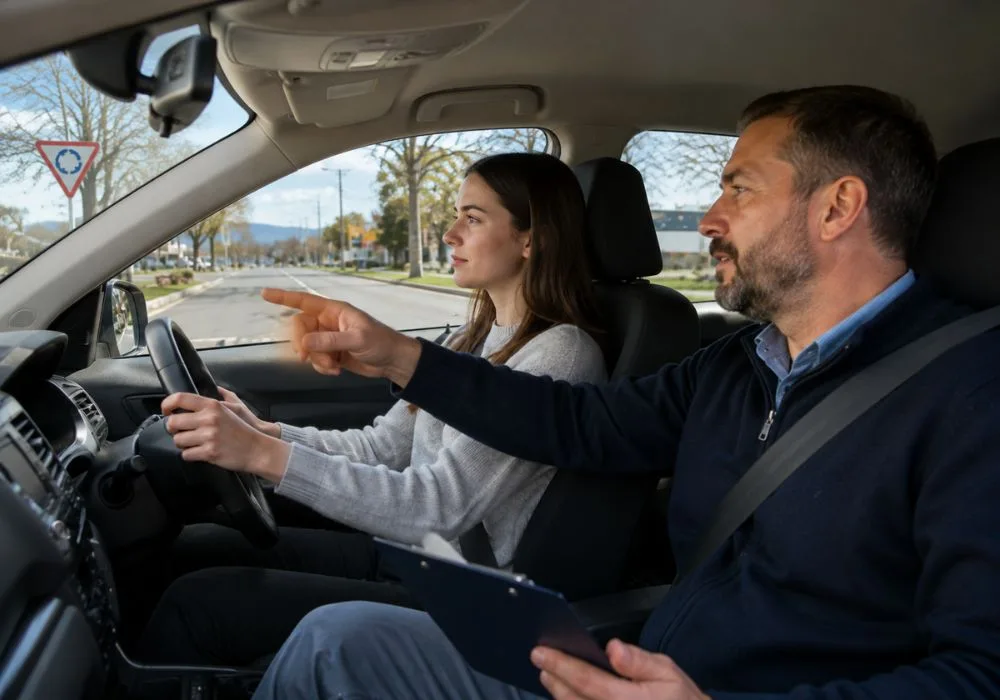
Real confidence is different. It comes from competence, from knowing what to do when a grain truck pulls out at a rural intersection, when a kangaroo appears in the headlights at 8pm, or when traffic builds behind you on the Mitchell Highway while you hold 90 km/h as a learner.
Confidence in the Specific Conditions Around Wongarbon
Generic driving confidence, the kind built on suburban roundabouts and parallel parking, is useful. But it does not automatically transfer to the road environment learners in Wongarbon will actually live in. A qualified instructor who knows the local area builds confidence in conditions that are specific and relevant.
Driving on the Mitchell Highway as a Learner
NSW learners are capped at 90 km/h regardless of the posted speed limit. On the Mitchell Highway between Wongarbon and Dubbo, a 100 km/h zone, that means other traffic moves faster than you. Learning to manage mirror checks, maintain appropriate following distance, and stay composed when vehicles overtake is a skill that has to be practised, not assumed.
An instructor who regularly teaches on this stretch knows where the pressure points are, where overtaking traffic is common, where the road narrows, and where the construction zone around Deep Creek currently affects traffic flow. That specific knowledge means the coaching is grounded in what actually happens on this road, not a generic version of highway driving.
Managing Wildlife Risk at Night
Night driving is a logbook requirement. NSW learners under 25 must complete at least 20 hours at night before they can sit the practical test. But around Wongarbon and Dubbo, night driving carries a specific risk that needs to be taught, not just experienced.
Dubbo sits at the top of NSW's animal collision hotspot list. NRMA Insurance claims data from 2015 to 2022 recorded 689 wildlife collision claims in this region alone. Separately, AAMI research found that dusk is the most dangerous period nationally for animal collisions, with around 26 per cent of incidents occurring between 4:30 pm and 8 pm. That window overlaps directly with evening driving practice.
Building confidence for night driving in this area means teaching learners to reduce speed when entering vegetation-lined road sections, to scan the road verges rather than only the centre, and to understand that where one kangaroo appears, others often follow. A learner who has practised that response under supervision handles it very differently from one who meets it for the first time on their Ps.
Responding to Agricultural Traffic
Wongarbon has a grain siding on the Main Western railway line. The roads around it see regular agricultural traffic during sowing and harvest seasons: grain trucks, farm machinery moving between paddocks, and vehicles turning across your path at rural intersections.
For many learner drivers, this kind of traffic is genuinely unfamiliar. Slow-moving vehicles, wide turning clearances, and roads without lane markings all demand judgement calls that are hard to make well the first time you face them. An instructor who includes this traffic type in the lesson progression gives learners a grounded response for when they encounter it independently.
How Confidence Carries Through Into Supervised Hours
A learner who has been coached to check mirrors at consistent intervals, to read intersections before they reach them, and to scan for wildlife at dusk carries those habits into every hour they drive with a parent or supervisor. Those remaining 70-odd hours of supervised practice with a parent or family member become more productive because the foundation was set correctly.
This is why early professional instruction matters for confidence-building , not just for the lessons themselves, but for the quality of everything after. Driving lessons in Wongarbon with a qualified, locally experienced instructor set a standard for the learner's own practice that self-supervised hours alone cannot replicate.