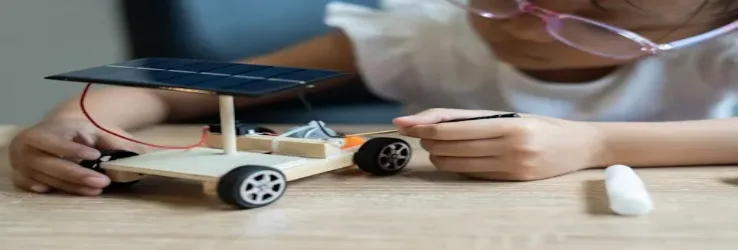
Walk into a physics class at Orion STEM Schools, and you might find teenagers wiring sensors into a garden bed instead of copying notes off a board. That's the point.
A STEM High School built around project-based learning skips easy answers and hands students problems worth solving. Parents searching for the best private school in Warrenville often ask the same question: will my kid be ready for what comes after graduation?
The short answer is yes, and the reason comes down to how learning happens here, project after project. It's less about textbooks and more about building things that work, or don't, and figuring out why.
Key Takeaways
- Project-based learning trades passive memorization for real, hands-on problem solving, the kind students will actually use later.
- A true STEM High School blends subjects together instead of teaching them in separate boxes, just like real-world problems demand.
- Students build soft skills like collaboration and communication by presenting their work to real audiences, not just a teacher.
- Failure isn't a setback here; it's part of the process. Testing, adjusting, and trying again builds resilience that sticks.
- Projects come with real constraints, budgets, deadlines, and actual community needs, so students see how classroom learning applies outside it.
- Among the best private schools in Chicago suburbs, this hands-on approach is often what sets a school apart during a campus visit.
How PBL Cultivates Real-World Problem Solvers
Fosters Interdisciplinary Inquiry
Real-world problems don't announce which subject they belong to. A bridge collapse touches physics, materials science, and city planning all at once. Project-based learning here treats that mess as the whole point. Instead of memorizing formulas in isolation, students pull ideas from math class into an engineering project, then borrow a concept from biology to make sense of a design flaw. It's messy, and that mess mirrors exactly how engineers, doctors, and researchers work every day.
Drives Sustained Investigation
Every project kicks off with one open-ended question, something with no obvious answer printed in a textbook. Students spend weeks chasing it down, researching, sketching, building prototypes, scrapping half of them, and starting over. Along the way, they get real say in how they approach the problem. That kind of ownership isn't handed out in a typical lecture hall, and it mirrors what colleges and employers expect once a student walks through the door.
Building Critical Skills for Life After Graduation
Solving a real problem takes more than technical know-how. A dedicated STEM PBL curriculum pushes students past subject boundaries and into skills employers actually look for.
Collaboration: Small teams split up technical tasks, argue over the best approach, and figure out how to move forward together. Nobody gets to coast.
Communication: Projects don't end quietly in a binder. Students present finished work to real audiences: local industry partners, community members, sometimes a room full of skeptical judges. Explaining a technical idea to a non-technical person is its own skill, and plenty of adults still struggle with it.
Critical thinking and adaptability: First attempts rarely work. Wires short out, code crashes, prototypes fall apart. Students test, fail, adjust, and try again, building the kind of resilience engineers rely on daily. That cycle sticks with kids longer than any exam ever could.
Mirroring Professional Workspace Realities
The best projects come with real constraints: a budget, a deadline, a client who actually cares about the outcome. Instead of a textbook lesson on circuitry, students at Orion might design wearable tech to track soil moisture for a local farm.
Suddenly math and engineering aren't abstract concepts on a whiteboard. They're tools solving a problem someone nearby actually has.
That's a big part of what separates a genuine STEM High School from a school that just teaches STEM subjects in isolated blocks. Parents comparing options among the best private schools in Chicago suburbs often notice the difference the first time they sit in on a student presentation.
The confidence, the specificity, the willingness to admit what didn't work and explain what changed- that's not something you can fake with a worksheet.
Bottom Line
For families weighing the best private school in Warrenville against other options nearby, that hands-on rigor tends to be the deciding factor. Reading about problem-solving skills on a website is easy enough. Watching a fifteen-year-old explain, in real detail, why their sensor array failed twice before it worked hits differently.
Among the best private schools in Chicago suburbs, that kind of learning is what actually prepares kids for whatever comes next: college, a trade, or a career nobody's invented yet.
Curious what project-based learning actually looks like in action? The best way to find out is to see it yourself. Visit Orion STEM Schools, sit in on a real classroom, and talk to our counselors about what your child's day-to-day would look like here. Bring your questions.
We'll walk you through our curriculum, our project process, and how we support every student along the way. Schedule your campus visit today and see why families across the Chicago suburbs choose Orion STEM.
FAQ
1. What Is Project-Based Learning, And How Is It Different From Traditional Teaching?
Project-based learning has students solve open-ended, real-world problems instead of memorizing facts for a test. At Orion STEM, kids research, build, and present actual solutions, working through failure and revision the way professionals do. Traditional teaching hands out information; PBL asks students to use it.
2. Is Project-Based Learning Effective For College And Career Readiness?
Yes. PBL builds skills colleges and employers actually screen for: collaboration, communication, adaptability. Students graduate having presented real work to real audiences, which gives them a head start over peers who've only taken tests. Orion STEM students walk into college already comfortable managing open-ended projects.
3. What Subjects Does Orion STEM Cover Through Project-Based Learning?
Orion STEM blends math, science, engineering, and technology into hands-on projects, plus core academics like English and social studies. Students don't learn subjects in isolation; a single project might pull in physics, coding, and research writing all at once, mirroring how problems work outside school.
4. Does Project-Based Learning Cover The Fundamentals As Well As Standardized Test Prep?
Yes, and this is a common worry among parents. PBL doesn't replace core academics; it builds on them. Students still master math, reading, and science fundamentals; they just apply that knowledge to real projects instead of worksheets. Orion STEM balances rigorous coursework with hands-on application, so test readiness isn't sacrificed.
5. What Age Or Grade Level Is Best To Start Project-Based STEM Learning?
High school is an ideal starting point, since students have the foundational skills to handle longer, more complex projects. Orion STEM's program is built specifically for high schoolers, giving them four years to develop real technical skills, teamwork, and confidence before college or career.