
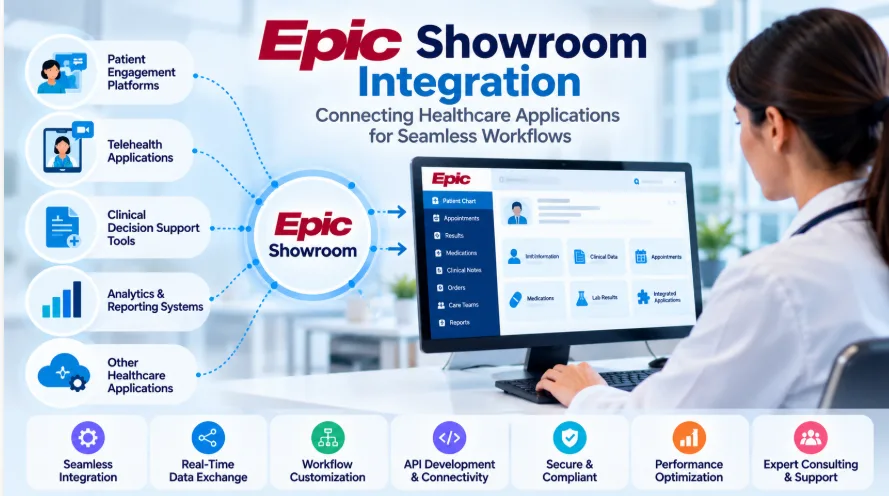
Healthcare organizations use a growing range of digital applications to support patient care, clinical decision-making, and administrative operations. When these applications operate separately from the electronic health record (EHR), healthcare professionals may face fragmented information, repeated data entry, and inefficient workflows. Connecting compatible third-party applications with Epic can help create a more unified digital environment.
epic showroom integration enables healthcare organizations to connect third-party applications, AI-powered tools, and clinical technologies with the Epic EHR environment. With appropriate integration architecture, organizations can improve data exchange, streamline workflows, and make relevant application capabilities more accessible to healthcare teams.
Understanding Epic Showroom Integration
Epic Showroom provides a way for healthcare organizations and technology vendors to connect compatible applications with Epic workflows. These integrations can support clinical applications, patient engagement platforms, analytics tools, and other healthcare technologies.
A successful implementation requires more than connecting two systems. It involves evaluating application compatibility, configuring interfaces, mapping data, establishing secure access, and validating how information moves between platforms.
Depending on the application and Epic environment, integration may use supported APIs, FHIR, HL7 interfaces, or other approved connectivity methods. The objective is to make connected applications work reliably within the organization's existing technology ecosystem.
Key Epic Showroom Integration Services
Professional epic showroom integration services help healthcare organizations manage the technical and operational requirements of connecting third-party applications with Epic.
Common service areas include:
- Application integration: Connect compatible third-party applications with Epic to support clinical and administrative workflows.
- API development and configuration: Build or configure APIs that enable communication between Epic and external platforms.
- Real-time data synchronization: Support timely exchange of relevant patient and operational information between connected systems.
- Workflow customization: Adapt application functionality and configurations to match organizational processes and user requirements.
- Vendor onboarding support: Assist third-party vendors with application compatibility checks, technical coordination, and integration troubleshooting.
Post-integration monitoring: Monitor system performance, identify connectivity issues, and optimize data exchange after deployment.
These services help healthcare organizations establish dependable integrations while reducing disruptions to daily operations.
Benefits of Epic Showroom Integration Solutions
Well-designed epic showroom integration solutions can improve the way healthcare teams access and use digital applications.
More Connected Clinical Workflows
Connecting compatible applications with Epic can reduce the need to move between disconnected systems. Healthcare professionals can access relevant tools and information through workflows designed around their daily responsibilities.
Improved Data Accessibility
Integrated systems can exchange relevant patient information through supported interfaces. This helps reduce information gaps and gives authorized users access to more complete data when performing clinical or administrative tasks.
Better Operational Efficiency
Automated data exchange can reduce repetitive manual work and help minimize duplicate data entry. More streamlined workflows allow staff to spend less time managing disconnected applications.
Support for AI-Enabled Healthcare
AI-powered applications can provide capabilities such as predictive analytics, clinical decision support, and workflow automation. Connecting these tools with Epic requires careful attention to data quality, access permissions, validation, and appropriate clinical oversight.
Scalable Application Connectivity
A structured integration approach makes it easier to evaluate and connect additional applications as organizational needs evolve. Ongoing monitoring and performance optimization help maintain reliability as usage and data volumes change.
Custom Epic Showroom Development Services
Healthcare organizations often need specialized integrations that address their particular clinical workflows and technology requirements. epic showroom development services can support custom API development, application configuration, integration enhancements, and workflow-specific functionality.
Development activities may include designing data exchange processes, mapping information between systems, building custom interfaces, validating application behavior, and improving integration performance.
Custom API development can also help external applications communicate with Epic and other healthcare platforms. Before implementation, teams should confirm available interfaces, technical specifications, security requirements, and the permissions needed for each connection.
Testing is essential to verify data accuracy, application compatibility, authentication, and workflow performance before production deployment.
The Role of Epic Showroom Integration Consulting
Planning an integration before development begins helps organizations identify technical dependencies and avoid unnecessary implementation challenges. epic showroom integration consulting supports healthcare teams in evaluating requirements, reviewing application compatibility, defining integration architecture, and preparing implementation plans.
A structured consulting process generally includes:
- Requirement discovery: Identify business objectives, clinical workflows, user needs, and expected integration outcomes.
- Technical assessment: Review Epic environment requirements, third-party application compatibility, available interfaces, and data exchange standards.
- Architecture planning: Define integration components, data flows, security controls, and implementation milestones.
- Testing strategy: Establish validation procedures for data accuracy, application functionality, security, and performance.
- Deployment planning: Coordinate vendor activities, user readiness, go-live requirements, and ongoing support.
This approach helps align technical decisions with healthcare operations and long-term organizational goals.
Building Secure and Reliable Epic Showroom Integrations
Healthcare integrations must protect sensitive patient information while maintaining dependable system performance. Organizations should implement appropriate authentication, encryption, role-based access controls, audit logging, and security monitoring.
Regular testing, interface monitoring, vendor coordination, and maintenance are equally important. As applications evolve and healthcare workflows change, integrations may require updates to maintain compatibility and reliability.
With the right development and integration strategy, healthcare organizations can extend their Epic environment, connect valuable third-party technologies, and create more efficient, coordinated digital healthcare workflows.