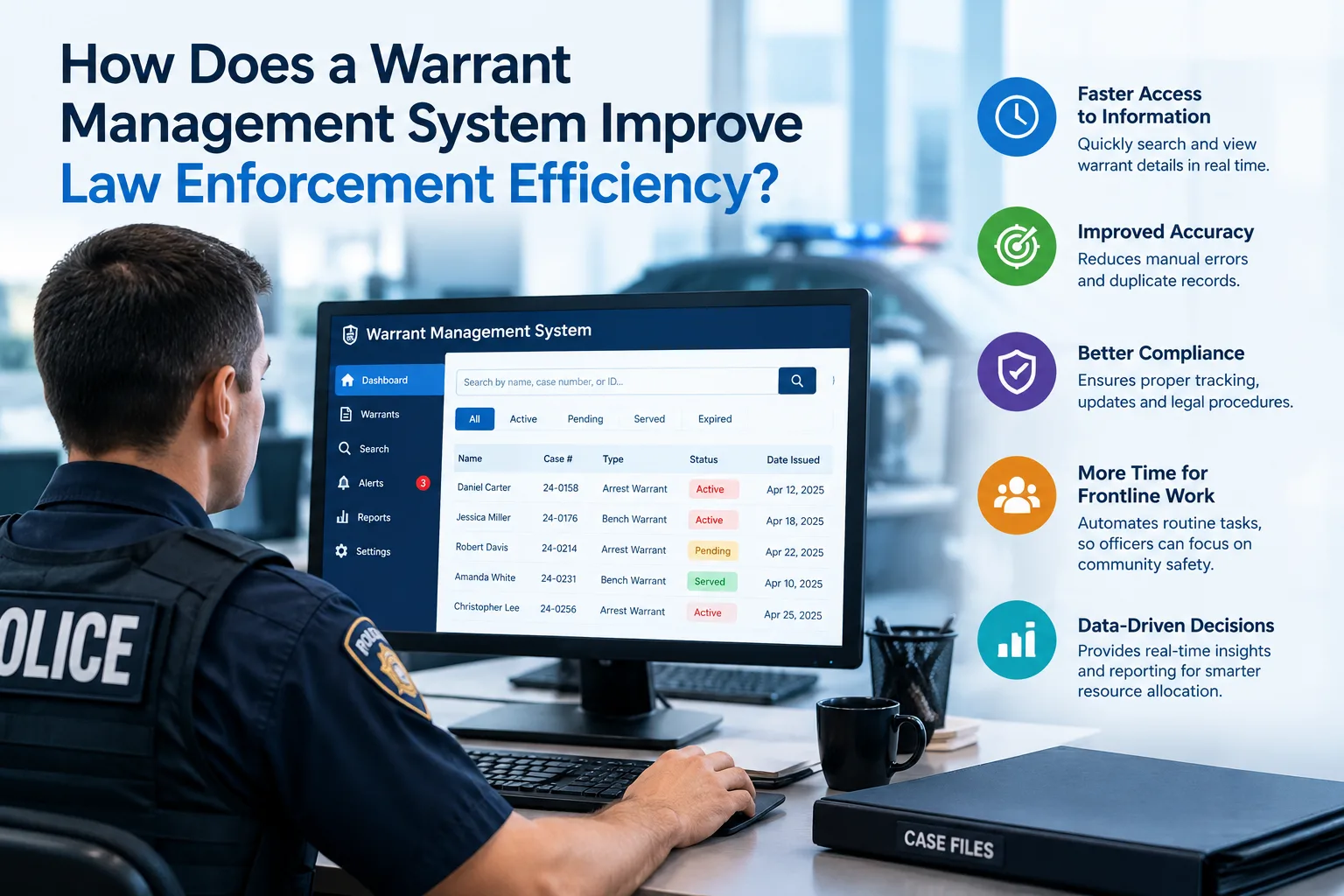
Picture a police officer standing at a front door at 2 a.m., trying to confirm whether a warrant is still active before making an arrest. A few years ago, that officer might have waited on hold with a records clerk, flipping through paper files, or calling a supervisor for confirmation. Today, that same check can happen in seconds, right from a patrol car.
That shift didn't happen by accident. It's the result of agencies moving away from paper-based warrant tracking and adopting a warrant management system built around electronic warrants. And the impact goes far beyond convenience. It touches officer safety, court accuracy, public trust, and how efficiently an entire department runs.
Let's break down what's actually changing, and why it matters.
What Is a Warrant Management System, Really?
At its core, a warrant management system is software that helps law enforcement agencies create, track, update, and serve warrants electronically instead of relying on paper documents and manual filing.
Instead of a warrant living in a filing cabinet or a scattered spreadsheet, it lives in a secure digital record that multiple people can access at once, judges, prosecutors, records units, and officers in the field, all working from the same accurate information.
That single detail, everyone seeing the same real-time data, is what solves most of the headaches paper systems create.
The Real Problem With Paper-Based Warrant Tracking
Before diving into the benefits, it helps to understand what agencies are actually moving away from.
Paper and disconnected digital systems tend to create the same recurring issues:
- Warrants that get served after they've already been recalled
- Duplicate entries across different databases
- Delays between a judge signing a warrant and it reaching officers
- Manual data entry mistakes that lead to wrong names, addresses, or charges
- No easy way to audit who accessed or updated a warrant, and when
None of these are small problems. Each one carries legal risk, safety risk, or both.
How a Warrant Management System Actually Improves Efficiency?
1. Warrants Move Faster, From Signature to Service
With electronic warrants, the moment a judge digitally signs off, the warrant is instantly available to authorized personnel. There's no printing, scanning, faxing, or physically transporting paperwork between offices.
This matters most in time-sensitive situations. A faster warrant means officers can act while information is still current, not hours or days later when circumstances may have already changed.
2. Fewer Errors, Less Rework
Manual data entry is one of the biggest sources of mistakes in warrant records. A misspelled name or an incorrect address isn't just an inconvenience, it can lead to wrongful stops or failed prosecutions.
A good warrant management system reduces this risk by:
- Auto-populating fields from existing case data
- Flagging incomplete or inconsistent entries before submission
- Standardizing formats across departments
Less manual re-typing means fewer chances for human error to creep in.
3. Real-Time Status Updates Keep Everyone Aligned
One of the most practical benefits is real-time visibility. When a warrant is recalled, updated, or served, that status change reflects immediately across the system.
This means an officer checking a warrant in the field sees the same, current information a records clerk sees at headquarters. No lag. No outdated printouts. No relying on someone remembering to make a phone call.
4. Better Coordination Between Agencies
Warrants often need to be recognized across county lines, state lines, or even between local and federal agencies. A centralized electronic system makes it far easier to share verified warrant data securely between jurisdictions.
This kind of interoperability reduces situations where a warrant exists but isn't visible to the agency that needs it most.
5. Stronger Accountability Through Digital Audit Trails
Every action, creation, review, approval, modification, or service, gets logged automatically. That means agencies can answer questions like:
- Who accessed this warrant, and when?
- When was it last updated?
- Who approved the final version?
This isn't just useful for internal oversight. It also strengthens the integrity of the warrant if it's ever challenged in court.
6. Less Administrative Burden on Officers and Staff
Time spent manually filing paperwork is time not spent on actual police work. Automating repetitive administrative tasks, like status updates, notifications, and record retrieval, frees up officers and support staff to focus on higher-priority responsibilities.
Smaller departments especially feel this benefit, since they often don't have large administrative teams to absorb paperwork backlogs.
Why This Matters Beyond Convenience
Efficiency isn't just about speed for its own sake. In law enforcement, delays and errors carry real consequences:
- A recalled warrant that's still marked active can lead to a wrongful arrest.
- A delayed warrant can mean a suspect isn't apprehended in time.
- Missing documentation can weaken a case in court.
By reducing these risks, a warrant management system doesn't just make departments faster. It makes them more accurate and more defensible, which ultimately builds public trust in the justice process.
What Agencies Should Look for in a Warrant Management System
Not all systems are built the same. When evaluating options, agencies generally benefit most from platforms that offer:
- Secure, role-based access controls
- Integration with existing records management systems (RMS) or case management tools
- Real-time synchronization across devices and locations
- Clear audit logs for compliance and legal review
- Mobile accessibility for field officers
The goal isn't just digitizing paperwork. It's creating a connected workflow where information flows accurately from courtroom to patrol car.
Final Thoughts
Warrant management isn't the flashiest part of law enforcement work, but it's one of the most consequential. Every warrant represents a real decision made by a judge, tied to a real person's rights and a real public safety concern.
Moving from paper to a structured, electronic system doesn't just speed things up. It closes the gaps where mistakes, delays, and miscommunication used to live. And in a line of work where accuracy and timing genuinely matter, that shift makes law enforcement not just faster, but fundamentally more reliable.