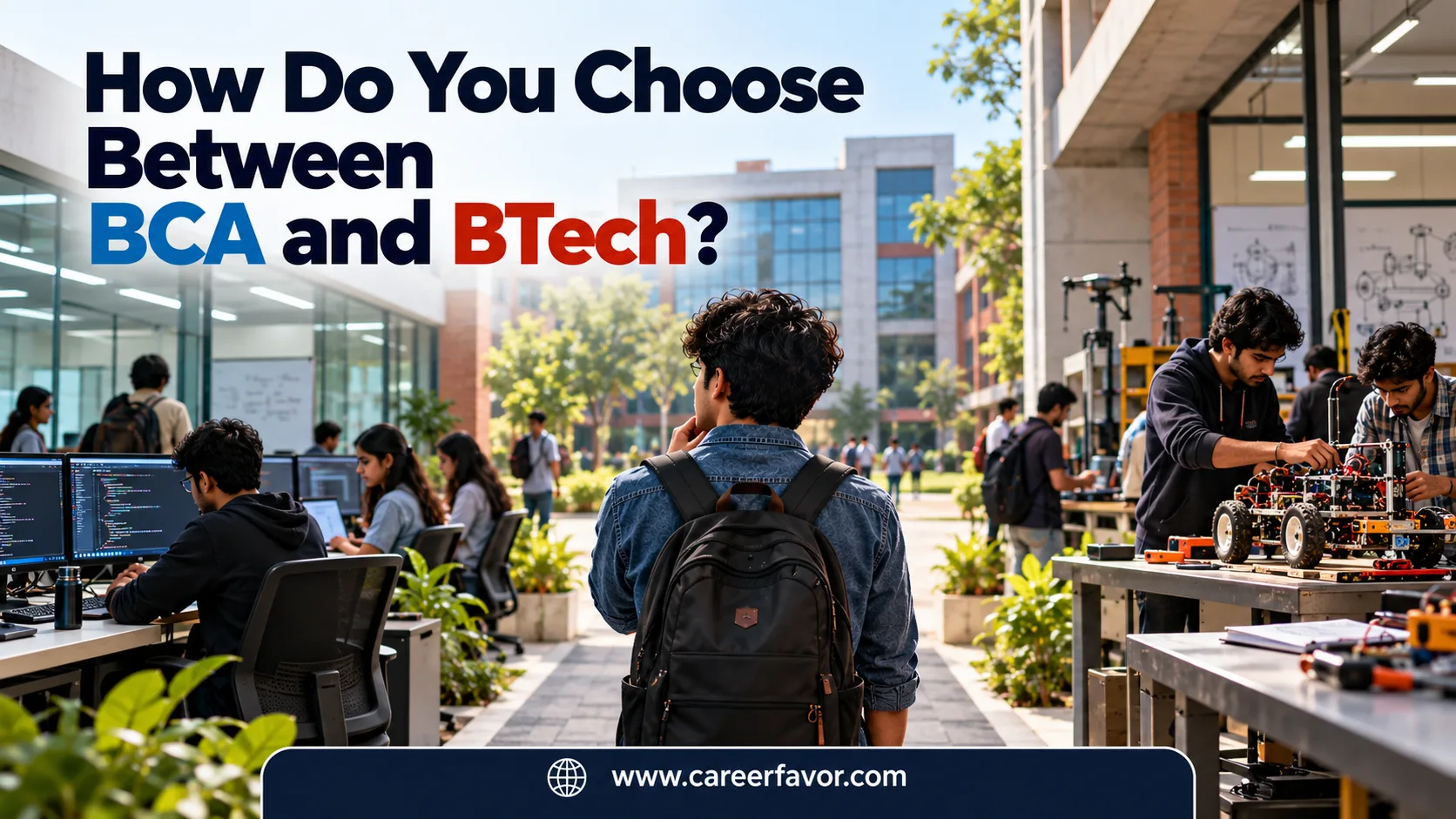
If you are finishing Class 12 and want to enter the technology field, there is a good chance you have heard the same advice from almost everyone around you: go for BTech.
Maybe your parents say it has better scope. A friend says BCA is only for students who couldn't get into BTech. Someone else tells you that BCA students have fewer job opportunities. Then you look at college fees and suddenly the decision becomes even more confusing.
The truth is less dramatic.
BCA is not simply a cheaper BTech, and BTech is not automatically the right choice for every student interested in computers. They are different routes, and the better option depends on the student, the college, the cost and the kind of technology career you are actually considering.
The first thing to understand is that BCA and BTech are different degrees
BTech in Computer Science or a related engineering branch is an engineering programme. You generally study computer science along with mathematics, engineering fundamentals and other technical subjects. The exact syllabus depends on the university and branch.
BCA, or Bachelor of Computer Applications, is focused more directly on computer applications and IT-related areas. Depending on the university, subjects can include programming, databases, networking, web technologies and software development.
That difference matters.
If you enjoy the technical and engineering side of computing, BTech may feel more natural. If you are interested in computers and software but don't necessarily want an engineering-oriented degree, BCA may be worth considering.
But don't decide from the course name alone. Look at the syllabus of the actual colleges you are considering.
The real question is not which degree has more value
This is where students often get bad advice.
Someone asks, "BCA or BTech?"
The answer comes back immediately: "BTech, obviously."
- But what does "better" actually mean?
- Better for which student?
- Better at which college?
- Better at what cost?
- Better for which career?
A good BTech programme can open strong technical opportunities. But if your choice is between a good, affordable BCA programme and a poor-quality BTech programme that costs your family several lakhs, the degree name alone doesn't settle the decision.
Similarly, choosing BCA simply because it costs less can be a mistake if you actually want an engineering-focused education and have a good BTech option available.
The comparison needs to be more personal than that.
Think about what you actually enjoy doing with computers
Saying "I like computers" isn't enough.
A student may enjoy gaming, using apps, watching technology videos or experimenting with software. That doesn't necessarily mean they will enjoy programming.
Another student may spend hours trying to understand why something isn't working, enjoy writing code and feel satisfied when they finally solve a technical problem. That is a stronger reason to explore a technology career.
So before choosing either degree, try something small.
Write some basic code. Build a simple website. Try a beginner programming project. See what happens when you get stuck.
If the first difficult problem makes you want to give up completely, that's worth noticing.
If it makes you curious enough to keep trying, that's also worth noticing.
You don't need to become a programmer before choosing your degree. You just need a little more evidence than "everyone says IT has scope."
BTech can be a strong choice if you want a technical and engineering route
For a student who enjoys Mathematics, technical subjects and problem-solving, BTech can provide a broader engineering foundation.
It can be particularly relevant if you are interested in software engineering, computer engineering, systems or other technical areas where an engineering background may be useful.
The programme also comes with a particular academic commitment. AICTE's approval framework treats undergraduate Engineering and Technology programmes as four-year programmes, with specific eligibility requirements depending on the programme and applicable admission rules.
That doesn't mean BTech is automatically superior.
It means you should choose it with an understanding of what you are signing up for.
If you dislike Mathematics, technical coursework and engineering-style learning, four years can feel very long.
Being capable of getting into BTech is not the same as wanting to study engineering.
BCA can be a sensible route into technology too
BCA makes sense for students who are interested in computing and IT but want a different undergraduate route.
It may also become the practical choice when the BTech options available to you are too expensive, too far away or simply not good colleges.
But there is one thing a BCA student should understand early.
You cannot expect the degree alone to carry your career.
Technology changes quickly, and employers hiring for technical roles want people who can actually do the work.
That means you may need to spend your college years learning beyond your regular syllabus. Build projects. Learn programming properly. Try internships. Work with tools used in the field. Improve your communication.
A BCA student who does this can have a much stronger profile than someone who spends three years only chasing marks.
Don't choose BCA because you think it will be easier
This is one of the worst reasons to choose it.
BCA is still a computer-related degree. Depending on the university, you may study programming, databases, networking and software-related subjects.
If you don't enjoy technical learning, switching from BTech to BCA won't solve the real problem.
You may simply end up with a different degree in a field you still don't enjoy.
Choose BCA because the route makes sense for you, not because someone told you it is the easy option.
What if your Maths background is different?
Check this before applying. BTech eligibility can depend on the engineering branch, institution, state and admission route. BCA eligibility also varies between universities.
Don't rely on a friend saying, "You can definitely get admission," or "You can't do this without Maths."
Go to the college's current admission page and check the actual requirements.
Also separate eligibility from academic fit.
You might technically qualify for a programme and still find its Mathematics or technical subjects difficult. On the other hand, a student who isn't naturally strong in a subject may manage it well with consistent effort.
The admission requirement tells you whether you can enter.
It doesn't tell you whether you will enjoy being there.
What happens after BCA or BTech?
This is where students often expect a clear winner. There isn't one.
A BTech can be useful for technical roles and may meet the degree requirements for jobs where engineering qualifications are preferred or specified.
BCA can also lead towards IT and software-related roles, especially when the student has strong practical skills.
Your degree is only one part of the hiring decision.
Imagine a BTech graduate who has never built anything outside classroom assignments. Now compare that with a BCA graduate who has built several projects, completed an internship and can demonstrate strong programming ability.
The second student may have a much better conversation with a recruiter.
That doesn't make BCA better than BTech.
It shows why degree versus degree is the wrong comparison.
What about doing MCA after BCA?
This is a route some students consider, and it can make sense.
AICTE's current handbook recognises BCA among the bachelor's qualifications that can provide eligibility for MCA, subject to the applicable conditions and institutional requirements. MCA is listed as a two-year postgraduate programme.
But don't choose BCA assuming you will automatically need an MCA.
First understand where you want to go.
If you can build the skills and experience needed for your target roles after BCA, you may not need another degree for every career path.
If a particular role or organisation values postgraduate study, then MCA may become useful.
The point is to make that decision based on the career you want, rather than treating MCA as a compulsory repair job for choosing BCA.
The college can matter more than the label
This is probably the part students overlook most.
Suppose you have an average BTech college with high fees and limited industry exposure.
You also have a good BCA college that is affordable, has better teaching and gives you more room to build practical skills.
Would it still make sense to choose BTech automatically?
Not necessarily.
Look at the actual college.
Check the curriculum. Look at faculty. Understand the fees. Investigate internships and placement information. Find out what students are actually doing during the programme.
Don't rely only on a college saying that it has "excellent placements."
UGC advises students to verify the status and authenticity of higher education institutions before admission.
The college you attend can influence your experience, opportunities and network. That deserves serious attention.
Don't forget what your family can realistically afford
This isn't a boring detail to discuss later. It should be part of the decision now.
A BTech programme may involve tuition, hostel, travel and other costs. If your family needs to take a large loan for it, you need to understand what that commitment means.
Maybe the expensive college provides opportunities that justify the cost.
Maybe it doesn't.
Maybe you have a good government or lower-cost BTech option.
Maybe a strong BCA programme closer to home makes more financial sense.
There isn't one correct answer for every family.
The right degree has to fit both your career direction and your financial reality.
So when does BTech make more sense?
BTech is worth serious consideration when you genuinely want an engineering-oriented technical education, are comfortable with Mathematics and technical subjects, and have access to a good programme that your family can reasonably afford.
It can be especially suitable if you already have some interest in programming or technical problem-solving and want to build a deeper foundation in the field.
Don't choose it because somebody told you that BTech automatically guarantees a better job.
It doesn't.
When can BCA make more sense?
BCA can be a good option when you are interested in computers and IT but prefer a computer applications-focused route.
It can also make practical sense when you have access to a strong BCA college but your BTech choices are expensive or academically unsuitable.
The condition is that you take the degree seriously.
Use those three years to become useful, not just qualified.
Build projects. Learn the tools your target roles require. Look for internships. Talk to people working in the field. Understand what employers expect.
That effort can make a big difference after graduation.
Compare your actual options before you decide
Don't compare an imaginary BCA with an imaginary BTech.
Take the colleges you can actually get into and put them side by side.
Check the syllabus, fees, location, eligibility, internships, placement information and opportunities for practical learning. Then consider what you would need to do outside college to become employable.
Finally, ask yourself one question:
If nobody had told me that BTech is better, which of these options would I choose after understanding what I will actually study and what I can do afterwards?
You may still choose BTech.
That's completely fine.
You may choose BCA.
That's fine too.
The important thing is that you understand your decision instead of borrowing it from somebody else.
If you're still comparing BCA vs BTech, Career Favor's career and education guides can help you research courses, eligibility, career paths and related options before you commit. The aim isn't to find a degree that sounds better to other people. It's to find an education path that fits what you want to learn, what your family can manage and the kind of work you may want to pursue.
BCA and BTech are both routes. Your choice should depend on where you actually want the route to take you.