Every business eventually hits the same wall. The spreadsheets get messier, the off-the-shelf tools stop fitting, and the team spends more time working around software than working with it. This is usually the moment a business starts looking seriously at custom software solutions instead of settling for generic platforms that were never built for their specific workflow.
Custom software solutions are not just a technical upgrade. They are a strategic decision that affects how fast a company can grow, how well it can serve customers, and how much control it has over its own data and processes. In this guide, we will break down what custom software solutions actually are, why more businesses are investing in them, and how to choose the right development partner for the job.
What Are Custom Software Solutions?
Custom software solutions are applications, platforms, or systems built specifically for one organization's needs, rather than designed for a mass market. Instead of adjusting your business processes to fit a generic tool, custom software is shaped around the way your business already operates, and the way you want it to operate in the future.
This can include anything from a custom customer relationship management system to a fully tailored enterprise resource planning platform, an internal automation tool, or a customer-facing web application.
Custom Software vs Off-the-Shelf SoftwareOff-the-shelf software is built to serve as many businesses as possible, which means it is designed around common denominators rather than specific needs. It is often cheaper to start with, but the limitations tend to show up quickly: rigid workflows, unnecessary features, licensing fees that scale badly, and integration headaches when you try to connect it with other systems.
Custom software solutions solve this by starting from the opposite direction. Instead of forcing your business to adapt to the tool, the tool adapts to your business. That difference becomes especially important as a company grows and its processes become more complex.
Why Businesses Are Moving Toward Custom Software Solutions
The shift toward custom software development is not a trend, it is a response to real operational pain points. Businesses across industries are running into the same issues with generic platforms:
- Paying for features they never use, while missing the ones they actually need
- Struggling to integrate multiple disconnected tools
- Hitting scalability limits as user numbers or data volume grow
- Facing security and compliance gaps that a generic platform cannot address
- Losing competitive advantage because their tech stack looks identical to every competitor's
Custom software solutions address each of these problems directly, which is why demand for tailored development has grown steadily across sectors like healthcare, real estate, education, travel, and e-commerce.
Key Benefits of Custom Software Solutions for Business Growth
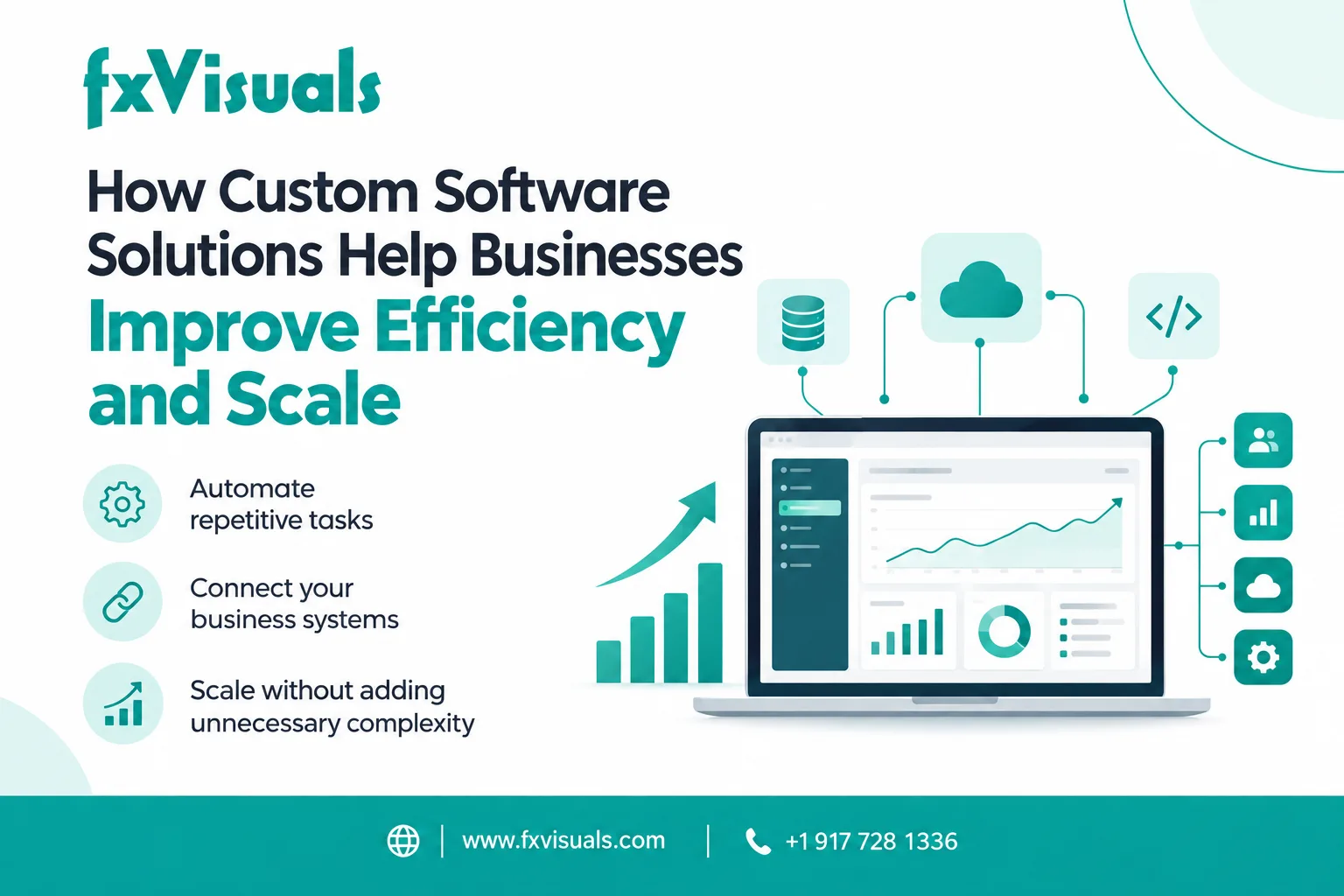
Improved Operational EfficiencyWhen software is built around your actual workflow, employees spend less time on manual workarounds and repetitive tasks. Business process automation built into custom systems can handle data entry, reporting, approvals, and notifications automatically, freeing up staff to focus on higher-value work.
Seamless ScalabilityGeneric software often forces businesses to migrate to a new platform once they outgrow it, which is disruptive and expensive. Custom software solutions are architected with growth in mind from day one, so new features, users, and integrations can be added without rebuilding the system from scratch.
Better Data Security and ComplianceOff-the-shelf platforms are common targets for attackers precisely because they are widely used. Custom-built systems reduce that exposure and can be designed to meet specific industry compliance requirements, whether that is healthcare data regulations, financial standards, or regional data protection laws.
Higher ROI Over TimeCustom software has a higher upfront cost than a subscription tool, but the long-term return is usually stronger. There are no recurring per-user licensing fees that scale unpredictably, and the software directly supports revenue-generating processes instead of forcing inefficient ones.
Competitive Advantage Through Unique FeaturesIf your competitors are using the same generic CRM or the same template-based platform, there is nothing differentiating your operations from theirs. Custom software allows you to build features and workflows that are unique to your business model, which can become a genuine competitive moat.
Core Types of Custom Software Solutions Businesses Need
Custom Web ApplicationsWeb applications remain one of the most common forms of custom software, since they can be accessed from anywhere and support everything from internal dashboards to customer-facing portals. A well-built custom web application becomes the operational backbone for daily business activity.
Enterprise Software and CRM SystemsCustomer relationship management is central to how a business manages leads, sales pipelines, and support. A custom-built CRM aligns exactly with your sales process rather than forcing your sales team to adapt to generic pipeline stages that do not match how your business actually sells.
Custom Software Integration ServicesMost businesses run several systems side by side: accounting software, marketing tools, inventory platforms, and communication apps. Without proper integration, data stays siloed and staff waste hours manually transferring information between systems. Dedicated integration services connect these systems so information flows automatically and accurately across the business.
Data Analysis and Visualization ToolsRaw data is only useful when it can be understood quickly. Custom data analysis and visualization tools turn scattered numbers into dashboards and reports that leadership can actually act on, supporting faster and more confident decision-making.
Mobile Application DevelopmentAs more customer interactions move to mobile devices, a strong mobile application has become essential rather than optional. Custom mobile apps let businesses control the full user experience instead of relying on a generic app builder with limited flexibility.
Signs Your Business Needs a Custom Software Solution
It is not always obvious when a business has outgrown its current tools. A few common warning signs include:
- Your team relies on spreadsheets or manual processes to fill gaps that software should be handling
- You are paying for multiple tools that overlap in function but still do not fully cover your needs
- Data has to be manually copied between systems because they cannot talk to each other
- Your current software cannot support new business models, services, or markets you want to enter
- Customization requests to your software vendor are ignored, delayed, or come with high additional fees
If more than one of these sounds familiar, it is worth evaluating whether custom software solutions would solve the underlying problem rather than continuing to patch around it.
How to Choose the Right Custom Software Development Company
Not every development team is equipped to deliver software that actually holds up long term. When evaluating a custom software development company, look for:
- A proven portfolio across industries similar to yours
- Clear communication and a defined project management process
- Technical expertise across the full stack: web, mobile, integrations, and data
- A security-first approach to development and deployment
- Ongoing support and maintenance after launch, not just a one-time build
At fxVisuals, this end-to-end approach is central to how projects are structured, from initial discovery through to post-launch support, so the software keeps working for the business long after deployment.
The Custom Software Development Process
Discovery and Requirement AnalysisEvery solid custom software project starts with understanding the actual business problem, not just the requested feature list. This stage maps out workflows, pain points, and goals before any code is written.
Design and PrototypingOnce requirements are clear, the design phase focuses on user experience and interface planning, often including clickable prototypes so stakeholders can review the flow before development begins.
Development and TestingThis is where the software is actually built, using an appropriate tech stack for the project's scale and requirements, with continuous testing to catch issues early rather than after launch.
Deployment and Ongoing SupportLaunch is not the finish line. Custom software needs monitoring, updates, and support to keep pace with changing business needs, new integrations, and evolving security requirements.
Custom Software Solutions in an AI-Driven Business Environment
Artificial intelligence is changing what businesses expect from their software. Custom systems built today increasingly need to support AI-driven features such as intelligent automation, predictive analytics, and natural language interfaces, rather than being retrofitted later. Businesses are also rethinking how their digital presence responds to AI agents and AI-powered search tools, a shift covered in more depth in our breakdown of Agentic AI Optimization. Custom software that is designed with this flexibility from the start avoids costly rework as AI capabilities become standard business expectations rather than an added feature.
Final Thoughts
Custom software solutions give businesses the flexibility, security, and scalability that generic platforms simply cannot match. Whether the goal is automating internal processes, integrating disconnected systems, or building a customer-facing application that scales with demand, a tailored approach pays off through efficiency gains and long-term cost savings. Learn more about the team and approach behind these projects on our About page.
Frequently Asked Questions
What are custom software solutions?
Custom software solutions are applications built specifically for one organization's workflows and goals, rather than generic tools designed for a broad market.
How much do custom software solutions cost?
Cost depends on scope, complexity, and features required. Simple internal tools cost less than enterprise-grade platforms with multiple integrations, but most businesses see the investment pay off through efficiency gains and reduced licensing fees over time.
How long does custom software development take?
Timelines vary based on project size, typically ranging from a few weeks for a simple application to several months for a complex enterprise system involving multiple integrations.
Is custom software better than off-the-shelf software?
It depends on business needs. Off-the-shelf software works for simple, standardized processes, while custom software solutions are better suited to businesses with unique workflows, growth plans, or integration requirements.
Can custom software integrate with existing tools?
Yes. One of the main advantages of custom software is that it can be built to integrate directly with existing accounting, CRM, marketing, or inventory systems, eliminating manual data transfer.
Do small businesses need custom software solutions?
Not always immediately, but as a small business grows and outgrows generic tools, custom software often becomes more cost-effective than stacking multiple subscription platforms.
How do I get started with a custom software project?
The process typically begins with a discovery call to outline business goals and pain points, followed by a proposal covering scope, timeline, and cost. You can contact our team to start that conversation.
Ready to Build Software That Works for Your Business?
Generic tools were never designed around your workflow, your customers, or your growth plans. Custom software solutions close that gap and give your business a system built to scale on your terms. Speak with our experts at fxVisuals to discuss what a tailored solution could look like for your business.