
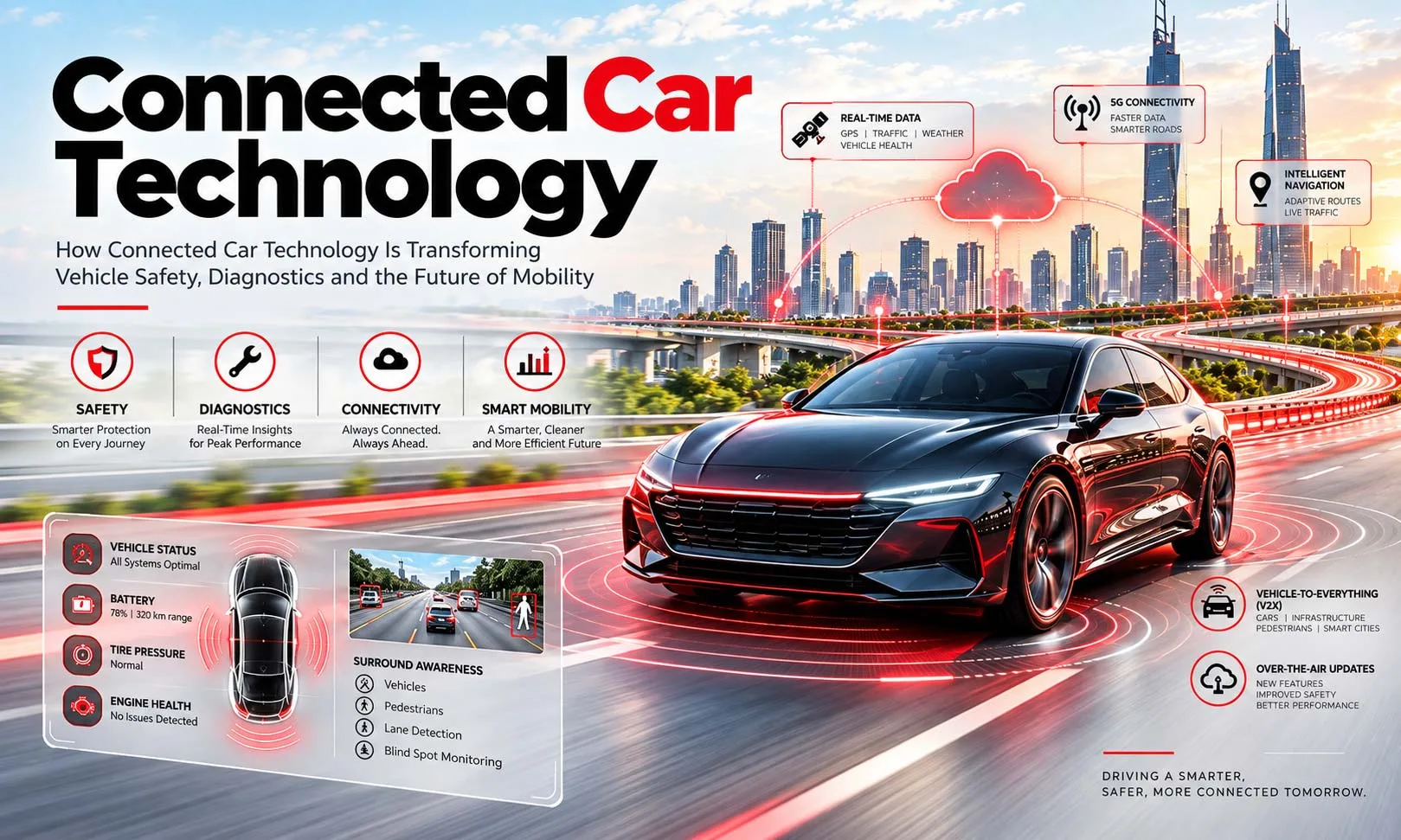
We are now in a new era of the automotive industry where the vehicles are evolving beyond just a means of transportation.Today’s cars contain sophisticated software, sensors, communication systems and intelligent features that enable them to collect data, monitor performance and communicate with external platforms.
This transformation is fueled by an increasing trend known as Connected Car Technology, a combination of automotive engineering and digital innovation.The operation of cars and the way drivers interface with them are being revolutionized by connected technology – from real-time monitoring of the vehicle to sophisticated driver assistance systems.
As cars become more reliant on electronics, manufacturers are focusing on reliability, cybersecurity and smarter maintenance solutions in addition to performance.
What Is Connected Car Technology?
Connected car technology is the use of internet connectivity, wireless communication and embedded systems to share information between the vehicle, drivers, manufacturers and external services.
A modern connected vehicle can do a variety of things such as navigation updates, remote monitoring of the vehicle, emergency assistance, software updates and maintenance alerts.
Connected cars use multiple electronic control units, sensors and communication modules to improve safety and efficiency, as opposed to traditional vehicles that rely more on mechanical hardware.
The Growth of Software-Driven Vehicles
The automotive industry is trending more and more toward software defined vehicles.Software is a major component in these vehicles to control features, boost performance and add new functionalities.
Like smartphones and computers, many new cars are capable of software updates to improve functionality without major hardware changes.
The change gives manufacturers the ability to roll out upgrades after the vehicle is delivered to customers, making for a more flexible ownership experience.
How Technology Is Improving Vehicle Maintenance
One of the biggest advantages of connected car technology is predictive maintenance.
Traditional vehicle maintenance is based on fixed schedules or on the occurrence of a problem.Interlinked systems can assess information from different parts and raise early alarms if something needs attention.
Sensors can monitor engine performance, electrical systems, tyre pressure and battery state.These can be used to identify anomalous patterns so as to minimize unscheduled failures and enhance the reliability of vehicles.
Battery Health Becomes More Important in Connected Vehicles
As vehicles get smarter, the role of the battery is also changing.
A bad battery could do more than keep you from starting. It may interfere with electronic systems and lead to dependability issues particularly in cars with advanced digital features.
The development of connected car makes regular inspection and timely maintenance on battery more and more important. Automotive support services such as mobile battery support and car battery services are among those that guaranty the reliability of vehicles when electrical issues arise.
Connected Cars and Vehicle Security
Connected vehicles are becoming more and more common auto manufacturers are putting cybersecurity as a top priority.
New cars gather and exchange a lot of information, so protection against unauthorized access is becoming more and more important.Automakers are shelling out cash to beef up security systems to protect software in their cars, their communication networks and their users’ information.
More advanced security features, including more sophisticated authentication systems and AI-powered threat detection, will likely be part of the future of connected cars.
The Role of Artificial Intelligence in Smart Mobility
The primary artificial intelligence technologies are connected vehicles.Artificial intelligence systems can learn driving styles, enhance navigation, offer driver assistance, and enable vehicles to make quicker decisions.
Advanced driver assistance systems use cameras, radar and sensors to detect road conditions, identify obstacles and help you to drive more safely. We’re still working on fully autonomous vehicles, but AI and connected technology are already changing how we design and service modern cars.
The Future of Connected Car Technology
The future of mobility will probably be about making smarter, more efficient and more responsive vehicles.
Connected car technology will get better as artificial intelligence, faster communication networks and better vehicle sensors are put to use.
Further developments could include better predictive maintenance, better energy management of electric vehicles, and a deeper integration of vehicles and smart city infrastructure.
That may mean a more proactive strategy for vehicle ownership for drivers. Rather than finding out about problems after a breakdown, vehicles may increasingly be able to tell us about their condition before things get serious.
Conclusion: A Smarter Future for Modern Vehicles
Connected car technology is revolutionizing the automotive industry through the integration of software, electronics and intelligent systems. Vehicles are becoming more aware of their surroundings, more connected to digital platforms, and better equipped to help drivers.
As this transformation continues, the significance of upholding the support systems behind these technologies will be more and more. Reliable electrical performance, battery health and professional vehicle support will continue to be core components of modern mobility.
The future of driving won’t be all about faster or more efficient cars. We are going to talk about how you make smarter transportation systems where technology will make things safer, more convenient and more reliable for the every day driver.