
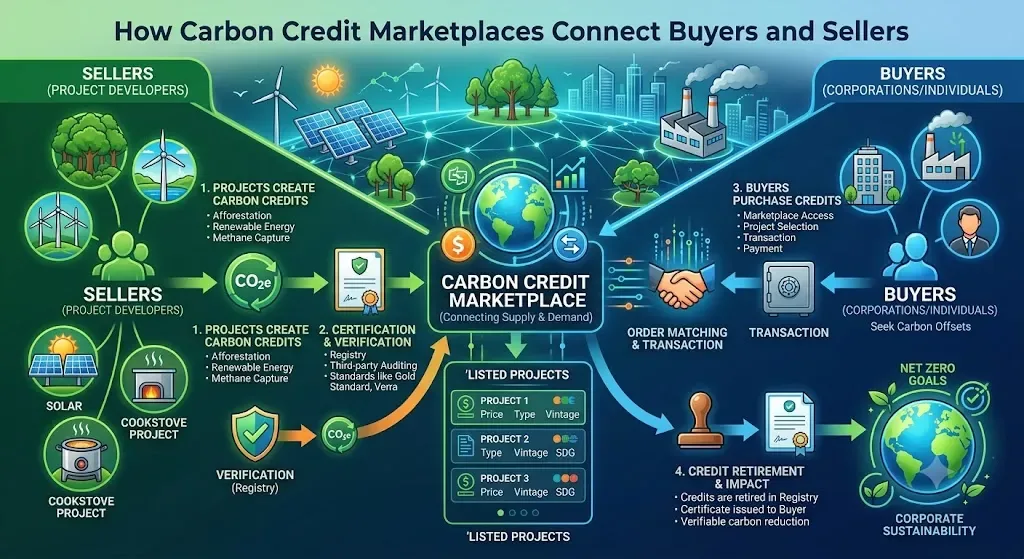
Carbon credits have become an important instrument for organizations working toward emissions reduction and broader climate-related goals. A carbon credit generally represents a unit associated with a reduction, avoidance, or removal of greenhouse gas emissions under a particular project or program. As interest in carbon markets grows, both buyers and sellers need practical ways to discover, evaluate, and transact carbon credits.
This is where carbon credit marketplaces come into the picture. Instead of relying entirely on direct relationships, brokers, or scattered sources of information, participants can use a digital marketplace to discover available credits and manage transactions through a structured environment. Sellers can present their projects and available credits, while buyers can search for options based on their requirements.
A marketplace can bring several activities into one platform, including seller onboarding, credit listings, search and filtering, project information, pricing, communication, payments, and transaction records. However, the marketplace is not automatically responsible for determining the environmental quality of every credit. Verification, certification, registries, and other forms of due diligence remain important parts of the broader carbon market.
What Is Carbon Credit Trading Platform Development and How Does a Marketplace Work?
Carbon credit trading platform development focuses on building the digital infrastructure required to connect participants in the carbon market. A marketplace can provide a central environment where sellers list available credits and buyers discover and evaluate those listings before entering into a transaction.
The process generally begins when a seller creates an account and provides information about the project and credits they want to offer. Depending on the marketplace model, the platform may collect project details, available quantity, vintage, pricing, verification information, and supporting documentation. Once the listing is available, buyers can search through the marketplace and identify credits that fit their requirements.
From the buyer’s side, the platform can make discovery easier through search and filtering tools. A buyer may be interested in a particular project type, geographic region, vintage, price range, or quantity. Instead of manually contacting different sellers, the buyer can use these criteria to narrow down the available options.
The next stage involves evaluation and transaction. Buyers can review listing information, examine available documentation, ask questions where necessary, and decide whether to purchase or make an offer. Depending on the platform’s business model, the transaction may involve fixed pricing, negotiation, bidding, or another mechanism.
In this way, the marketplace acts as a digital connection point between supply and demand. Sellers gain a structured way to present their inventory, while buyers gain tools for discovering and comparing available credits. Triple Minds can support this type of marketplace through the technology needed to organize users, listings, workflows, transactions, and supporting information.
Who Buys and Sells Carbon Credits?
The supply side of a carbon credit marketplace can include a variety of participants. Project developers are one of the most important groups because they create and manage projects associated with generating carbon credits. These projects can involve renewable energy, forestry and land use, waste management, methane reduction, energy efficiency, carbon removal, and other activities depending on the applicable market and methodology.
For example, a project developer may operate a renewable energy project and generate credits according to an applicable carbon standard and methodology. Another project may focus on forestry or land management, while a waste project may reduce emissions by capturing methane. The characteristics of the underlying project can be important to buyers when they compare available credits.
Other sellers can include organizations or market participants that already hold credits and are eligible to transfer them. Brokers and intermediaries may also participate by helping source credits or connect buyers with available supply. Because sellers can have different types and quantities of credits, the marketplace needs a consistent listing system that makes the relevant information easy to understand.
On the demand side, companies can purchase carbon credits as part of their broader climate or sustainability strategies. Their requirements can vary considerably. One organization may be interested in a particular project category, while another may focus more heavily on geographic location, vintage, price, documentation, or available volume.
Institutional buyers, traders, brokers, and other organizations can also participate. Some buyers may be looking for relatively small quantities, while larger organizations may want substantial volumes and more detailed documentation before completing a transaction.
This diversity is one reason a carbon marketplace needs more than a simple catalog of credits. Buyers and sellers need tools that can accommodate different requirements while still presenting listings in a consistent and understandable format.
What Information Helps Buyers Evaluate Carbon Credits?
Press enter or click to view image in full size

Once a buyer finds a potentially relevant listing, they need enough information to determine whether it is worth investigating further. A useful marketplace should therefore present important project and credit details in a clear and standardized way.
Basic project information can include the project name, project type, location, description, and activities associated with the project. This helps buyers understand the source of the credits before moving further into the evaluation process.
The listing can also show the number of credits available, along with information such as vintage and applicable verification or crediting standards. Quantity is particularly important for buyers because their requirements may range from a relatively small purchase to a much larger transaction.
Pricing and availability are also central to the buying decision. Some marketplaces may display a fixed price, while others may allow buyers to submit offers or negotiate with sellers. Making the applicable pricing mechanism clear helps buyers understand what steps are required to move forward.
Supporting documentation can provide additional information about the project and credits. Depending on the marketplace, buyers may be able to access project documents, verification-related information, certificates, reports, or registry references. The exact documentation available will depend on the project, market structure, and platform’s role.
The marketplace should make these details easy to compare without suggesting that the platform itself replaces independent due diligence. A buyer may still need to examine relevant standards, verification records, registry information, and project documentation before completing a transaction.
A well-organized listing therefore does more than display a price. It gives buyers the context they need to understand what is being offered and helps them move from initial discovery toward a more informed evaluation.
Why Marketplace Structure Matters
Carbon credit markets can involve many different projects, participants, standards, registries, and transaction arrangements. Without a structured digital environment, buyers may spend considerable time identifying available credits and gathering information from different sources.
A marketplace can bring these activities into one interface. Sellers can manage listings and inventory, while buyers can search, filter, compare, communicate with sellers, and manage transactions. This can make the process more organized for both sides.
The real value of the marketplace comes from connecting these activities into one workflow. A buyer does not simply need to find a carbon credit; they need to understand its characteristics, compare it with alternatives, review relevant information, and potentially complete a transaction. Sellers similarly need a way to present inventory, respond to demand, manage offers, and keep track of completed sales.
This foundation sets up the next stage of the marketplace journey: how sellers put their credits on the platform and how buyers discover, compare, and match those credits with their specific requirements.
How Sellers List Carbon Credits on a Marketplace
Once a seller joins a carbon credit marketplace, the first major step is creating a listing for the credits they want to make available. The marketplace can provide a structured form where sellers enter information about the underlying project, the credits, available quantity, vintage, applicable standards, pricing, and supporting documentation. Using standardized fields helps create consistency across different listings and makes it easier for buyers to compare opportunities.
Seller onboarding can also include account and business verification, depending on the marketplace model. The platform may collect information about the seller and require relevant project or credit documentation before allowing inventory to become publicly available. These processes can help the marketplace maintain organized records and provide buyers with clearer information, although the platform’s responsibilities will depend on its role and applicable market requirements.
After a listing is created, sellers need tools to manage their inventory. They may want to change the quantity available, update pricing, respond to buyer inquiries, review offers, or remove credits that are no longer available. A seller dashboard can bring these activities together and provide an overview of active listings and completed transactions.
For sellers with multiple projects, inventory management becomes even more important. Instead of maintaining separate spreadsheets or relying entirely on manual communication, they can use the marketplace to organize available credits and monitor activity. This creates a more efficient connection between the supply a seller has available and the buyers searching for it.
How Buyers Search, Compare, and Match With Carbon Credits
After sellers make their credits available, buyers need an efficient way to find listings that match their requirements. A marketplace with a large number of credits can quickly become difficult to navigate if every listing is presented in the same undifferentiated feed. Search and filtering tools therefore become an important part of the buyer experience.
Buyers may want to search according to factors such as project type, geographic location, vintage, price, available quantity, verification information, or other project characteristics. For example, a company looking for a particular type of project within a specific region can use filters to narrow the available listings rather than manually reviewing every project.
A buyer can also combine several requirements. They may need a certain number of credits, within a particular price range and vintage period, while also looking for specific project characteristics. A marketplace can use these conditions to reduce irrelevant results and present options that more closely fit the buyer’s needs.
Matching technology can take this process a step further. A basic marketplace may simply return listings that satisfy selected conditions, while a more advanced system can organize results according to how closely each listing corresponds to the buyer’s requirements. This can help buyers move more quickly from a broad marketplace search to a smaller group of relevant opportunities.
For example, imagine a buyer needs a specific volume of credits from a particular project category and wants credits from a certain vintage range. Instead of searching through every available listing, the marketplace can identify credits that satisfy those conditions and present them together. The buyer can then compare the relevant options based on price, project information, documentation, and other factors.
Matching does not mean that the marketplace has determined that a credit is suitable in every respect. It simply helps connect buyer requirements with available supply. Buyers may still need to conduct their own evaluation and due diligence before completing a transaction.
How Carbon Credit Pricing and Transactions Work
Pricing is an important part of the connection between buyers and sellers. Unlike a conventional online store where similar products may have relatively standardized prices, carbon credits can differ according to project characteristics, vintage, location, supply, demand, verification information, and other factors.
A marketplace can support fixed pricing, where sellers publish an asking price and buyers can purchase credits according to the listed terms. This approach creates a relatively straightforward buying experience because the buyer can see the price before beginning the transaction.
Another model is buyer offers. Instead of accepting the listed price immediately, a buyer can submit an offer for a particular quantity. The seller can then accept the offer, reject it, or respond with different terms. This approach can be useful when the parties want more flexibility in determining the final transaction price.
For larger purchases, direct negotiation can become more important. A buyer may be interested in a substantial quantity and want to discuss pricing or other transaction terms with the seller. The marketplace can provide communication and offer-management tools that keep these discussions connected to the relevant listing.
Some marketplaces may also support auction or bidding mechanisms. Under this model, multiple buyers can submit bids according to predefined marketplace rules. Such systems require clear processes for bidding, acceptance, payment, and transaction completion so that participants understand how the marketplace operates.
The price of a carbon credit can be influenced by several characteristics. Buyers may consider the underlying project, geographic location, vintage, available supply, verification or crediting standard, and their own purchasing requirements. Market conditions can also affect the relationship between supply and demand.
For this reason, a marketplace should provide enough information for buyers to understand what they are paying for rather than presenting price as the only meaningful attribute. Clear project information, quantity, vintage, documentation, and applicable verification details can give buyers greater context when comparing different listings.
Ultimately, pricing mechanisms help transform marketplace discovery into an actual commercial relationship. A buyer finds credits that appear relevant, evaluates the available information, and then uses the marketplace’s purchasing, offer, or negotiation process to engage with the seller.
The next stage is completing that relationship. Once a buyer and seller agree on a transaction, the marketplace needs to support payment, credit transfer, documentation, verification-related information, and ultimately the retirement of credits where applicable. These processes form the focus of Part 3.
How a Carbon Credit Transaction Works
After a buyer finds a suitable listing and agrees to the applicable price or transaction terms, the marketplace moves from discovery to execution. The exact process can differ between platforms, but a typical transaction begins with the buyer selecting a quantity of credits and submitting a purchase request or offer.
If the seller accepts the transaction, the marketplace can move the order into a payment stage. Depending on the platform’s model, payment may be processed through an integrated payment system or through another agreed arrangement. The platform can record the transaction details, including the buyer, seller, quantity, price, and relevant credit information.
Once the payment and required conditions are completed, the credits can be transferred according to the applicable market and registry processes. The marketplace can update the transaction status and provide both parties with records showing what was purchased or sold. Keeping these records organized is particularly important for organizations that may need transaction information for internal reporting or future reference.
The process does not necessarily end when the buyer receives the credits. Depending on the buyer’s purpose, the credits may remain in an account for future use, be transferred again where permitted, or eventually be retired. A marketplace should therefore support the full lifecycle rather than treating the initial purchase as the only important event.
How Verification and Trust Work in a Carbon Marketplace
Trust is one of the most important considerations when buying and selling carbon credits. Buyers need confidence that the credits they are considering correspond to identifiable projects and that relevant project and credit information can be reviewed. This makes verification-related information, documentation, and registry records important parts of the marketplace experience.
A marketplace can collect and display relevant information about the project, applicable standards, verification status, and supporting documents. It can also organize references to external registries or other systems where appropriate. This gives buyers a clearer starting point for their own due diligence.
However, the marketplace should not automatically be presented as the entity that independently verifies every carbon credit. Verification and certification can involve external standards, validation and verification bodies, registries, and other organizations depending on the market and project. The marketplace’s role may instead be to organize information and make relevant records easier for participants to access.
Technology can also help reduce operational risks. Structured listings can require important information before credits are made available, while transaction records can help create a traceable history of marketplace activity. Access controls can restrict sensitive documentation to authorized users, and automated checks can help identify incomplete or inconsistent information.
Trust also depends on transparency. Buyers should be able to understand what information is available, where it comes from, and which aspects require additional verification or independent review. Clear marketplace rules can help participants understand the responsibilities of buyers, sellers, and the platform itself.
What Is Carbon Credit Retirement and Why Does It Matter?
Buying a carbon credit and retiring a carbon credit are not necessarily the same event. A purchase transfers ownership or control of credits according to the applicable process, while retirement generally refers to permanently removing credits from further use in the relevant registry or system.
Retirement is important when a buyer wants to claim the use of particular credits for an intended purpose. Once credits are retired, they are no longer available for another participant to use in the same way. The retirement process therefore helps create a record showing that the credits have been taken out of circulation.
A marketplace can make this process easier by providing information about the credits purchased and supporting the relevant retirement workflow where the platform has that capability. The platform may connect with registry systems or provide the records and documentation needed to complete the process through the appropriate external system.
Retirement records can also be useful for organizations that need to maintain internal documentation. A buyer may want to retain information about the quantity retired, the associated project, relevant credit details, and the date or reference connected to the retirement.
The exact retirement process depends on the type of carbon credit, registry, market, and applicable rules. A marketplace should therefore make the distinction between purchasing, transferring, and retiring credits clear to users rather than treating these steps as interchangeable.
How Technology Supports the Carbon Credit Transaction
Technology connects the different stages of the marketplace journey. A buyer may begin with a search, review project information, communicate with a seller, submit an offer, make a payment, receive transaction confirmation, and later manage or retire the credits. A digital platform can connect these steps into one workflow.
Buyer and seller dashboards are useful for managing this activity. Sellers can see active listings, available inventory, offers, and completed transactions, while buyers can manage purchases, saved listings, documents, and transaction records. Notifications can keep users informed when an offer is received, a transaction changes status, or an important action is required.
Integration with external systems can also be important. Depending on the marketplace model, APIs can be used to exchange relevant information with registries, verification systems, payment providers, or other services. These integrations can reduce manual data entry and help keep marketplace records synchronized with connected systems.
Document management is another important technology component. Carbon credit transactions can involve project information, verification documents, certificates, contracts, and other records. A centralized document system can help users locate relevant information while permissions can control who is allowed to view or manage particular documents.
Security is equally important because the platform can handle business information, user accounts, transaction records, payment-related information, and potentially sensitive project documentation. Strong authentication, access controls, encryption, monitoring, backups, and appropriate security practices can help protect the marketplace and its participants.
Some marketplace operators may also explore blockchain or distributed ledger technology for particular use cases involving traceability and transaction records. However, blockchain is not automatically required for every carbon marketplace. The appropriate technology depends on the marketplace’s business model, integrations, regulatory environment, transaction requirements, and the needs of its users.
The result is a marketplace that does more than display carbon credit listings. Technology can connect discovery, evaluation, communication, payment, transfer, documentation, and retirement into a more organized digital experience.
Technology and Features Behind a Carbon Credit Marketplace
A carbon credit marketplace needs more than a basic listing page. Since the platform brings together sellers, buyers, transactions, documents, and credit information, its features need to support the complete marketplace journey. The goal is to make it easy for sellers to manage their supply while giving buyers the tools they need to discover and evaluate available credits.
User registration and account management form the foundation of the platform. Sellers may need to create business profiles, submit relevant information, manage their projects, and maintain credit listings. Buyers need their own accounts for searching, saving listings, submitting offers, purchasing credits, and maintaining transaction records.
The marketplace should also include structured listing and inventory management. Sellers can add available credits with information such as project type, location, quantity, vintage, pricing, and relevant documentation. Buyers can then use search and filtering tools to narrow down listings according to their requirements.
A marketplace can also provide offer and transaction management. Depending on its business model, buyers may purchase credits at a listed price, submit offers, or negotiate with sellers. Notifications can keep participants informed when an offer is received, accepted, rejected, or when a transaction requires action.
Payment integration can simplify the commercial side of the process. Once the relevant transaction conditions are met, the platform can support payment processing and update the order status. Transaction histories and downloadable records can help buyers and sellers maintain an organized record of their marketplace activity.
An administrative dashboard is equally important. Marketplace operators may need to manage users, review listings, monitor transactions, manage disputes, oversee platform activity, and generate reports. Analytics can provide information about trading volume, popular project categories, buyer activity, seller activity, and other marketplace metrics.
How Carbon Credit Marketplaces Make Money and Scale
A carbon credit marketplace can use several revenue models depending on its audience and transaction structure. One common approach is a transaction fee, where the platform charges a percentage or fixed amount when a transaction is completed. This model directly connects marketplace revenue with trading activity.
Another option is a listing fee, where sellers pay to make certain listings available on the platform. Subscription plans can also provide recurring revenue by offering additional features to professional buyers, sellers, brokers, or organizations managing larger carbon credit portfolios.
A marketplace can also introduce premium or enterprise plans. Larger customers may require additional user accounts, advanced reporting, higher transaction limits, dedicated support, API access, or other specialized capabilities. Offering these services through enterprise packages can create a different revenue stream from standard marketplace transactions.
Some platforms may also generate revenue through additional services around the marketplace. These could include analytics, data access, workflow services, or other tools that provide value to professional market participants. The exact model depends on what the platform offers and the needs of its target users.
Scaling a marketplace, however, is not only a technical challenge. A platform needs sufficient supply and demand to create meaningful marketplace activity. Sellers need access to potential buyers, while buyers need enough relevant inventory to make the platform useful. Building this two-sided network can be one of the most important commercial challenges for a marketplace business.
As activity grows, the technology must also be capable of handling more users, listings, searches, transactions, documents, and integrations. A scalable architecture, reliable infrastructure, strong security, and effective monitoring become increasingly important as the marketplace expands.
Challenges in Building a Carbon Credit Marketplace
One of the major challenges is the complexity of the carbon market itself. Different projects can have different characteristics, standards, verification processes, registries, and documentation requirements. A marketplace therefore needs a flexible data structure that can represent different types of credits without making the buyer experience unnecessarily complicated.
Trust is another major consideration. Buyers need access to reliable information about the credits they are evaluating, while sellers need confidence that the platform provides a fair and secure environment for reaching potential customers. Clear marketplace rules, transparent information, appropriate verification processes, and strong transaction records can contribute to a more trustworthy environment.
Registry and external-system integration can also create technical complexity. If a marketplace needs to exchange information with external registries, payment providers, verification systems, or other services, each integration can introduce different technical requirements and operational dependencies.
Regulatory and compliance requirements can vary by jurisdiction and market structure. A marketplace operator needs to understand which requirements apply to its activities, users, transactions, data handling, and financial processes. The platform’s technology should be designed around those requirements rather than treating compliance as an afterthought.
Liquidity can be another challenge. A marketplace may have many registered users but still struggle if there is not enough active buying and selling activity. Encouraging quality sellers to list inventory and attracting buyers with genuine purchasing requirements can help create the activity needed for a functioning two-sided marketplace.
User experience matters as well. Carbon markets can involve complex information, but the platform does not need to make that complexity harder for users. Clear navigation, structured listings, useful filters, understandable transaction steps, and accessible documentation can help buyers and sellers use the platform more effectively.
What Makes a Carbon Marketplace Effective?
An effective carbon credit marketplace brings several elements together rather than relying on one feature. Buyers need relevant inventory and useful information, while sellers need access to genuine demand and practical tools for managing their listings.
Transparency is central to this process. Buyers should be able to understand the characteristics of a credit, see relevant project information, review available documentation, and understand how pricing and transactions work. Sellers should also have clear information about marketplace fees, listing requirements, transaction procedures, and platform rules.
Technology should support the process without creating unnecessary complexity. Good search and matching tools can help buyers find relevant credits, while dashboards and inventory management tools can help sellers manage their supply. Secure payment and transaction workflows can then help move the relationship from discovery to completion.
The marketplace also needs to recognize the difference between facilitating a transaction and independently verifying every aspect of a carbon credit. Clear responsibilities between the marketplace, sellers, buyers, verification organizations, registries, and other participants can help prevent misunderstandings.
Ultimately, the strongest marketplace experience comes from connecting the entire journey. A buyer should be able to discover relevant credits, understand the available information, communicate with sellers when necessary, complete a transaction, and maintain appropriate records without navigating an unnecessarily complicated process.
Conclusion
Carbon credit marketplaces create a digital connection between people and organizations that have carbon credits to offer and buyers looking for credits that meet their requirements. By bringing listings, search, matching, pricing, communication, payments, documentation, and transaction records into one environment, these platforms can make the buying and selling process more structured.
The technology behind the marketplace is only one part of the equation. Reliable project information, appropriate verification, transparent processes, registry connectivity, security, and clear marketplace rules are equally important. A platform that combines these elements can provide a more organized experience for both sides of the market.
As carbon markets continue to develop, digital marketplaces can play a role in making carbon credit supply easier to discover and demand easier to connect with. Triple Minds can help businesses explore and build the technology infrastructure required for such marketplace models, from core marketplace functionality to customized workflows and integrations.
The long-term value of a carbon credit marketplace ultimately depends on its ability to create trust and useful connections between participants. When buyers can find relevant credits and sellers can reach genuine demand through a transparent and efficient platform, the marketplace becomes more than a digital catalog — it becomes an operational layer connecting different parts of the carbon market.