
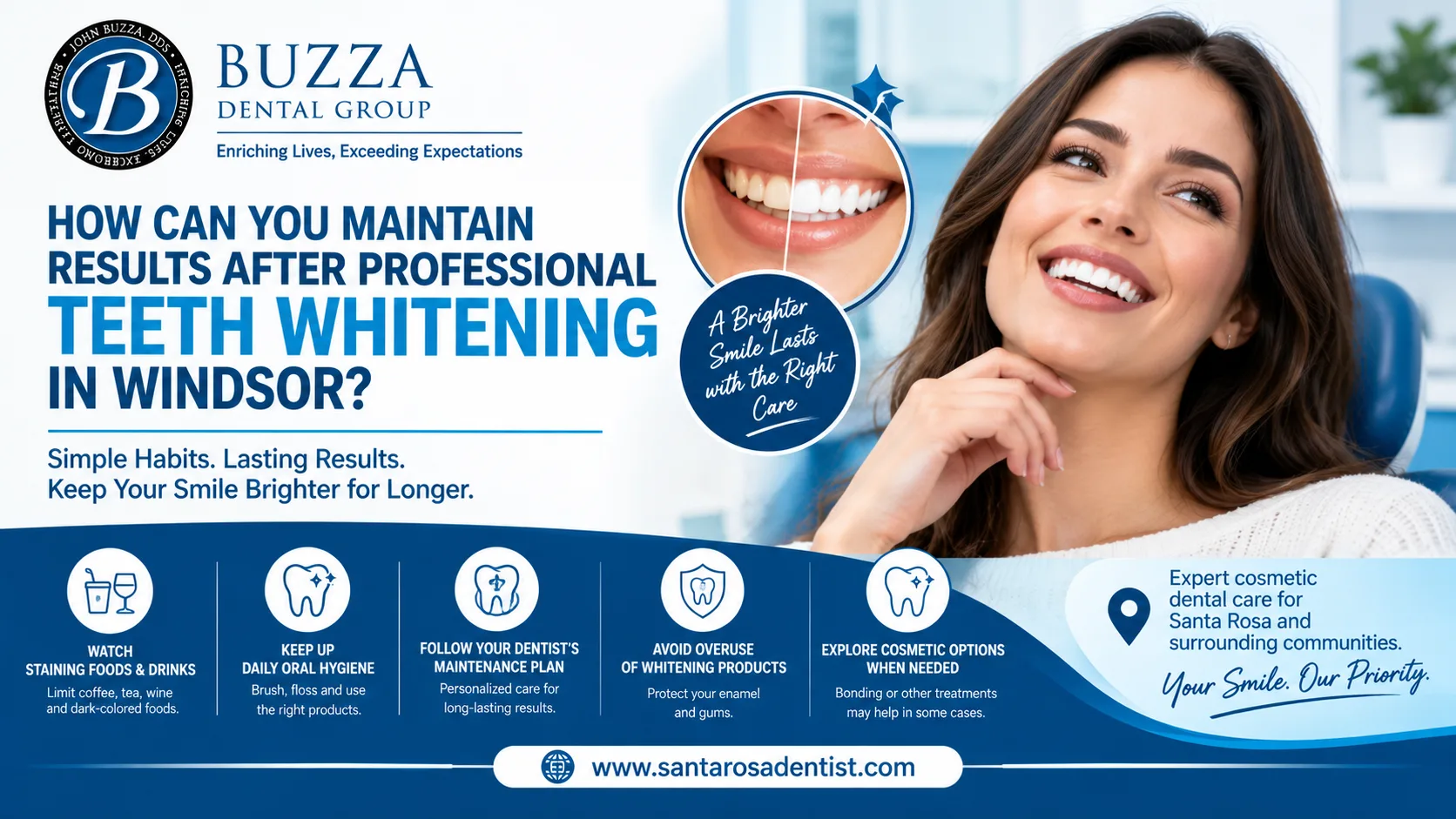
Professional teeth whitening can give your smile a noticeable cosmetic boost, but maintaining that brighter shade depends heavily on what you do afterward. For patients in Windsor and surrounding Sonoma County communities, the goal is not simply to whiten teeth once—it is to minimize new staining, maintain healthy enamel and gums, and know when professional touch-up treatment may be appropriate.
If you are considering Santa Rosa CA teeth whitening, understanding post-whitening care can help you protect your results for longer and avoid habits that accelerate discoloration.
Key Takeaways
- Coffee, tea, red wine, tobacco, and other pigmented foods can contribute to new surface staining.
- Brushing twice daily and cleaning between your teeth help control plaque and surface discoloration.
- Professional whitening results naturally fade over time; maintenance varies by individual.
- Whitening products should be used according to professional or manufacturer instructions rather than excessively.
- Dental bonding may be more appropriate than whitening for certain types of discoloration.
- Regular dental examinations and cleanings can help maintain both oral health and smile appearance.
1. Be Mindful of Foods and Drinks That Stain
One of the most important ways to maintain whitening results is to manage exposure to highly pigmented foods and beverages.
Coffee, tea, red wine, cola, dark berries, and other strongly colored foods and drinks can contribute to extrinsic, or surface-level, tooth staining. Tobacco use can also contribute significantly to discoloration.
You do not necessarily have to eliminate every favorite food or beverage. Instead, consider practical habits such as:
- Drinking water after coffee, tea, or other staining beverages.
- Limiting frequent sipping of highly pigmented drinks throughout the day.
- Maintaining regular brushing and interdental cleaning.
- Avoiding tobacco products.
These habits address the causes of new surface staining without turning your daily routine into a restrictive diet.
2. Maintain Consistent Oral Hygiene
Whitening does not replace preventive dental care. Brushing twice a day with fluoride toothpaste and cleaning between your teeth daily help control plaque and maintain a cleaner tooth surface. The ADA also recommends regular dental visits as part of maintaining oral health.
A whitening toothpaste carrying the ADA Seal of Acceptance may help remove surface stains, although whitening toothpastes generally work by removing surface discoloration rather than changing the underlying intrinsic color of teeth.
The important distinction is that stain removal and bleaching are not the same thing. A toothpaste can help maintain a clean appearance, but it should not be treated as a substitute for professional whitening when deeper discoloration is the concern.
3. Follow Your Dentist's Maintenance Plan
Professional whitening is not necessarily a one-time treatment for a permanently unchanged shade. Buzza Dental Group's whitening information notes that patients may need occasional retreatment to maintain their preferred level of whiteness, with the specific approach depending on individual needs.
Maintenance should therefore be individualized rather than based on a fixed schedule found online.
Your dentist can consider factors such as:
- Your original tooth shade.
- The type and severity of staining.
- Your diet and lifestyle.
- Your sensitivity level.
- The whitening system used.
- Whether you have crowns, veneers, fillings, or bonding.
For patients considering Santa Rosa CA teeth whitening, this individualized approach can be particularly useful when the goal is a natural-looking result rather than simply achieving the lightest possible shade.
4. Do Not Overuse Whitening Products
More whitening does not necessarily mean a better result.
Temporary tooth sensitivity and gum irritation are recognized side effects of whitening, and excessive use of whitening products can increase the risk of irritation or damage. The ADA recommends following product directions and discussing whitening options with your dentist.
If your teeth become noticeably sensitive after whitening, give them time to recover rather than immediately applying additional whitening products. Persistent or significant sensitivity should be evaluated by a dental professional because sensitivity can also be associated with cavities, gum problems, enamel wear, or other dental conditions.
5. Understand What Whitening Can—and Cannot—Change
Whitening works best when discoloration responds to bleaching. However, not every type of tooth discoloration responds equally.
Extrinsic staining from foods, beverages, tobacco, and similar exposures can often be reduced through whitening or professional cleaning. Intrinsic discoloration, which involves changes within the tooth, can be more difficult to address with bleaching alone.
This is where consultation with a cosmetic dentist Santa Rosa can be valuable.
For example, if one tooth remains noticeably darker than the surrounding teeth after whitening, repeating the bleaching treatment may not be the most appropriate solution. Depending on the cause and condition of the tooth, options such as dental bonding or veneers may warrant discussion.
6. Consider Dental Bonding When Whitening Is Not Enough
Dental bonding Santa Rosa patients may consider can address certain cosmetic concerns that whitening cannot adequately correct.
Dental bonding uses tooth-colored composite resin to change the appearance of teeth affected by discoloration, chips, gaps, or uneven shape. Buzza Dental Group describes bonding as a cosmetic option that can be shaped and polished to blend with surrounding teeth.
This can be particularly relevant when a single tooth has discoloration that does not respond adequately to whitening. Rather than repeatedly bleaching the entire smile, your dentist can assess whether localized cosmetic treatment would provide a more balanced result.
Explore dental bonding in Santa Rosa if you want to understand how bonding may complement or serve as an alternative to whitening.
7. Schedule Regular Professional Cleanings
Even excellent home care cannot completely prevent surface buildup. Regular professional cleanings can help remove plaque and external stains while allowing your dentist to monitor your teeth and gums.
This is important because a darker-looking smile is not always a sign that whitening has “worn off.” Surface deposits, new staining, enamel changes, decay, or existing dental restorations can all influence how your smile looks.
Buzza Dental Group provides comprehensive dental care in Santa Rosa and serves patients throughout surrounding Sonoma County communities, including Windsor.
8. Keep Dental Restorations in Mind
Whitening affects natural tooth structure differently from dental restorations. Existing crowns, veneers, fillings, and bonding may not change color in the same way as natural teeth during bleaching. Professional assessment is therefore important if you have several cosmetic restorations and want to change your overall tooth shade.
A Santa Rosa cosmetic dentist can evaluate the relationship between your natural teeth and existing restorations before recommending additional whitening or cosmetic treatment.
For broader smile enhancement, you can also explore cosmetic dentistry in Santa Rosa.
How Long Can Professional Whitening Results Last?
There is no universal expiration date for whitening results. Longevity depends on the original discoloration, oral hygiene, diet, tobacco exposure, and maintenance habits.
Buzza Dental Group notes that occasional retreatment may be used to maintain whitening results, while current dental guidance emphasizes controlling staining habits and maintaining good oral hygiene.
The practical objective is not to keep your teeth permanently at their post-treatment shade. Instead, it is to slow the return of staining and maintain a healthy, natural-looking smile.
Conclusion
Maintaining professional whitening results in Windsor comes down to consistent oral hygiene, sensible management of staining foods and beverages, avoiding tobacco, professional cleanings, and using whitening products responsibly. When discoloration persists despite whitening, a dental evaluation can determine whether another approach—such as bonding or another cosmetic treatment—is more appropriate.
If you are exploring Santa Rosa CA teeth whitening, a personalized assessment can help determine which whitening and maintenance strategy fits your teeth, lifestyle, and long-term smile goals.
FAQs
How can I keep my teeth white after professional whitening?
Maintain twice-daily brushing, clean between your teeth daily, limit frequent exposure to staining foods and beverages, avoid tobacco, and follow your dentist's recommendations for any whitening maintenance.
Can coffee make professionally whitened teeth dark again?
Coffee can contribute to extrinsic tooth staining over time. You do not necessarily need to eliminate coffee, but reducing frequent exposure and rinsing with water afterward can help limit staining.
Should I whiten my teeth every few weeks?
Not automatically. Excessive whitening can contribute to temporary sensitivity and gum irritation. Follow the maintenance schedule recommended by your dentist or the specific product instructions.
What if one tooth stays darker after whitening?
Whitening may not correct every type of discoloration. If an individual tooth remains darker, your dentist can determine whether the cause is intrinsic staining, a restoration, or another dental issue and discuss appropriate cosmetic options.
Can dental bonding replace teeth whitening?
In some cases, yes—but the treatments solve different problems. Whitening changes the color of suitable natural teeth, while bonding uses composite resin to alter the appearance of specific teeth affected by discoloration, chips, gaps, or shape concerns.
Is professional whitening appropriate for everyone?
Not necessarily. A dentist should evaluate your teeth and oral health before treatment, particularly if you have significant sensitivity, cavities, gum problems, restorations, or discoloration that may not respond well to bleaching.