
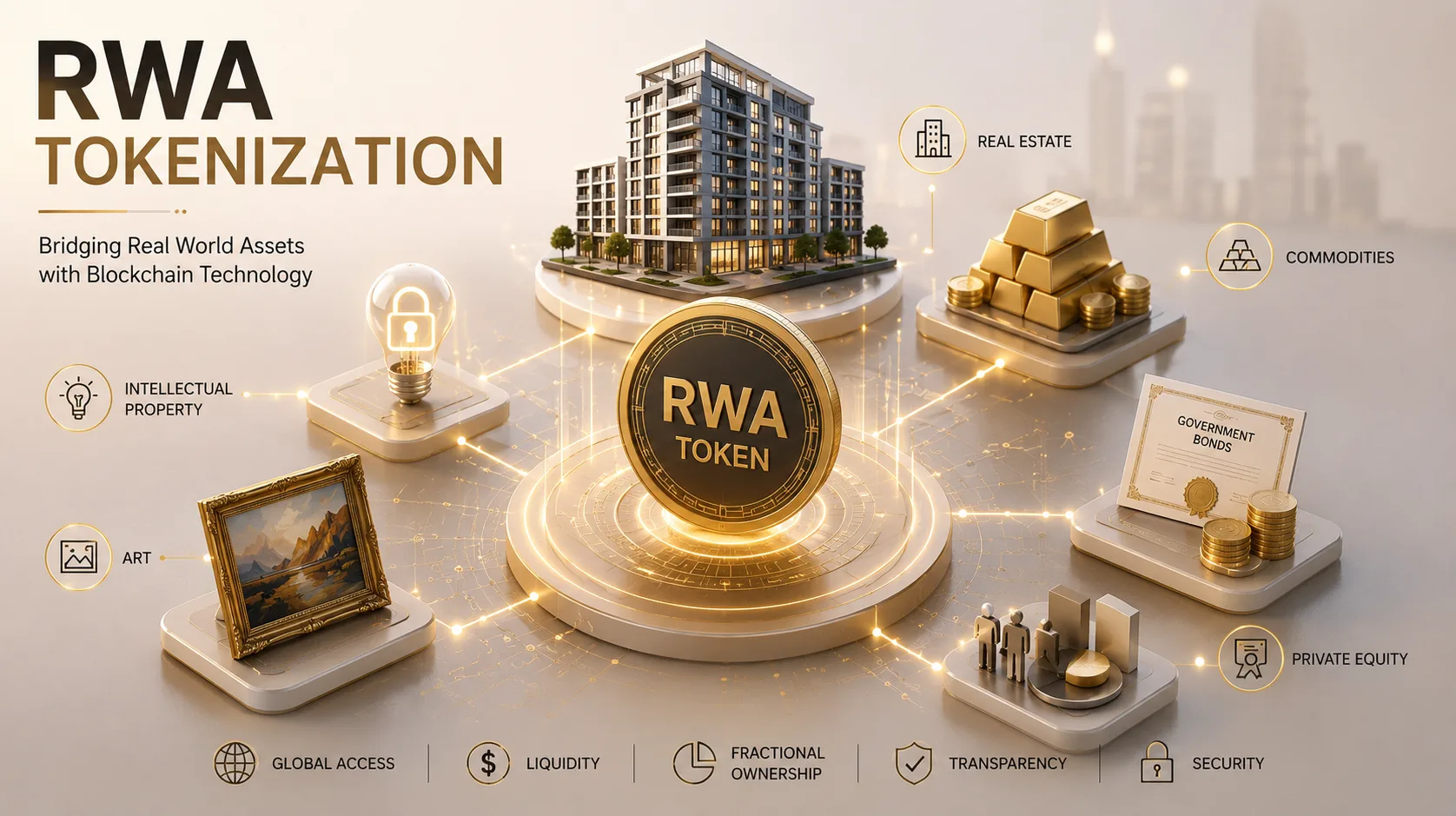
Many valuable economic rights exist inside private contracts rather than on public financial markets. Rental agreements create claims on future rent. Supply contracts create payment obligations. Licensing agreements generate royalty streams. Infrastructure contracts can produce long-term revenues, while private credit agreements establish rights to interest and principal payments.
These contractual rights can have significant economic value, yet they are often difficult to access, transfer, finance, or trade. Real-world asset (RWA) tokenization offers a way to represent these rights digitally and connect them with modern financial infrastructure.
Rather than tokenizing only the physical asset itself, RWA tokenization can focus on the economic rights generated by contractual relationships. This creates new possibilities for financing, fractional participation, automated settlement, and secondary-market development.
What Are Economic Rights Inside Private Contracts?
Economic rights are claims to financial benefits created by a legal agreement. They may exist even when the underlying asset is not directly transferred.
Examples include:
- Rights to rental payments
- Rights to licensing royalties
- Trade receivables
- Interest and principal payments
- Revenue-sharing agreements
- Subscription payments
- Infrastructure concession revenues
- Future purchase payments
- Contractual profit distributions
For example, a company may have a five-year agreement requiring a customer to make monthly payments. The company owns a contractual right to those future payments. That right itself may have economic value. RWA tokenization can create a digital representation of such rights, provided the legal structure permits the rights to be transferred, financed, or otherwise represented through tokens.
How Can RWA Tokenization Unlock These Rights?
1. Identify the Underlying Contract
The process begins by identifying a contract that generates predictable economic value.
This could be a lease, invoice, licensing agreement, loan agreement, supply contract, or infrastructure concession.
The contract must be reviewed carefully to determine:
- Who owns the economic rights?
- Who is obligated to make payments?
- What payments are expected?
- When do payments become due?
- Can the rights be assigned?
- What restrictions apply to transfers?
This legal analysis is critical because tokenization cannot create rights that the original contract does not provide.
2. Verify and Structure the Economic Rights
Once the contract has been identified, the relevant economic rights need to be separated from unrelated contractual obligations. For instance, a property owner might retain ownership of a building while assigning a defined portion of future rental income to a special-purpose vehicle. The SPV could then issue tokens representing claims connected to those contractual cash flows. This structure allows the physical asset and its economic rights to be treated as distinct components.
3. Establish Legal Ownership of the Rights
A token is only useful when its legal connection to the underlying economic right is clearly established.
Depending on the jurisdiction and transaction structure, this may involve:
- Assignment agreements
- SPVs
- Trust structures
- Security interests
- Receivables agreements
- Custody arrangements
The objective is to establish an enforceable connection between the blockchain token and the underlying contractual entitlement.
4. Convert the Rights Into Digital Tokens
After the legal structure is established, the economic rights can be represented through blockchain-based tokens. For example, suppose a portfolio of contracts is expected to generate $10 million in eligible payments over several years. The economic interest could potentially be divided into a defined number of tokens. Each token would represent a specified claim or participation right according to the legal documents. The token itself becomes the digital representation of that economic interest.
5. Connect Smart Contracts With Real-World Cash Flows
Smart contracts can automate portions of the financial relationship.
They can define:
- Distribution schedules
- Token ownership records
- Payment allocation rules
- Redemption conditions
- Transfer restrictions
- Maturity events
However, blockchain infrastructure cannot automatically determine whether an off-chain payment has occurred. Reliable data providers, payment systems, custodians, or oracles may therefore be required to connect real-world events with on-chain execution.
Major Use Cases for Contract-Based RWA Tokenization
Tokenized Rental Income
Property owners can potentially tokenize defined rights to future rental payments rather than selling the underlying property.
Investors receive exposure to rental cash flows while the property remains within the established ownership structure.
Tokenized Trade Receivables
Businesses can convert eligible invoices or receivables into digital assets. This can help them access financing before customers make their contractual payments.
Tokenized Royalties
Artists, pharmaceutical companies, software developers, and other IP owners can potentially tokenize defined royalty rights.
Investors receive exposure to future licensing income based on the applicable legal structure.
Tokenized Private Credit
Loans and private debt agreements contain contractual rights to interest and principal payments. These rights can potentially be represented through tokenized financial instruments.
This could expand access to private credit markets while improving transparency around ownership and payment obligations.
Infrastructure Revenue
Infrastructure projects often operate under long-term contracts that generate predictable revenue.
Examples include renewable energy purchase agreements, transportation concessions, and utility contracts. Tokenization can potentially connect these future revenues with external capital.
How Tokenization Creates New Liquidity
One of the biggest opportunities is converting traditionally static contractual rights into more transferable digital instruments.
A company waiting for payments over several years may have substantial future revenue but limited current liquidity.
Tokenization can potentially allow the company to structure those future cash flows into an investable instrument and receive capital upfront.
Investors, meanwhile, gain exposure to a defined stream of contractual income.
This creates a financial bridge:
Future contractual cash flows → Tokenized economic rights → Investor capital today
The result can be more efficient capital deployment without requiring the underlying physical asset to be sold outright.
Fractionalization of Contractual Rights
Private contracts can represent large economic interests that are inaccessible to smaller investors.
Tokenization can divide those interests into smaller units, subject to applicable securities and financial regulations.
For example, rather than one investor acquiring an entire $5 million receivables portfolio, the economic interest could potentially be divided among multiple eligible investors.
Fractionalization can therefore expand the potential investor base while allowing asset owners to raise capital more efficiently.
Greater Transparency and Auditability
Private contracts are typically managed through documents, spreadsheets, databases, and centralized reporting systems.
Tokenization can introduce a transparent digital record of:
- Token ownership
- Transfers
- Distribution events
- Outstanding balances
- Maturity dates
- Redemption activity
This does not make the underlying contract automatically transparent. Confidential contractual information may remain private. Instead, blockchain can provide a controlled and auditable record of the tokenized economic interest.
Programmable Economic Rights
One of the most powerful features of tokenization is programmability.
Unlike conventional records of ownership, tokens can contain rules governing how economic rights operate.
For example, a tokenized revenue structure could automatically allocate incoming payments between different investor classes.
A structure might include:
Senior investors → Priority distributions → Junior investors → Residual distributions
Smart contracts can execute these predefined rules when verified payment events occur.
This creates opportunities for more sophisticated financial products built around real-world contractual cash flows.
Challenges of Unlocking Contractual Economic Rights
Legal Enforceability
The biggest challenge is ensuring that token holders actually possess enforceable rights.
A blockchain transaction does not override contract law. The legal agreement must establish what the token represents and what happens if contractual obligations are breached.
Transfer Restrictions
Some contracts prohibit assignment or transfer without the counterparty's consent. These restrictions can limit the ability to tokenize the associated economic rights.
Regulatory Classification
Tokenized contractual rights may qualify as securities, debt instruments, investment contracts, or other regulated financial products.
Compliance requirements must therefore be assessed before offering tokens to investors.
Counterparty Risk
Tokenization does not remove the risk that the party responsible for making payments could default.
If a tenant, borrower, customer, or licensee fails to pay, token holders may experience reduced or delayed returns.
Data Verification
Blockchain can verify what has been recorded on-chain, but it cannot independently confirm every real-world event.
Reliable data infrastructure is therefore essential.
Liquidity Risk
Tokenization creates transferability, but transferability does not guarantee liquidity. A secondary market still requires sufficient buyers, sellers, regulatory access, and market infrastructure.
RWA Tokenization as a Bridge Between Contracts and Capital Markets
The broader significance of contract-based tokenization is that it can transform how financial markets view private economic rights.
Traditional financial systems often focus on standardized securities. Blockchain infrastructure makes it technically easier to represent a wider range of contractual claims digitally.
This could expand the universe of assets that can interact with capital markets.
Instead of asking only:
“Can this physical asset be tokenized?”
financial institutions can increasingly ask:
“What economic rights does this asset generate, and can those rights be structured into an investable digital instrument?”
That shift expands the scope of RWA tokenization beyond physical ownership.
The Future of Contract-Based RWA Tokenization
As legal frameworks, token standards, custody infrastructure, and blockchain interoperability improve, contractual economic rights could become an increasingly important category of tokenized assets.
Future platforms may combine blockchain records with AI-based risk assessment, automated contract analysis, real-time payment data, and compliance systems.
This could make it easier to evaluate and structure portfolios of contractual cash flows across multiple industries.
Real estate, trade finance, private credit, intellectual property, infrastructure, and corporate finance could all benefit from this development.
The result could be a financial ecosystem in which previously fragmented contractual rights become easier to identify, structure, finance, and manage.
Conclusion
RWA tokenization can unlock economic value that already exists inside private contracts by creating a digital representation of defined contractual rights. Rental income, receivables, royalties, interest payments, and infrastructure revenues can potentially be transformed into structured digital financial instruments.
The opportunity lies not simply in putting contracts on a blockchain but in creating a legally enforceable connection between off-chain economic rights and on-chain assets.
When supported by appropriate legal structures, regulatory compliance, reliable data, and secure blockchain infrastructure, contract-based RWA tokenization could create new pathways for liquidity and capital formation.
Ultimately, the next phase of asset tokenization may focus less on tokenizing what an asset is and more on tokenizing what an asset is contractually capable of generating.