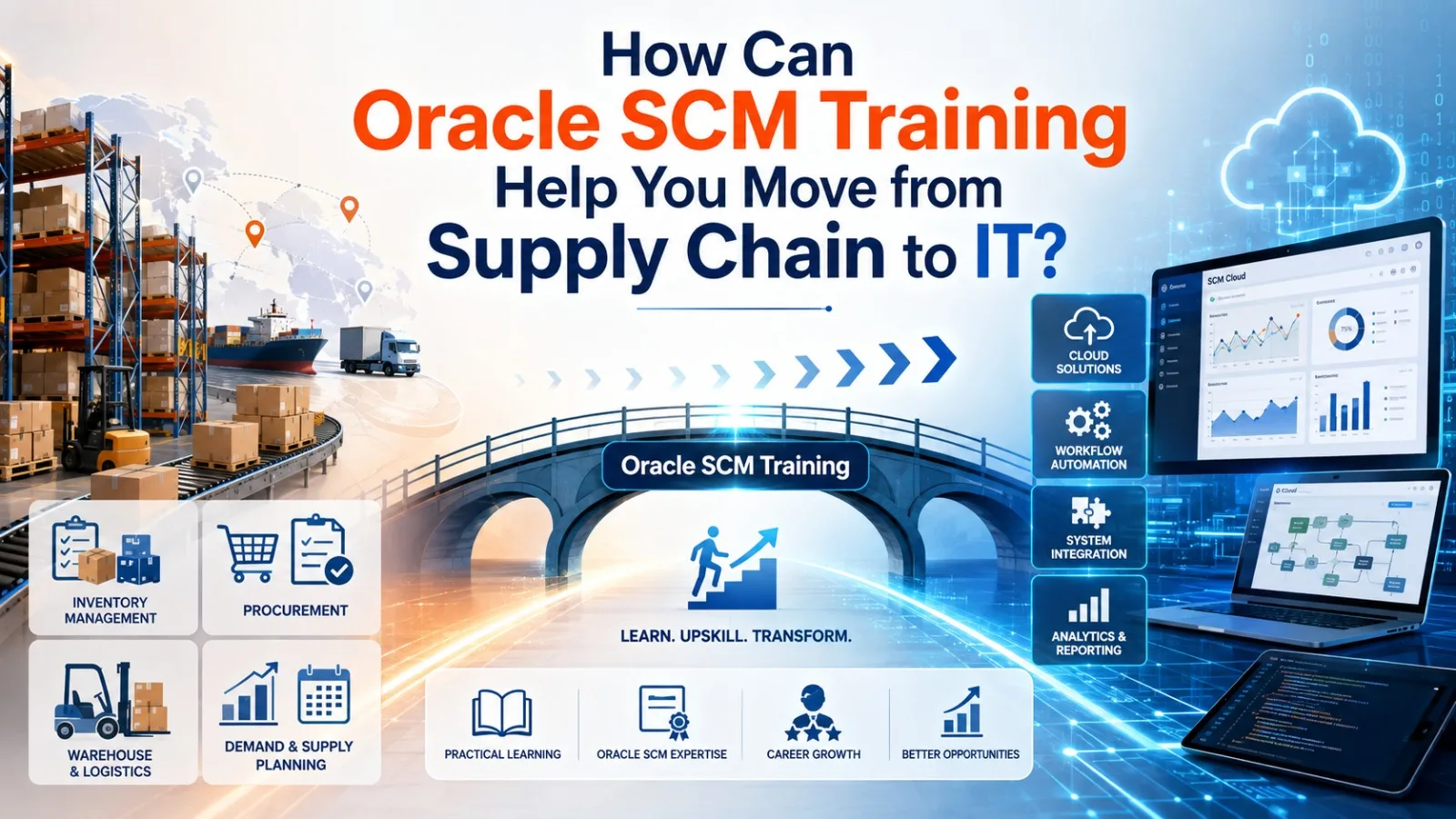
Moving from a traditional supply chain role into IT can be a strong career opportunity for professionals with experience in procurement, inventory, logistics, order management, and planning. Instead of starting from zero, your existing domain knowledge can become a valuable foundation for learning cloud-based ERP technology. Tech Leads IT helps learners develop practical knowledge of Oracle Fusion SCM concepts, business processes, configuration, and implementation. Through Fusion SCM Training, professionals can understand how real-world supply chain activities are managed through Oracle applications. Oracle Fusion SCM Online Training provides a flexible way to learn these concepts, while Oracle Fusion SCM Cloud Online Training focuses on modern cloud ERP environments. An Oracle Fusion SCM Course can help learners build the functional and technical understanding needed to explore roles such as Oracle SCM Functional Consultant, Business Analyst, or Implementation Consultant.
Why Move from Supply Chain to IT?
A traditional supply chain career can involve activities such as purchasing materials, managing vendors, monitoring inventory, processing orders, coordinating logistics, planning demand, and supporting warehouse operations. These activities are essential to business operations, but modern organizations increasingly perform them through integrated enterprise applications.
Companies use ERP systems to connect different departments and automate business processes. Instead of maintaining separate systems for procurement, inventory, finance, sales, and logistics, organizations can use platforms such as Oracle Fusion Cloud Applications to create connected workflows.
This creates an opportunity for supply chain professionals.
Suppose you have five years of experience in procurement. You already understand purchase requisitions, purchase orders, suppliers, approvals, receiving, and invoice-related processes. If you learn how these processes are represented and configured inside Oracle Fusion SCM, you can potentially move from performing the process manually to helping organizations implement and support the technology behind that process.
The transition therefore does not necessarily mean abandoning your previous experience.
Instead, you are adding technology knowledge to your existing business knowledge.
This combination can be particularly useful because implementation projects require professionals who can communicate with business users while also understanding the ERP application.
How Oracle Fusion SCM Training Builds a Bridge Between Supply Chain and IT
Oracle Fusion SCM Training can act as a bridge between supply chain domain knowledge and enterprise technology skills.
A supply chain professional already understands the "business side" of the process. Training introduces the "application side."
For example, consider procurement.
A supply chain professional may understand:
- How suppliers are selected
- How purchase requisitions are created
- How purchase orders are processed
- How approvals work
- How goods are received
- How supplier performance is monitored
- How purchasing problems affect operations
Oracle SCM training can help the professional understand how these activities are handled inside the Oracle application.
This may include understanding:
- Enterprise structures
- Procurement configuration
- Requisitions
- Purchase orders
- Suppliers
- Approval workflows
- Receiving
- Inventory transactions
- Security
- Reporting
- Business process flows
- Testing and implementation activities
This combination creates a powerful profile: someone who understands supply chain operations and can also work with an enterprise application.
That is one of the main reasons Oracle SCM can be an attractive transition path for supply chain professionals who want to enter IT.
What Is Oracle Fusion SCM and Why Does It Matter?
Oracle Fusion SCM is part of Oracle's cloud application ecosystem and focuses on managing supply chain processes across an organization.
The platform brings together multiple supply chain functions so organizations can manage processes through an integrated system.
Depending on the organization's requirements, professionals may work with areas such as:
- Procurement
- Inventory Management
- Order Management
- Product Management
- Manufacturing
- Supply Planning
- Cost Management
- Maintenance
- Logistics
- Warehouse-related processes
The exact responsibilities of a consultant depend on the implementation and the modules involved.
For a supply chain professional, this is important because many of the concepts are already familiar from the business side.
For example, someone working in procurement may already know what a purchase order is. Someone working in inventory may already understand stock transfers and receipts. Someone working in logistics may understand shipment processes.
Oracle SCM provides a technology environment where these real-world processes are managed.
Learning the application allows professionals to understand how business requirements are translated into system processes.
How Oracle Fusion SCM Online Training Can Help Working Professionals
Many supply chain professionals are already employed full-time, so leaving a job to learn a new technology may not be practical.
Oracle Fusion SCM Online Training can provide a flexible learning approach for professionals who want to develop technology skills while continuing their existing careers.
Online learning can allow learners to study concepts, attend sessions, practice scenarios, and review difficult topics according to their availability.
However, the effectiveness of online training depends heavily on how the learner approaches it.
Simply watching classes is not enough.
A professional trying to move from supply chain to IT should focus on understanding the relationship between business processes and application functionality.
For every topic, ask questions such as:
- What business problem does this feature solve?
- Which supply chain process does it support?
- Who uses this functionality?
- What happens before and after the transaction?
- What configuration is required?
- What happens if the process fails?
- How would a consultant troubleshoot the issue?
- How would I explain this process to a business user?
This approach makes learning more practical and prepares learners for real project situations.
Oracle Fusion SCM Cloud Online Training and the Shift to Cloud ERP
The move toward cloud-based enterprise applications has changed how organizations implement and manage ERP systems.
Oracle Fusion SCM Cloud Online Training can help learners understand supply chain management in a modern cloud ERP environment rather than focusing only on traditional on-premises ERP concepts.
Cloud applications are designed around standardized processes, continuous updates, integrations, security, reporting, and configurable business functionality.
For professionals moving into IT, this means they need to understand more than individual screens.
They should understand the overall application architecture at a functional level, business flows, integrations between modules, roles and security, data movement, reporting, and testing.
For example, a sales order can affect inventory availability, fulfillment, shipping, invoicing, and financial processes. A procurement transaction can involve suppliers, receiving, inventory, accounts payable, and financial accounting.
Understanding these connections helps a learner think like an ERP consultant rather than simply an application user.
What You Can Learn in an Oracle Fusion SCM Course
An Oracle Fusion SCM Course should ideally provide a structured understanding of both supply chain concepts and Oracle application functionality.
The exact syllabus can vary, but learners should look for important areas such as:
1. Enterprise Structures
Before configuring business processes, learners need to understand how organizations are represented in Oracle.
Important concepts may include:
- Legal entities
- Business units
- Ledgers
- Locations
- Inventory organizations
- Procurement business functions
Understanding enterprise structures is important because many application processes depend on how an organization is configured.
2. Procurement
Procurement is one of the most important areas for supply chain professionals.
Learners can explore:
- Requisitions
- Purchase orders
- Suppliers
- Supplier sites
- Procurement catalogs
- Approvals
- Receiving
- Purchasing processes
Someone with procurement experience can connect these application concepts to real business situations.
3. Inventory Management
Inventory is another major SCM area.
Training may cover:
- Inventory organizations
- Subinventories
- Items
- On-hand quantities
- Receipts
- Transfers
- Inventory transactions
- Stock management
Understanding inventory processes helps learners see how physical supply chain activities are represented digitally.
4. Order Management
Order Management connects sales orders with fulfillment activities.
Learners can understand:
- Order capture
- Order orchestration
- Scheduling
- Fulfillment
- Shipping
- Order status
- Exceptions
This can be especially useful for professionals with order processing or logistics experience.
5. Product Management
Product information is fundamental to supply chain operations.
Learners may study:
- Items
- Item classes
- Categories
- Item attributes
- Product structures
- Lifecycle concepts
This area demonstrates how product information is managed centrally within an enterprise system.
6. Supply Planning
Supply planning helps organizations determine how to meet demand while managing resources and inventory.
Learners can explore concepts related to:
- Demand
- Supply
- Planning
- Forecasting
- Replenishment
- Exceptions
- Planning recommendations
Professionals with planning experience can often relate these concepts directly to their existing responsibilities.
Can Supply Chain Experience Give You an Advantage in Oracle SCM?
Yes, domain knowledge can be a significant advantage.
Imagine two candidates applying for a junior Oracle SCM functional position.
Candidate A has basic IT knowledge but no supply chain experience.
Candidate B has several years of procurement experience and has learned Oracle SCM.
Candidate B may have an advantage in understanding business requirements because they already know how procurement works in practice.
For example, if a client says:
"We need an approval process for high-value purchase orders."
A supply chain professional may immediately understand why approval thresholds exist and what business risks they address.
The Oracle knowledge then helps translate that requirement into an application solution.
This is the value of combining domain expertise with technology expertise.
The goal is not necessarily to become a programmer.
Instead, many functional SCM roles require professionals to understand business processes, application configuration, testing, documentation, troubleshooting, and communication with technical teams.
Which IT Roles Can You Target After Oracle SCM Training?
After developing sufficient knowledge and practical experience, supply chain professionals can explore several technology-oriented career paths.
Oracle SCM Functional Consultant
Functional consultants work closely with business requirements and Oracle application functionality.
Typical responsibilities may include:
- Requirement gathering
- Process analysis
- Application configuration
- Testing
- Documentation
- User support
- Issue analysis
- Training users
- Implementation support
Oracle SCM Business Analyst
A business analyst focuses heavily on understanding business requirements and translating them into technology requirements.
Your supply chain background can be particularly useful here because you already understand operational challenges.
Oracle SCM Implementation Consultant
Implementation consultants can support organizations during Oracle ERP implementations.
Responsibilities may include:
- Requirement analysis
- Solution design
- Configuration
- Testing
- Data-related activities
- User training
- Go-live support
- Post-production support
Oracle SCM Support Consultant
Support professionals help organizations resolve application issues after implementation.
For example, users may report problems related to purchasing, inventory, orders, receiving, or approvals.
A consultant investigates the issue, identifies the root cause, and works toward a solution.
ERP Functional Analyst
Some organizations use broader ERP roles where professionals support multiple business functions.
Oracle SCM knowledge can provide a foundation for such positions, especially when combined with strong business process knowledge.
How to Develop IT Skills Alongside SCM Knowledge
Learning Oracle SCM should not be treated as memorizing application terminology.
To successfully move into IT, you should gradually develop several additional skills.
Business Process Analysis
Learn how to document a business process from beginning to end.
For example:
Requirement → Requisition → Approval → Purchase Order → Receipt → Invoice → Payment
Understanding the complete flow helps you identify where problems occur.
Configuration Knowledge
Understand why specific setup decisions are required and how configuration affects business processes.
Testing Skills
Learn how to create test scenarios.
A good consultant should be able to test:
- Positive scenarios
- Negative scenarios
- Approval scenarios
- Exception scenarios
- Integration-related scenarios
Documentation
Learn to create functional documents, process documents, test scripts, and requirement descriptions.
Communication
IT consulting involves communication with clients, business users, developers, testers, and project managers.
Being able to explain a technical concept in simple business language is extremely valuable.
Practical Scenarios You Should Learn During Oracle Fusion SCM Training
If your goal is career transition, scenario-based learning should be a major part of your preparation.
For example, imagine a company wants to automate procurement approvals.
Instead of only learning the definition of an approval workflow, understand the business scenario.
A purchase requisition is created by an employee. The request is submitted for approval. Depending on the amount, department, or business rules, it may go to one or multiple approvers. Once approved, the purchasing process continues.
Now ask:
- What if the approver rejects the request?
- What if the approver is unavailable?
- What if the amount exceeds a specific threshold?
- What if the supplier is inactive?
- What if receiving is not completed?
- What happens when the transaction fails?
These questions help develop consultant-level thinking.
Another scenario could involve inventory.
Suppose a warehouse receives goods but the expected quantity does not match the received quantity.
A functional consultant should understand the business impact and know where to investigate the application process.
This type of practical thinking is more valuable than memorizing definitions.
From Supply Chain User to Oracle SCM Consultant: What Changes?
The biggest change is the type of responsibility you handle.
A supply chain user may execute transactions.
An Oracle SCM consultant helps design, configure, test, support, or improve the system through which those transactions are performed.
For example:
Supply Chain User: Creates purchase orders.
Oracle SCM Consultant: Helps determine how purchase orders should be created, approved, processed, tested, and supported in Oracle.
Similarly:
Supply Chain User: Tracks inventory.
Oracle SCM Consultant: Helps configure and support inventory processes and investigates application issues affecting inventory transactions.
This shift from "using the process" to "understanding and supporting the system behind the process" is the core of the transition.
How to Build a Career Transition Roadmap
Moving from supply chain to IT should be treated as a gradual process.
Step 1: Identify Your Existing Domain Strength
Determine your strongest supply chain area.
It could be:
- Procurement
- Inventory
- Logistics
- Order Management
- Planning
- Manufacturing
- Warehouse Operations
Use that experience as your starting point.
Step 2: Learn Oracle Fusion SCM Fundamentals
Start with the overall Oracle SCM ecosystem before focusing heavily on configuration.
Understand the major modules and how they connect.
Step 3: Select a Primary Functional Area
Do not try to master every SCM module immediately.
If your background is procurement, start with Procurement.
If your background is inventory, begin with Inventory Management.
If your background is logistics, explore Order Management and related fulfillment processes.
Step 4: Learn End-to-End Business Flows
Understand how transactions move across modules.
For example, procurement may interact with receiving, inventory, and finance.
This gives you a broader ERP perspective.
Step 5: Practice Scenarios
Create realistic business cases and try to solve them.
Step 6: Learn Testing and Troubleshooting
Develop the ability to identify why a transaction is not behaving as expected.
Step 7: Build Interview Knowledge
Prepare for questions related to both your previous supply chain experience and Oracle SCM.
Interviewers may ask:
- Why do you want to move from supply chain to IT?
- Why did you choose Oracle SCM?
- How does your domain experience help you as an SCM consultant?
- Explain a procurement flow.
- What is an inventory organization?
- How does order management work?
- How would you troubleshoot a transaction issue?
- How would you gather requirements from a client?
Your answers should connect business experience with Oracle knowledge.
How Oracle Fusion SCM Training Can Improve Your Career Profile
One of the biggest benefits of learning Oracle SCM is that it can help create a hybrid professional profile.
Instead of presenting yourself only as a supply chain professional, you can position yourself as someone with:
Supply Chain Domain Knowledge + Oracle Cloud ERP Knowledge + Functional Consulting Skills
This combination can be useful in implementation, support, business analysis, and ERP transformation projects.
However, training itself does not guarantee a job.
Professionals need to combine training with practical learning, project scenarios, communication skills, interview preparation, and continuous development.
Employers typically look for people who can understand requirements and contribute to solving business problems rather than simply listing a training certificate on a resume.
Common Mistakes to Avoid When Moving from Supply Chain to IT
Trying to Learn Everything at Once
Oracle SCM is broad. Trying to master every module immediately can create confusion.
Start with one functional area and gradually expand.
Focusing Only on Definitions
Knowing definitions such as business unit, inventory organization, supplier, and purchase order is not enough.
Understand how these concepts work in real business scenarios.
Ignoring Your Previous Experience
Your supply chain background is an asset.
Do not present yourself as someone with no experience simply because you are new to IT.
Instead, explain how your domain experience supports your Oracle SCM knowledge.
Avoiding Hands-On Practice
Watching training videos without practicing scenarios can make interviews difficult.
Try to understand transaction flows and configuration concepts through practical exercises.
Expecting an Immediate Career Change
Moving from supply chain to IT requires consistent learning.
You may need time to build confidence, understand Oracle terminology, practice scenarios, and prepare for interviews.
A structured approach is more effective than trying to learn everything quickly.
Is Oracle Fusion SCM Online Training Suitable for Freshers and Experienced Supply Chain Professionals?
Both groups can benefit, but their learning approaches may be different.
A fresher needs to build both supply chain and Oracle fundamentals.
An experienced supply chain professional already has domain knowledge, so the focus can be more heavily placed on Oracle application functionality, implementation concepts, configuration, testing, and consulting skills.
For example, a procurement professional may already understand supplier management and purchasing operations. The learning objective is therefore to understand how these processes are handled within Oracle Fusion SCM.
This can potentially reduce the conceptual gap between supply chain operations and IT.
How to Make Your Oracle Fusion SCM Course More Career-Oriented
Choosing a course is only the beginning.
To make an Oracle Fusion SCM Course career-oriented, learners should supplement formal training with practical activities.
Create your own business scenarios.
For example:
Scenario 1: Procurement
A company wants purchase requests above a certain value to go through additional approval.
Understand the requirement, process flow, approval logic, testing requirements, and possible exceptions.
Scenario 2: Inventory
A company has multiple warehouses and needs to transfer stock between locations.
Understand the business requirement and transaction flow.
Scenario 3: Order Management
A customer places an order, but the required item is unavailable.
Understand how order fulfillment and exceptions may be handled.
Scenario 4: Supplier Management
A company wants to standardize supplier information.
Explore how supplier-related processes can be managed within Oracle.
These scenarios help you develop the mindset of a consultant.
Conclusion
Moving from supply chain to IT does not mean starting your career from scratch. Your experience in procurement, inventory, logistics, order management, and planning can provide a strong foundation for building an Oracle career. Through Oracle Fusion SCM Training, professionals can develop practical knowledge of enterprise applications, business processes, configuration, testing, and functional consulting. Tech Leads IT helps learners connect their existing supply chain expertise with cloud ERP technology through practical scenarios and career-focused learning. Oracle Fusion SCM Online Training and Oracle Fusion SCM Cloud Online Training can offer a flexible way to build relevant Oracle skills while continuing your current career. An Oracle Fusion SCM Course can provide structured learning, but consistent practice and understanding real-world business requirements are essential. By combining supply chain experience with Oracle SCM knowledge, professionals can confidently work toward functional consultant, business analyst, and other Oracle SCM-focused IT roles.