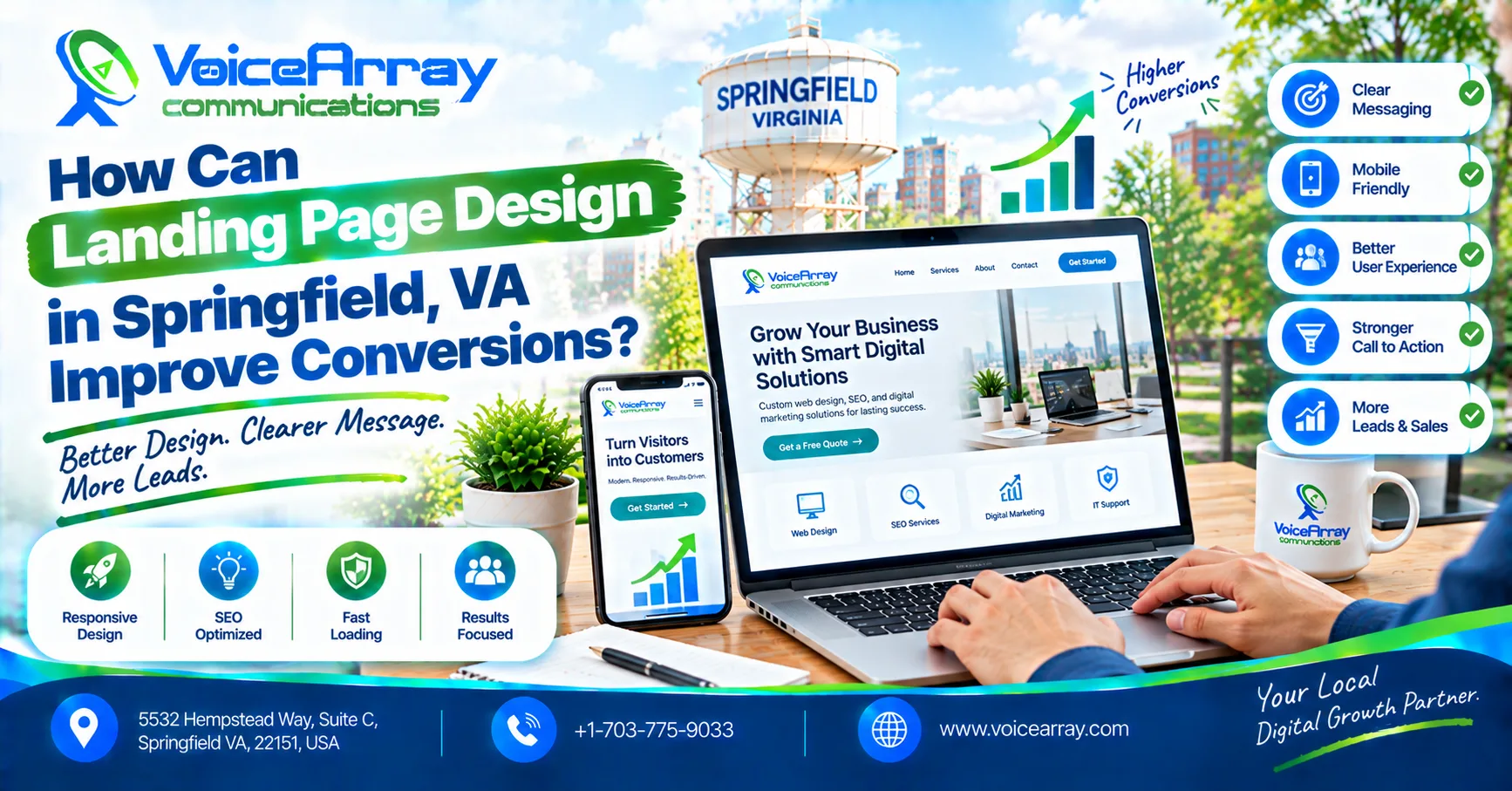
A business website can attract visitors without generating the inquiries, purchases, or appointments the company expects. Sometimes the problem is not the amount of traffic but what happens after visitors arrive. A confusing message, unclear call to action, slow-loading page, or complicated form can prevent potential customers from taking the next step.
Landing page design helps businesses create focused web pages that guide visitors toward a specific action. For businesses in Springfield, Virginia, a well-planned landing page can support marketing campaigns, communicate a service's value, and make it easier for prospective customers to contact the business.
Whether a company is promoting IT support, professional services, ecommerce products, or digital marketing, an effective landing page combines relevant content, thoughtful design, usability, and measurable goals.
What Is a Landing Page?
A landing page is a web page designed around a particular campaign, offer, product, service, or conversion goal. Visitors may arrive through paid advertising, organic search, email campaigns, social media, or links from other websites.
Unlike a general homepage that introduces a business and provides multiple navigation options, a campaign landing page typically focuses on a more specific audience and action.
Examples include:
- A service page encouraging visitors to request a consultation
- A campaign page offering a quote or assessment
- A product page promoting a particular item
- An event page collecting registrations
- A lead-generation page offering a downloadable resource
The most suitable structure depends on the visitor's intent and the action the business wants them to complete.
1. Create a Clear and Relevant Headline
The headline is one of the first elements visitors notice. It should quickly explain what the page offers and why the information is relevant to them.
A vague headline may leave visitors uncertain about the product or service. A specific headline helps establish the page's purpose and connects the offer with the audience's needs.
For example, a local IT company could use a headline that clearly describes its business IT support offering instead of relying on a generic phrase such as “Better Solutions for Your Business.”
The headline should match the message that brought the visitor to the page. If someone clicks an advertisement for a particular service, the landing page should immediately address that service rather than introduce an unrelated offer.
2. Match the Page to the Visitor's Search Intent
Visitors arrive with different expectations. Someone searching for service pricing may want cost information, while someone comparing providers may be looking for expertise, deliverables, and trust signals.
Landing page design should reflect these differences.
Before creating a page, identify:
- The intended audience
- The problem the visitor wants to solve
- The offer or service being promoted
- The questions the visitor is likely to have
- The next action the visitor should take
For Springfield businesses, local context can be useful when the service genuinely relates to the area. Accurate service-area information, relevant local examples, and clear contact details can help visitors determine whether a business is a suitable option.
However, inserting location keywords without useful context will not automatically improve conversion rates or search visibility.
3. Use a Strong and Specific Call to Action
A call to action (CTA) tells visitors what to do next. Examples include requesting a quote, booking a consultation, contacting the business, or completing a purchase.
An effective CTA should be easy to identify and clearly related to the page's goal.
Consider these practices:
- Use descriptive wording rather than vague labels.
- Make buttons easy to locate and tap.
- Provide sufficient contrast between buttons and surrounding content.
- Place a relevant CTA near important decision points.
- Explain what happens after the visitor submits a form.
- Avoid presenting too many competing actions at once.
For a service business, “Request a Quote” may be more useful than a generic “Click Here” button. For an online store, a purchase-oriented CTA may be appropriate when visitors already have enough product information to make a decision.
The CTA should set accurate expectations. Avoid promising an immediate response or a guaranteed result unless the business can reliably deliver it.
4. Build Trust With Relevant Evidence
Visitors may hesitate to submit their information or make a purchase if they do not trust the business. Landing pages can reduce uncertainty by providing genuine, relevant evidence that supports the company's credibility.
Depending on the business, useful trust elements may include:
- Authentic customer testimonials used with permission
- Relevant case studies with accurate results
- Clear service descriptions and deliverables
- Professional business contact information
- Transparent pricing or an explanation of the quote process
- Relevant qualifications or certifications
- A clear privacy notice near forms where appropriate
Trust signals should be truthful and verifiable. Invented reviews, misleading statistics, and unsupported guarantees can damage customer confidence rather than improve it.
For Springfield businesses, accurate business details and a clear explanation of the service area can also help prospective customers understand who they are dealing with.
5. Simplify Forms and Reduce Unnecessary Friction
Forms are often an important part of lead-generation landing pages. However, asking visitors for too much information can discourage them from completing the process.
Collect only the information needed for the next business step. A simple consultation request may require a name, contact method, and brief description of the visitor's needs rather than a long list of unnecessary questions.
Form improvements may include:
- Clear field labels and instructions
- Logical field order
- Helpful validation messages
- Mobile-friendly input controls
- A visible privacy notice where appropriate
- A clear confirmation after successful submission
Test forms on mobile devices as well as desktop computers. A form that looks good on a large screen may become frustrating when users need to scroll through crowded fields on a phone.
6. Improve Mobile Usability and Page Speed
Visitors may access landing pages from smartphones, tablets, or desktop computers. A page should adapt to different screen sizes while preserving readability and functionality.
Important mobile design considerations include legible text, appropriately sized buttons, flexible layouts, and forms that are easy to complete with touch input.
Performance matters too. Large images, unnecessary scripts, excessive animations, and poorly configured third-party tools can delay page loading or interaction.
Businesses should optimize image sizes, reduce unnecessary code, review tracking scripts, and test representative landing pages. Tools such as Google PageSpeed Insights can help identify performance issues, while analytics can show where visitors abandon the journey.
A visually impressive page is not effective if its design makes it slow or difficult to use.
7. Use Visuals That Support the Message
Images, illustrations, product screenshots, and diagrams can help visitors understand an offer. However, visuals should support the page's purpose rather than distract from it.
Choose images that are relevant to the service or product. Keep layouts organized, maintain a consistent visual hierarchy, and avoid filling the page with decorative elements that compete with the main CTA.
For example, a technology company might use a relevant product interface or a clear illustration of its service process. An ecommerce business may prioritize product images that help customers evaluate the item.
Ensure that visual content is optimized for performance and that meaningful images have suitable alternative text for accessibility.
8. Align Landing Pages With SEO and Advertising Campaigns
Landing pages often support both paid and organic marketing. The optimization approach should reflect the source of traffic and the page's purpose.
For paid campaigns, the landing page should closely match the advertisement's message, offer, and audience. This helps visitors find the information they expected after clicking.
For organic search, the page should address a clear search intent and provide useful, original information. Relevant headings, descriptive metadata, sensible internal links, and an accessible page structure can support search engines in understanding the content.
Local landing pages should provide genuine value to the geographic audience. A Springfield-focused page, for instance, should explain relevant service availability or local business needs rather than simply repeating the city name throughout the content.
Search rankings and advertising performance depend on multiple factors. Landing page design alone cannot guarantee a specific ranking, advertising cost, or conversion rate.
9. Test and Improve the Page Over Time
Landing page optimization should be an ongoing process rather than a one-time design task.
Track meaningful actions, such as completed forms, qualified leads, purchases, and booked consultations. Where appropriate, compare these outcomes with traffic sources, device types, and campaign performance.
A/B testing can help compare two versions of a page element, such as a headline, CTA, or form layout. Each test should focus on a clear hypothesis and use enough data to support a useful conclusion.
Avoid changing too many elements simultaneously if you want to understand which change influenced the result. Also consider lead quality: a page that generates more form submissions is not necessarily better if those submissions are irrelevant to the business.
Why Landing Page Design Matters for Springfield, VA Businesses
Businesses in Springfield may compete for customers across different industries, including professional services, IT support, retail, home services, and digital marketing. A focused landing page helps explain a particular offer to the right audience and provides a clear route to the next step.
A local service provider might use a landing page to generate consultation requests, while an online retailer could promote a specific product category or seasonal offer. The design and content should reflect the audience's needs, the campaign's purpose, and the business's ability to fulfill the offer.
Businesses serving Northern Virginia or the wider Virginia market should also make service-area claims accurate and ensure that each page has a clear purpose.
How Voice Array Can Fit Into Your Digital Marketing Plans
Voice Array provides digital marketing and business technology-related services. Businesses evaluating landing page design or broader digital marketing support can visit Voice Array to review its available services and determine whether they align with their requirements.
Before choosing a provider, discuss your target audience, campaign goals, existing website, required integrations, tracking needs, and expectations for reporting. A clear scope can help ensure the page is built around measurable business objectives.
Final Thoughts
Landing page design in Springfield, VA can improve conversions by clarifying the offer, building trust, simplifying forms, improving mobile usability, and guiding visitors to the next step.
The strongest landing pages combine clear messaging with practical design decisions and reliable measurement. Start with a specific audience and goal, remove unnecessary friction, and use real performance data to identify improvements.
By continuously testing and refining the visitor experience, businesses can focus their marketing efforts and better align them with customer needs.
FAQs
What is the purpose of a landing page?
A landing page focuses on a particular offer, campaign, or goal. It helps visitors understand the offer and take an action such as requesting a quote, making a purchase, or booking a consultation.
How can landing page design improve conversions?
Clear messaging, relevant content, trust signals, simple forms, mobile usability, and visible calls to action can make it easier for visitors to complete a desired action. Results depend on the audience, offer, traffic quality, and other factors.
What should a high-converting landing page include?
Most landing pages benefit from a clear headline, a relevant explanation of the offer, an appropriate CTA, useful supporting evidence, and a simple next step. The exact elements depend on the conversion goal.
Is mobile-friendly landing page design important?
Yes. Mobile-friendly design helps visitors read content, navigate the page, interact with buttons, and complete forms on smartphones and tablets.
Does landing page design affect SEO?
Landing page design can support usability, accessibility, and clear content structure. Organic visibility also depends on content relevance, technical SEO, competition, and other ranking factors.
How do I measure landing page conversion rates?
Divide the number of desired conversions by the number of relevant visits or sessions, using a consistent measurement definition, and multiply by 100. Track meaningful outcomes such as qualified leads or completed purchases rather than relying only on button clicks.
How much does landing page design cost?
Costs vary based on design complexity, copywriting, development requirements, integrations, analytics setup, and testing. Request a proposal that defines the deliverables, revisions, tracking requirements, and post-launch support.