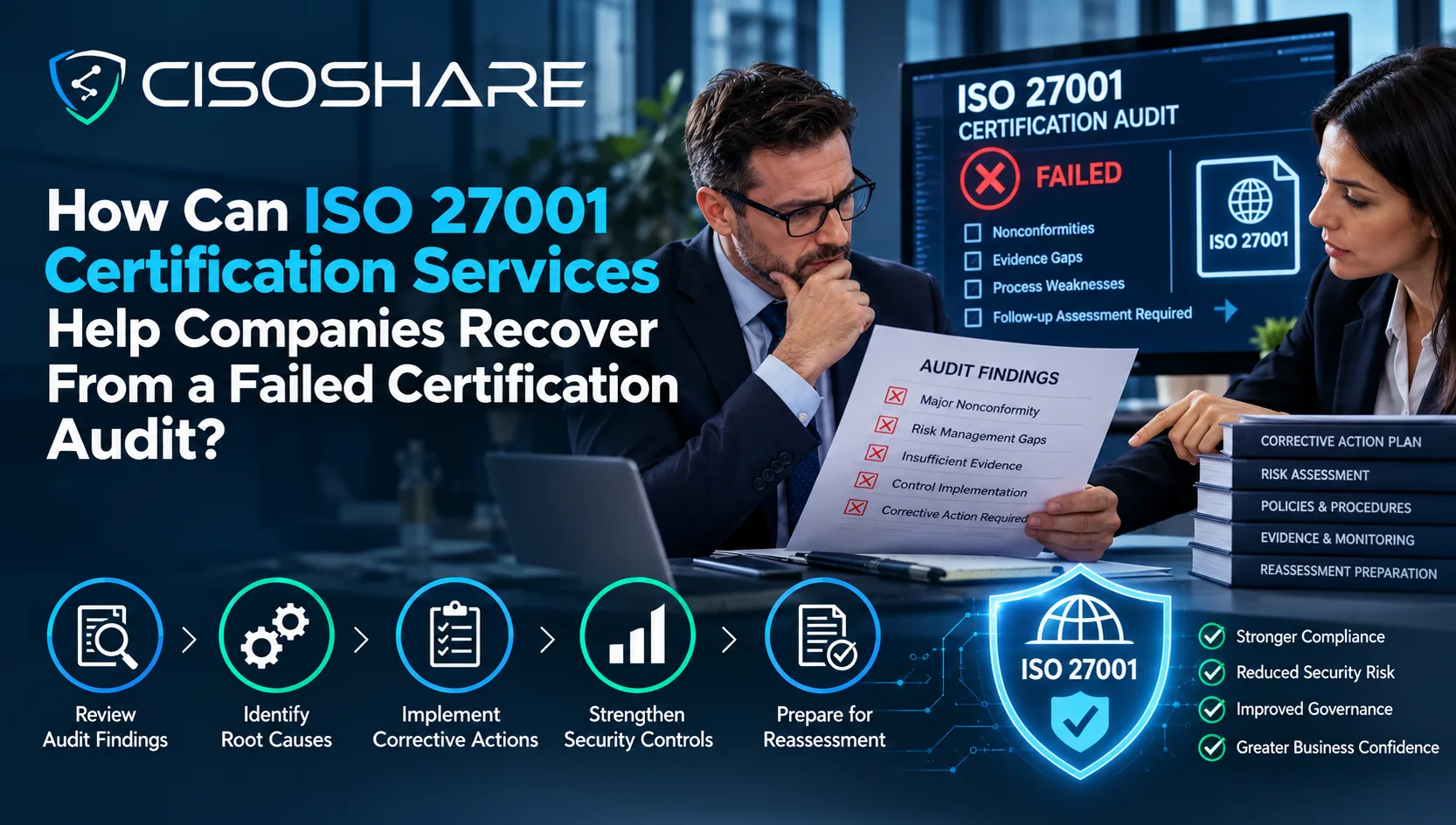
Failing an ISO 27001 certification audit can disrupt business plans, delay customer contracts, and create uncertainty about an organization's information security management system (ISMS). For SaaS companies, technology providers, and regulated businesses, certification can be an important requirement during enterprise procurement and vendor security evaluations. An unsuccessful audit does not necessarily mean the organization must restart the entire certification process, but it does indicate that specific requirements have not been adequately demonstrated. Professional ISO 27001 Certification Services can help organizations understand audit findings, address nonconformities, and prepare for the next assessment. CISOSHARE, based in San Clemente, California, supports businesses across the United States with cybersecurity compliance, risk management, and information security program development.
Recovering from an unsuccessful certification assessment requires more than updating policies or submitting additional documents. Organizations must understand why the nonconformities occurred, determine whether existing security controls are effective, and implement corrective actions that address underlying weaknesses. Some findings may involve incomplete risk assessments, inconsistent security procedures, insufficient monitoring, or missing evidence of management oversight. Others may reveal more significant problems with the design or implementation of the ISMS. A structured remediation process helps organizations demonstrate that identified problems have been corrected and that measures are in place to prevent recurrence.
What Happens When a Company Fails an ISO 27001 Certification Audit?
An ISO 27001 certification audit evaluates whether an organization's ISMS meets the applicable requirements of ISO/IEC 27001. Certification audits are generally conducted in two stages, beginning with an assessment of readiness and documentation followed by a more detailed evaluation of implementation and effectiveness. If auditors identify nonconformities, the organization must address them according to the certification body's procedures. Major nonconformities can prevent certification from being granted until acceptable corrective action has been taken and verified. The outcome depends on the severity of findings, the certification body's requirements, and the organization's ability to demonstrate effective remediation.
What Is the Difference Between Major and Minor Nonconformities?
A major nonconformity generally indicates a significant failure to meet an ISO 27001 requirement or a problem that raises substantial doubt about the ISMS's ability to achieve its intended outcomes. Examples may include a missing or ineffective risk assessment process, widespread failure to implement required procedures, or serious deficiencies in management oversight. A minor nonconformity typically represents a more limited failure that does not, by itself, undermine confidence in the overall management system. However, repeated minor findings or multiple related weaknesses may indicate a broader systemic issue. The certification body determines the classification of findings according to its audit procedures and applicable accreditation requirements.
Does a Failed Audit Mean Certification Is Permanently Denied?
An unsuccessful assessment does not automatically mean the organization is permanently ineligible for ISO 27001 certification. In many situations, the certification body provides an opportunity to implement corrective actions and submit supporting evidence within specified deadlines. Major findings may require additional verification or a follow-up assessment before certification can proceed. However, organizations should not assume that every certification body follows identical remediation timelines or reassessment procedures. The next steps should be confirmed directly with the auditor or certification body responsible for the assessment.
How Can Audit Failure Affect Business Operations?
Certification delays can affect organizations that rely on ISO 27001 credentials to satisfy customer procurement requirements or contractual commitments. Enterprise customers may request updated remediation plans, alternative security assurance documentation, or evidence of progress toward certification. Internal teams may also need to redirect resources toward corrective actions, additional assessments, and security improvements. These activities can increase operational costs and delay planned business initiatives. Transparent communication and a documented recovery plan can help stakeholders understand how the organization intends to resolve outstanding issues.
Why Do Companies Fail ISO 27001 Certification Audits?
Organizations may struggle with ISO 27001 certification when documented security policies do not accurately reflect operational practices. In other cases, security controls may exist but lack sufficient evidence to demonstrate consistent implementation. Incomplete risk assessments, ineffective internal audits, weak management reviews, and unresolved corrective actions can also contribute to nonconformities. Certification requires organizations to demonstrate that the ISMS is established, implemented, maintained, and continually improved. Understanding the specific cause of each finding is essential before selecting an appropriate corrective action.
Incomplete Information Security Risk Assessments
ISO 27001 requires organizations to establish and apply an information security risk assessment process that produces consistent, valid, and comparable results. Some companies struggle because their assessments do not adequately identify relevant risks, define evaluation criteria, or connect risk treatment decisions to appropriate controls. Others may rely on outdated assessments that no longer reflect current systems, business processes, or threat exposure. Auditors may also identify weaknesses when risk owners, treatment decisions, or acceptance criteria are not sufficiently documented. Correcting these issues requires reviewing both the assessment methodology and how it is applied throughout the organization.
Missing or Inconsistent Security Documentation
Documentation provides evidence that an organization's ISMS operates according to defined requirements. Common problems include outdated policies, incomplete records, inconsistent procedures, and missing evidence of security activities. For example, a company may have an access control policy but lack records demonstrating periodic access reviews. Similarly, documented incident response procedures may not match how security incidents are actually handled. Organizations must ensure that required documentation is controlled, current, accessible to authorized personnel, and supported by operational evidence.
Weak Internal Audit and Management Review Processes
Internal audits and management reviews are important components of an effective ISMS. Internal audits help determine whether the management system conforms to organizational requirements and the applicable ISO 27001 standard. Management reviews evaluate ISMS performance, relevant changes, risks, improvement opportunities, and other required inputs. Organizations may receive findings when these activities are missing, incomplete, or performed without adequate independence and supporting evidence. Establishing a meaningful internal audit program and management review process can help prevent recurring certification problems.
How Can ISO 27001 Certification Services Support Audit Recovery?
Organizations facing significant certification findings may benefit from external specialists who understand ISO 27001 requirements, audit expectations, and corrective action processes. ISO 27001 Certification Services can support gap analysis, remediation planning, documentation improvement, and preparation for reassessment. The objective is to address the underlying causes of nonconformities rather than simply produce additional paperwork. External advisers can also help coordinate responsibilities across compliance, IT, security, and executive teams. Certification decisions remain the responsibility of the independent certification body, and consulting support does not guarantee approval.
Reviewing the Original Audit Findings
The recovery process should begin with a detailed review of the certification body's audit report. Each finding should be mapped to the relevant ISO 27001 requirement, supporting evidence, and affected business processes. The organization should clarify the auditor's observations and distinguish documented facts from assumptions about the underlying problem. This review helps identify whether findings relate to missing controls, ineffective implementation, inadequate records, or broader governance weaknesses. A clear understanding of the original nonconformities reduces the risk of implementing corrective actions that fail to address the actual issue.
Conducting a Root-Cause Analysis
Root-cause analysis examines why a nonconformity occurred rather than focusing only on its visible symptoms. For example, missing access review records may result from unclear ownership, inadequate procedures, insufficient training, or ineffective monitoring. Simply creating the missing records would not necessarily prevent the same issue from recurring. Organizations should evaluate the relevant processes, responsibilities, tools, and management controls to identify contributing factors. Effective corrective actions should address these underlying causes and include a method for verifying that the changes work.
Developing a Corrective Action Plan
A corrective action plan should identify the nonconformity, root cause, required remediation activities, responsible personnel, and expected completion dates. The plan should also specify what evidence will demonstrate that the corrective action has been implemented successfully. High-priority findings may require immediate containment measures while longer-term process improvements are developed. Progress should be reviewed regularly to identify delays, resource constraints, and dependencies between activities. A documented plan helps demonstrate that remediation is organized, accountable, and focused on measurable outcomes.
What Steps Should Companies Take After Receiving Major Nonconformities?
Major nonconformities require careful attention because they may prevent the certification body from issuing a positive certification decision. Organizations should begin by confirming the required corrective action process and applicable deadlines with their certification body. Internal leadership must then assign ownership, allocate resources, and establish a realistic remediation schedule. Technical, procedural, and governance changes should be supported by evidence demonstrating implementation and effectiveness. A coordinated approach reduces the likelihood of submitting incomplete corrective action packages or repeating the same findings during reassessment.
Step 1 – Confirm Certification Body Requirements
The certification body should explain the process for addressing nonconformities and submitting corrective action evidence. Requirements may differ depending on whether the assessment involves initial certification, surveillance, or recertification. Organizations should confirm submission deadlines, evidence expectations, and whether additional on-site or remote assessment activities are required. These details should be documented and communicated to the teams responsible for remediation. Missing a deadline or misunderstanding the required process can create additional delays.
Step 2 – Assign Clear Remediation Responsibilities
Every nonconformity should have a designated owner responsible for coordinating corrective action. Depending on the finding, this may involve IT administrators, security personnel, compliance managers, human resources, procurement teams, or executive leadership. Responsibilities should be specific enough to prevent important tasks from being overlooked. Management should also ensure that assigned personnel have sufficient authority, time, and resources to complete their work. Clear accountability helps organizations maintain momentum throughout the recovery process.
Step 3 – Implement Corrective Actions
Corrective actions may involve revising policies, improving technical controls, updating risk assessments, or strengthening governance processes. For example, an access management finding may require a documented review procedure, appropriate system changes, and evidence that access permissions have been reassessed. A risk management finding may require changes to the organization's assessment methodology and treatment approval process. Actions should be implemented consistently across the affected ISMS scope rather than limited to isolated examples. The organization should retain records showing what changed, when it changed, and who approved the changes.
Step 4 – Verify Corrective Action Effectiveness
Implementing a corrective action does not automatically demonstrate that the underlying problem has been resolved. Organizations should verify whether the revised process operates as intended and produces the required results. This may involve reviewing new records, testing controls, interviewing responsible personnel, or performing targeted internal audits. Evidence should demonstrate both correction of the identified issue and reasonable measures to prevent recurrence. Effectiveness verification is particularly important when the original finding involved a systemic management failure.
Step 5 – Submit Evidence and Prepare for Reassessment
Once corrective actions have been implemented and verified, the organization should prepare the evidence requested by its certification body. Submissions may include revised procedures, risk assessment records, training documentation, management review outputs, and control testing results. Evidence should be organized so auditors can clearly connect each corrective action to the corresponding nonconformity. Depending on the severity and nature of findings, the certification body may conduct additional assessment activities before making its decision. Organizations should remain prepared to explain how corrective actions have improved the effectiveness of the ISMS.
How Can Companies Strengthen Risk Management During Certification Recovery?
Risk management is central to ISO 27001 because the standard requires organizations to identify, assess, and treat information security risks systematically. Certification recovery provides an opportunity to review whether the existing risk management process reflects actual business operations and technology dependencies. Companies should examine whether risks are consistently evaluated, assigned to responsible owners, and supported by appropriate treatment decisions. They should also determine whether selected controls are implemented and monitored effectively. Strengthening these practices can improve both certification readiness and long-term cybersecurity governance.
Aligning Risk Assessments With Business Operations
Information security risks should be evaluated in the context of the organization's systems, data, services, and business objectives. A SaaS company may need to prioritize cloud security, application vulnerabilities, customer data protection, and service availability. A healthcare organization may face additional concerns involving patient information, access management, and third-party data processing. Risk assessments should reflect these operational differences rather than rely exclusively on generic templates. This alignment helps organizations select controls that address meaningful threats and business consequences.
Connecting Risk Management With Corrective Actions
Organizations can explore Cyber Security Risk Management Services to support structured identification, assessment, prioritization, and treatment of information security risks. Findings from certification audits should be evaluated alongside existing risk registers and treatment plans. Significant weaknesses may require revised risk ratings, additional controls, or changes to previously accepted risk decisions. Management should review whether remediation activities adequately reduce the identified exposure. Integrating audit findings into the broader risk management process helps prevent corrective actions from becoming isolated compliance tasks.
Monitoring Risks After Remediation
Cybersecurity risks can change as organizations deploy new technologies, introduce services, or modify business processes. A risk assessment completed solely to satisfy an audit may quickly become outdated if it is not maintained. Organizations should establish appropriate review intervals and event-driven reassessment triggers. Relevant changes may include major infrastructure upgrades, acquisitions, new regulatory obligations, or significant security incidents. Ongoing monitoring supports continual improvement and helps maintain the ISMS after certification is achieved.
What Evidence Should Companies Prepare for ISO 27001 Reassessment?
Certification bodies need objective evidence that identified nonconformities have been addressed effectively. The specific documentation required depends on the findings and the organization's ISMS scope. Evidence should be accurate, current, traceable, and consistent with actual operational practices. Creating documents shortly before reassessment without implementing the corresponding processes may result in additional findings. Organizations should focus on demonstrating sustained control effectiveness rather than merely increasing the volume of documentation.
Risk Assessment and Treatment Records
Risk assessment records should demonstrate that the organization applies its defined methodology consistently. Documentation may include risk criteria, identified risks, analysis results, treatment decisions, and assigned risk owners. The risk treatment plan should explain how selected actions address identified exposures. Organizations should also maintain an appropriate Statement of Applicability that identifies relevant Annex A controls and justifies inclusion or exclusion decisions. These records help auditors evaluate whether risk management requirements are being fulfilled.
Internal Audit and Management Review Evidence
Internal audit records should show the audit scope, criteria, findings, conclusions, and follow-up activities. Organizations should also demonstrate that auditors were selected and assessments conducted in a manner that supports objectivity and impartiality. Management review records should reflect required inputs, relevant decisions, and actions related to ISMS improvement. When previous findings involved inadequate oversight, updated records should demonstrate meaningful management participation. The goal is to show that governance activities operate as part of the management system rather than as one-time certification exercises.
Technical Control and Operational Evidence
Technical evidence may include access review records, vulnerability remediation logs, security monitoring reports, backup testing results, and incident response documentation. The appropriate evidence depends on the controls selected through the organization's risk treatment process. For example, a finding related to vulnerability management may require proof that identified weaknesses are tracked, prioritized, and addressed according to established procedures. Organizations may consider vulnerability management as a service to support recurring vulnerability identification and remediation tracking. Technical evidence should demonstrate that the relevant controls are functioning within the defined ISMS scope.
How Long Does It Take to Recover From an Unsuccessful ISO 27001 Audit?
The time required for recovery depends on the number and severity of nonconformities, available resources, and the certification body's requirements. A limited documentation issue may be resolved relatively quickly, while a systemic failure in risk management or governance may require more substantial changes. Organizations should avoid assuming that every audit finding can be closed within the same timeframe. Corrective action deadlines must be confirmed with the certification body, particularly when major nonconformities are involved. Realistic planning should account for implementation, evidence collection, effectiveness verification, and any required reassessment.
What Can Delay the Remediation Process?
Remediation may be delayed when responsibilities are unclear, required evidence is unavailable, or corrective actions depend on major technology changes. Limited internal resources can also create challenges when compliance teams must coordinate multiple departments. Organizations may discover that a single audit finding reflects broader weaknesses affecting several processes. In these situations, resolving the root cause may require more time than initially expected. Regular progress reviews and executive oversight can help identify obstacles before they threaten certification timelines.
Can External Compliance Specialists Accelerate Recovery?
External compliance specialists can help organizations interpret audit findings, prioritize remediation activities, and organize supporting evidence. Their involvement may reduce uncertainty when internal teams have limited experience with ISO 27001 assessments. However, consultants cannot eliminate the need for actual control implementation or guarantee a successful certification decision. The organization remains responsible for operating its ISMS and demonstrating conformity with the standard. External assistance is most effective when internal leadership actively supports corrective actions and provides access to the necessary personnel and information.
How Do ISO 27001 Requirements Relate to Other Compliance Frameworks?
Organizations pursuing ISO 27001 certification may also face contractual or regulatory requirements under other cybersecurity frameworks. Although some security practices overlap, each framework has distinct objectives, assessment methods, and compliance obligations. A company should not assume that ISO 27001 certification automatically satisfies every customer or regulatory requirement. Mapping controls across frameworks can help identify shared evidence and reduce unnecessary duplication. However, framework-specific gaps must still be addressed according to the applicable requirements.
ISO 27001 and CMMC Requirements
Organizations supporting the U.S. defense industrial base may need to meet Cybersecurity Maturity Model Certification requirements based on their contracts and the information they process. Businesses considering cmmc consulting services should evaluate applicable CMMC levels, assessment procedures, and evidence expectations. Some cybersecurity practices may support both ISO 27001 and CMMC objectives, but the frameworks are not interchangeable. Certification under one framework does not automatically establish compliance with the other. Organizations should assess their specific contractual obligations before selecting a compliance strategy.
ISO 27001 and HIPAA Compliance
Healthcare organizations and service providers handling protected health information may need to comply with HIPAA requirements. While ISO 27001 provides a framework for managing information security risks, HIPAA establishes specific legal obligations for covered entities and business associates. Organizations can explore hipaa compliance services to help evaluate relevant administrative, physical, and technical safeguards. ISO 27001 certification does not automatically demonstrate full HIPAA compliance. Each organization's obligations should be evaluated according to its activities, data handling practices, and applicable laws.
When Should Companies Consider Fractional Security Leadership During Audit Recovery?
Certification remediation often requires coordination between executive management, compliance personnel, IT teams, and external assessors. Smaller organizations may lack a dedicated senior security leader who can oversee these activities consistently. Engaging a fractional ciso may provide experienced security leadership without immediately hiring a full-time executive. This role can help coordinate remediation priorities, clarify responsibilities, and report progress to management. The appropriate engagement depends on the organization's existing capabilities, audit findings, and longer-term security requirements.
Coordinating Compliance and Technical Teams
Audit findings frequently involve processes that extend beyond the compliance department. Technical teams may need to modify configurations, improve monitoring, or strengthen access controls, while business teams update procedures and governance records. Security leadership helps connect these activities to a common remediation plan. Clear communication reduces the likelihood of inconsistent changes or incomplete evidence collection. Coordinated execution can improve the organization's ability to demonstrate that corrective actions are effective.
Reporting Remediation Progress to Executives
Executive leadership should understand which nonconformities remain unresolved and how they affect certification readiness. Reporting should identify corrective action owners, target dates, implementation status, and significant dependencies. High-risk issues may require additional investment or changes to business priorities. Management should also receive information about the effectiveness of completed actions rather than relying solely on task completion percentages. This visibility supports informed decisions and reinforces accountability throughout the recovery process.
How Can CISOSHARE Help Companies Recover From ISO 27001 Audit Findings?
CISOSHARE provides cybersecurity consulting and compliance-related services to organizations seeking to strengthen information security governance and risk management. Based in San Clemente, California, the company supports businesses across the United States, including technology providers, SaaS companies, and organizations with complex security requirements. Companies facing certification nonconformities can explore assistance with gap assessments, corrective action planning, risk management, and ISMS improvement. The appropriate scope of support depends on the audit findings, existing security controls, and certification requirements. A consultation can help determine which remediation activities require immediate attention and what resources may be necessary.
Why Should Organizations Address Root Causes Before Reassessment?
Submitting additional documents without resolving underlying weaknesses may result in repeated audit findings. Effective remediation requires organizations to understand why controls failed and whether corrective actions prevent similar problems from recurring. This may involve improving processes, strengthening technical safeguards, clarifying responsibilities, or establishing more effective management oversight. Organizations should verify that revised controls operate consistently before presenting them for reassessment. A root-cause-focused approach supports both certification readiness and long-term information security performance.
Request an ISO 27001 Audit Recovery Consultation
If your organization has received major or minor ISO 27001 nonconformities, consider reviewing the findings before committing to a remediation schedule. CISOSHARE can be contacted to discuss your existing ISMS, identified compliance gaps, and potential support requirements. An initial conversation can help clarify whether additional risk assessments, documentation improvements, technical remediation, or governance changes may be necessary. Organizations should also confirm all corrective action deadlines directly with their certification body. Contact [email protected] to request information about relevant cybersecurity compliance services.
Conclusion
An unsuccessful ISO 27001 certification audit can create operational and commercial challenges, but it also provides an opportunity to strengthen an organization's information security management system. Successful recovery requires understanding audit findings, identifying root causes, implementing corrective actions, and demonstrating their effectiveness through appropriate evidence. ISO 27001 Certification Services can help organizations organize remediation activities, improve governance, and prepare for reassessment without replacing the independent certification process. Businesses should prioritize meaningful security improvements rather than treating certification as a documentation exercise. CISOSHARE, based in San Clemente, California, supports organizations across the United States seeking structured cybersecurity compliance and risk management assistance.
Contact CISOSHARE
Email: [email protected]
Website: https://cisoshare.com/
Location: San Clemente, California, United States
Failed an ISO 27001 Certification Audit? Take the Next Step Toward Remediation.
Contact CISOSHARE to discuss major nonconformities, corrective action planning, ISMS gaps, and certification reassessment preparation. Share your organization's primary audit concerns to begin exploring an appropriate remediation strategy.