As cyber threats continue to evolve they are becoming more persistent, sophisticated, and harder to combat with security tools alone. When it comes to MSPs having to contend with the need to monitor multiple customer environments, compete against other providers and deliver a consistent security service the pressures increase exponentially. This is where Co-managed SOC services can provide tremendous support. A co-managed SOC model enables MSPs to leverage the technology investments they already have in place while providing around-the-clock security monitoring, threat hunting, investigation and response skills to complement the MSP's own security team. It's not about displacing or replacing tools, but augmenting with an extra layer of security tools, expertise and capacity, delivered through dependable Managed SOC 24/7 monitoring.

What Are Co-managed SOC Services?
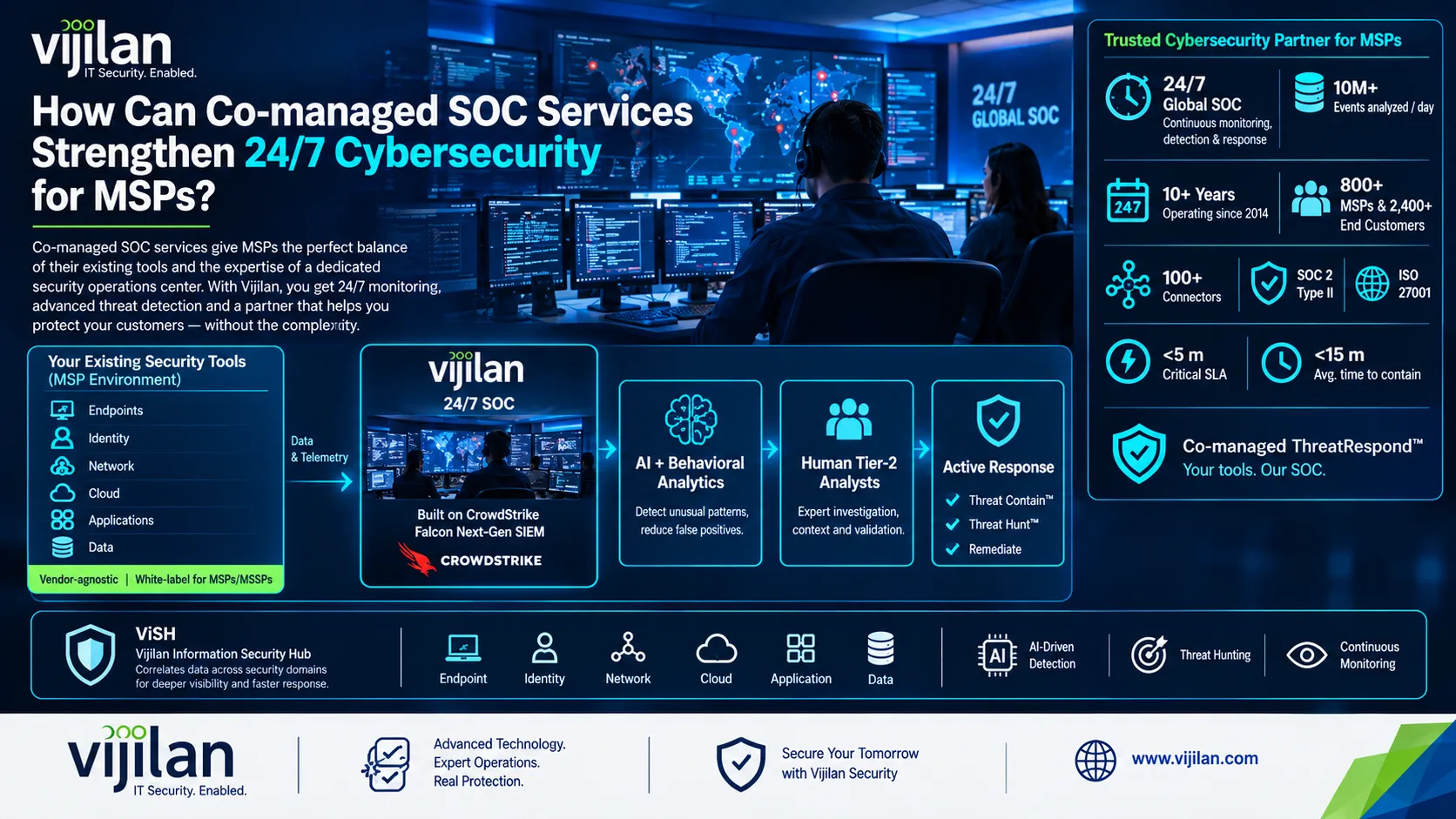
Co-managed SOC services The co-managed security operations center (SOC) model integrates your organization's current security setup with a comprehensive outsourcing solution. The MSP continues to manage customer relationships and existing technology, while the SOC provider monitors, investigates, and responds to threats in real-time. The Threat Respond co-managed SOC offered by Vijilan embodies this model by expanding existing customer or MSP security investments with a 24/7 SOC that integrates into existing security investments in a vendor-neutral fashion, eliminating the need to rip and replace security infrastructure. This shared security model enables automation, by the SOC's cloud-based automation engine, and security analysts to work together to identify activity that warrants further investigation and take the appropriate action, as part of continuous Managed SOC 24/7 monitoring.
Why Is 24/7 SOC Monitoring Important for MSPs?
Cyberattacks don't take a break when your employees go home. Ransomware, hacking, phishing, and other types of suspicious activity can happen at any time - even if it's the middle of the night, weekends, or holidays. Managed SOC 24/7 monitoring is able to give MSPs peace of mind - continuous visibility across their customer environments - without having to wait until the following morning to investigate an alert. Security analysts can examine suspicious activity while it's happening. This can be especially helpful for SMB customers who may not have a large enough budget or HR resources to operate their own internal security operations center, which is exactly where 24/7 threat monitoring for small business clients matters most.
How Can Co-managed SOC Services Improve MSP Security Operations?
An effective co-managed model should provide more than alert notifications. It should help MSPs reduce the operational burden associated with monitoring, investigation, and response.
Key benefits include:
- Continuous monitoring across endpoint, identity, network, cloud, application, and data environments.
- Threat investigation and hunting supported by experienced security analysts.
- Faster identification and prioritization of meaningful security incidents.
- Active containment and remediation instead of simply forwarding alerts.
- Scalability across multiple customer environments.
- Support for compliance-focused customers and regulated industries.
- Integration with existing security tools and MSP workflows.
This approach can help MSPs focus internal resources on strategic IT services while the SOC handles the demanding operational work associated with cybersecurity monitoring and response, especially when paired with a strong Managed MDR for MSPs engagement and a scalable MSP SOC multi-tenant platform.
How Do CrowdStrike Managed Services Support MSPs?
Crowd Strike is also helping MSPs take advantage of their remote monitoring and management capabilities, without requiring every customer to have those capabilities. CrowdStrike MSP services Crowd Strike MSP services can supplement an MSPs already supported security service offering by providing the capabilities of Crowd Strike's platform along with routine monitoring and security operations. Related MSP services Crowd Strike Falcon EDR - Crowd Strike can also provide an EDR managed service and that telemetry can be monitored and investigated by Crowd Strike's security team. Crowd Strike Falcon Log Scale - If you have larger data and/or SIEM requirements, CrowdStrike's LogScale service will help with security data collection, correlation, investigation and analysis. Vijilan can leverage Crowd Strike Falcon Next-Gen SIEM as part of its technology portfolio and the Vijilan Vision platform correlates telemetry from multiple security domains.
Can MSPs Use Managed ITDR Alongside SOC Services?
Identity is now one of the most critical aspects of modern cybersecurity. The use of attack on credentials, privileged accounts, authentication systems and cloud identities is replacing malware attacks. A managed ITDR for MSPs can help mitigate this risk by offering visibility and response to these threats. An MSP ITDR Solution can provide visibility into threat behavior around alerting for suspicious sign-ins, account compromise, privilege escalation and other identity indicators. Seeing identity alongside endpoint and network telemetry enhances an attack picture for security teams. For example, an unexpected login will carry more weight when correlated with anomalous endpoint activity or cloud utilization.
Is a Managed SIEM Useful for SMB and MSP Environments?
Many organizations find it difficult and expensive to handle a large volume of security data. A Managed SIEM for SMBs offers a way to deliver security monitoring, log analysis, correlation, and detection features without requiring the business to have their own dedicated SIEM team. For MSPs, a Cloud-native SIEM solution for MSPs can be a flexible platform for monitoring multiple customer sites, and can also make it easier to consolidate security data while segmenting customer environments. Organizations comparing solutions may also consider a Blumira SIEM alternative when they need a wider range of SOC capabilities, more integrations, active response, or a more MSP-oriented operational model.
How Can MSPs Support Regulated Healthcare Customers?
Healthcare organizations present these modern day security and compliance hurdles as they manage sensitive patient data. MSPs with these customers require a security offering that can address both threat detection and compliance considerations. A Healthcare MDR HIPAA compliant strategy can leverage managed detection and response to deliver security operations that's built on healthcare security principals. Likewise, a HIPAA-compliant SIEM for healthcare can assist organizations in aggregating and analyzing security events across these sensitive data repositories. This is a particularly useful capability if a managed services provider has numerous healthcare clients that it supports.
How Do MDR and XDR Fit Into a Co-managed SOC Strategy?
How Managed MDR for MSPs Takes on Traditional Monitoring Managed detection and response (MDR) for MSPs adds investigation and response to the detection service. The core focus shifts away from mere detection of anomalies towards response and containment of the threat. An MSP MDR solution also becomes more effective when integrated with an MSP XDR solution. XDR for MSPs can correlate security signals across multiple layers in the environment to provide greater insight into the complete attack chain. This is especially helpful as modern threat actors traverse between endpoints, identities, cloud, applications, and network. A unified view of security can make it easier for analysts to notice linkages between events otherwise perceived as unrelated.
How Does AI Improve Co-managed SOC Services?
AI can assist security teams manage huge volumes of telemetry and spot anomalous behavior faster. An AI security monitoring service can help detection by identifying patterns and anomalies that may be hard to spot in manual analysis. That said, AI should augment human expertise, rather than substitute for it. Security analysts still need to verify what they see, piece together the wider business context, investigate, and determine how to respond to threats. As more organizations use AI applications and AI agents, protecting AI model security is also likely to become a concern. Businesses need to think about risks including breaches, data exposure, manipulation, and abuse of the AI system. A modern co-managed SOC can therefore help organizations watch over traditional infrastructure and also adapt security operations to the new threat landscape involving AI.
What Should MSPs Look for in a Co-managed SOC Provider?
Understand why selecting the right provider is critical because the SOC is the equivalent of the MSP itself. MSPs need to look at the provider for its ability to provide consistent monitoring, intelligent investigation and pragmatic response, an important consideration for anyone evaluating a Huntress alternative for MSPs. Key factors include interoperability, analyst skills, response procedures, flexibility, reporting, compliance, and the ability to work with different customer technologies. A good provider will understand the MSP perspective as well. White label capabilities, multi-tenancy, flexible delivery, and dedicated partner support will allow MSPs to develop security offerings without compromising on the customer relationship, much like dependable CrowdStrike managed services.
How Does an MSP SOC Multi-tenant Platform Help?
MSP SOC multi-tenant platform for multiple end-customer environments An MSP platform lets you scale security operations to support multiple end customers from a shared platform. It can give you a clearer picture of your customers' security while making day-to-day operations more manageable. You can implement shared security workflows for monitoring, reporting, investigation, and escalation, using different policies tailored to each client - without duplicating the workflows for every customer. If you're expanding your security-as-a-service offering, this type of platform can help you serve SMBs, hospitals, and other end customers with widely varying needs, complementing any existing Cloud-native SIEM solution for MSPs already in place.
Conclusion
Cybersecurity can be too much of a challenge for many MSPs to defend against through alerts and standalone security tools. Co-managed SOC services offer a way to augment the MSP's existing IT expertise with round-the-clock security monitoring, best-in-class analysts, threat hunting, investigations, and active response. MSPs can leverage Managed SOC 24/7 monitoring, MDR, XDR, SIEM, ITDR, Crowd Strike, and AI-based detection to build out a comprehensive, scalable security stack for their customers. For companies in need of 24/7 protection that lack the resources to run a full internal SOC, a partner-led model can put enterprise-class security operations within reach without the operational overhead. Ultimately, MSPs can stay customer-centric while a dedicated security team keeps watch over the relentless threats.
FAQs
What are co-managed SOC services?
Co-managed SOC services combine an MSP's existing security tools and team with an external SOC's monitoring, investigation, and response expertise.
How does 24/7 SOC monitoring help MSPs?
It provides continuous security monitoring so threats can be investigated and addressed even outside normal business hours, the core benefit of Managed SOC 24/7 monitoring.
Can co-managed SOC services work with existing security tools?
Yes, a vendor-agnostic co-managed model can add SOC capabilities without requiring MSPs to replace their existing security stack, including tools like a CrowdStrike Falcon EDR managed service.
What is the difference between MDR and XDR for MSPs?
MDR focuses on managed detection and response, while XDR correlates security signals across multiple technologies and environments for broader visibility, which is why a well-rounded MSP MDR solution often includes both.
Why do MSPs need an MSP SOC multi-tenant platform?
It helps MSPs efficiently monitor and manage security operations across multiple customer environments from a scalable framework, the definition of a true MSP SOC multi-tenant platform.