
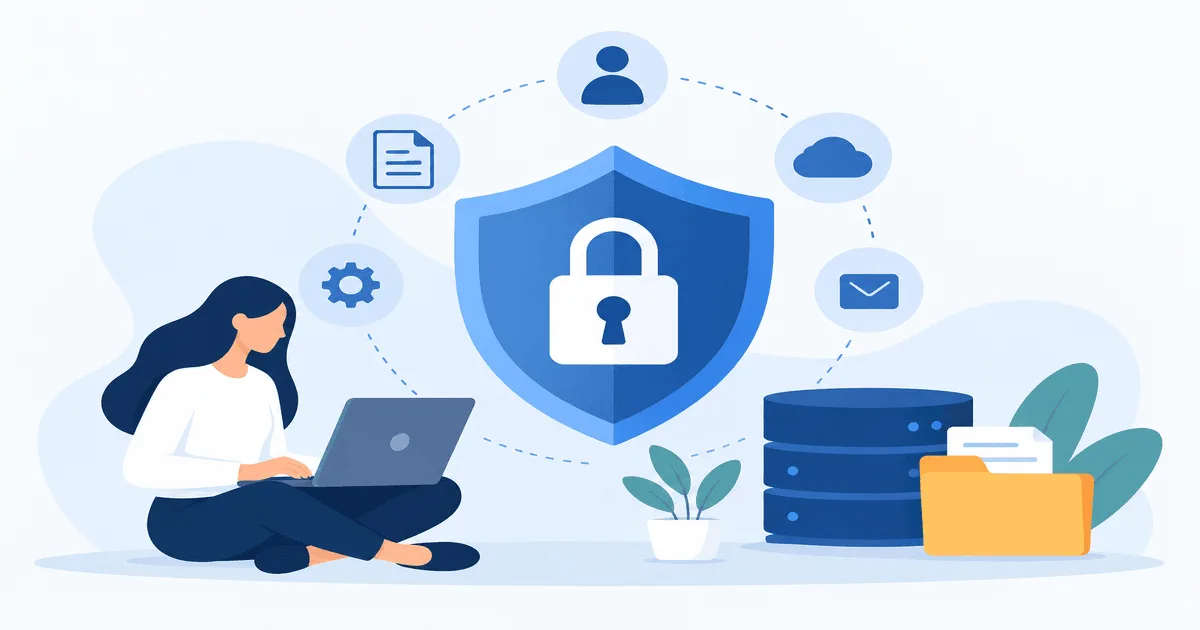
I started paying closer attention to data privacy after noticing how much information I'd handed out without thinking twice: my number to a coffee app, my location to a weather widget, my address to a contest form I never won. None of it felt like a big decision, but together it built a profile I never explicitly agreed to.
If you're reading this, maybe a breach story prompted it, or you're just trying to understand what these privacy laws mean for you. This guide covers what data privacy really is, why it matters, and what you can do about it.
What Is Data Privacy?
Data privacy is the right and ability to control how your personal information is collected, used, stored, and shared. It covers everything from your name and email to your browsing history and financial details. In simple terms, it's who gets to see your information and what they can do with it.
Why Data Privacy Matters Today
Every app, website, and smart device you use collects some form of data. Regulators have taken notice: the IAPP now tracks data protection laws enforced across 144 countries, and nineteen US states had comprehensive privacy laws in effect as of early 2026. It shapes how businesses build products and how people get targeted with ads and, sometimes, scams.
Wow News 24x7 recently covered how India's privacy law is fueling a hiring boom for data protection officers, a sign of how seriously companies must now treat this issue.
How Your Data Gets Collected
- Apps and websites track clicks and location through cookies and SDKs.
- Loyalty programs and forms collect contact details, often bundled with vague "marketing" consent.
- Smart devices like trackers and voice assistants log behavior continuously.
- Data brokers combine this information into profiles, then resell it to advertisers.
Key Data Privacy Laws You Should Know
India's DPDP Act, 2023 makes consent the legal basis for processing personal data and gives individuals rights to access and correct their data. Core provisions take full effect by May 2027, with penalties up to ₹250 crore per violation.
The EU's GDPR remains the global benchmark, with cumulative fines exceeding €7 billion.
US state laws, including newer ones in Kentucky, Indiana, and Rhode Island, give residents rights to opt out of data sales and targeted ads, though the country still lacks a federal privacy law.
Practical Steps to Protect Your Data Privacy
- Read permission requests before accepting. An app asking for contacts or location it doesn't need is a red flag.
- Use unique, strong passwords with a password manager. Reused passwords are one of the easiest ways accounts get compromised.
- Turn on two-factor authentication, especially for email and banking.
- Limit what you share on forms and social platforms. If a field isn't required, leave it blank.
- Review privacy settings periodically. Defaults are usually set to share more, not less.
Common Data Privacy Mistakes
People often skip privacy policies entirely, missing details about third-party data sharing. Another common mistake is treating "I have nothing to hide" as a reason to ignore privacy settings; the real risk is misuse for fraud, not secrecy. Ignoring software updates is another one, since many patches close privacy gaps.
Data Privacy for Businesses: What It Means for You as a Consumer
When a company invests in privacy compliance, it shows up in small ways: clearer consent forms, an easy way to request data deletion, and fewer unexplained emails from third parties. Laws like the DPDP Act push businesses toward this standard, a win for anyone tired of guessing where their information ends up.
Key Takeaways
- Privacy laws are expanding fast, but they only work if you also watch your own habits.
- Small changes, like reviewing app permissions, matter more than most people assume.
- Businesses are increasingly accountable for your data, shifting some burden off individuals.
Conclusion
Data privacy isn't about becoming paranoid or disconnecting from technology. It's about being more deliberate with what you share and who you share it with. Once I started reviewing app permissions, I realized most of it takes minutes, not hours. I hope this gives you a clearer starting point.
FAQs
What is the difference between data privacy and data security? Data privacy is about who has the right to access and use your data. Data security is about the technical measures that protect it from unauthorized access, like encryption.
Does the DPDP Act apply to businesses outside India? Yes, it applies to any organization processing the personal data of individuals in India, even if based elsewhere.
Can I ask a company to delete my personal data? Under most modern privacy laws, including the DPDP Act and GDPR, individuals can request correction or erasure of their data.
Is using a VPN enough to protect my privacy? A VPN hides your browsing activity from your internet provider, but it doesn't stop apps and websites you log into from collecting your data.
Why do apps ask for so many permissions? Some permissions are genuinely needed for the app to work, while others support advertising unrelated to the core service.
What rights do I have if my data is misused? You can file a complaint with the relevant data protection authority, such as the Data Protection Board of India under the DPDP Act.
How can I stay updated on data privacy developments in India? Outlets like Wow News 24x7 regularly cover regulatory and business developments around India's privacy law, which is a practical way to stay informed.