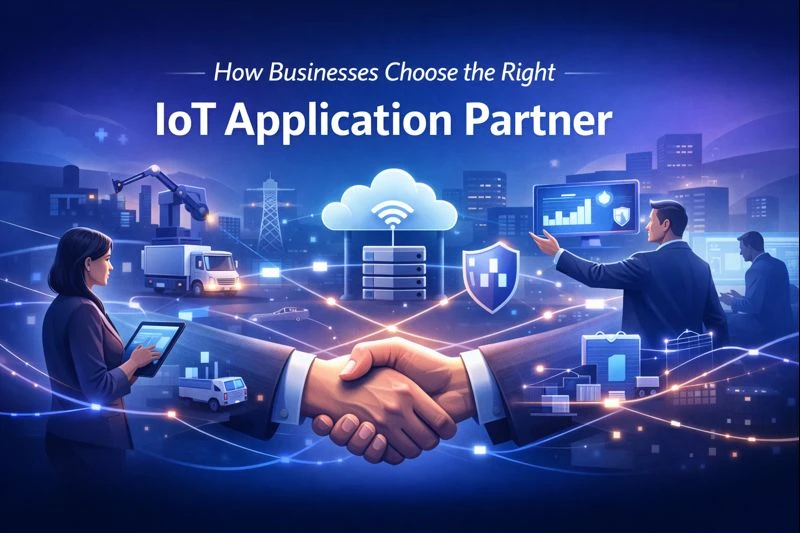
As connected systems become a core part of digital transformation, businesses are increasingly investing in scalable and secure IoT solutions. From real-time monitoring to predictive automation, IoT is no longer experimental—it is operationally critical. However, achieving long-term value depends heavily on choosing the right IoT application development company and the right development approach.
This blog explains how organizations can evaluate custom IoT development services, what distinguishes enterprise-grade IoT development services, and how to plan for scalable, secure, and future-ready IoT applications.
Why IoT Application Development Requires a Strategic Partner
IoT solutions sit at the intersection of hardware, software, connectivity, cloud, and security. Unlike traditional applications, IoT systems must operate reliably in real-world environments while processing large volumes of real-time data.
Working with an experienced IoT application development company ensures that business requirements are translated into robust technical architectures rather than short-term prototypes.
A capable IoT partner helps organizations:
- Align IoT architecture with business goals
- Integrate devices, cloud platforms, and enterprise systems
- Design for scalability, performance, and resilience
- Embed security and compliance from day one
This strategic alignment is essential for organizations planning long-term IoT adoption rather than isolated pilots.
What Are Custom IoT Development Services?
Custom IoT development services focus on building tailored solutions that reflect a company’s workflows, infrastructure, regulatory requirements, and growth plans. Instead of adapting business processes to a rigid platform, custom development adapts technology to the business.
These services typically include:
- Device and sensor integration
- Firmware and edge computing development
- Cloud-native backend architecture
- Web and mobile dashboard development
- Data analytics, automation, and alerting
- Security, compliance, and governance frameworks
Custom solutions provide full control over system behavior, data ownership, and future enhancements—key advantages for organizations operating at scale.
Why Businesses Move Beyond Off-the-Shelf IoT Platforms
Prebuilt IoT platforms can be useful for proof-of-concept deployments. However, businesses often encounter limitations as their needs evolve.
Common challenges with generic platforms:
- Restricted integration with ERP, CRM, or legacy systems
- Limited customization of workflows and user roles
- Platform-dependent scalability constraints
- Generic security models that may not meet compliance needs
Custom IoT development addresses these gaps by enabling deeper integration, tailored security policies, and architecture-level scalability.
Core Components of Enterprise IoT Development Services
Successful IoT systems are built on multiple interconnected layers, each requiring specialized expertise.
Device & Hardware Integration
Ensures reliable connectivity between sensors, gateways, and networks using Wi-Fi, cellular, LPWAN, or Ethernet. Proper provisioning and device identity management are critical for long-term reliability.
Firmware & Edge Computing
Custom firmware enables local processing, validation, and decision-making at the edge—reducing latency and cloud dependency while improving system resilience.
Cloud & Backend Architecture
Modern IoT development services rely on cloud-native, microservices-based architectures with event-driven data pipelines. These systems support high availability and horizontal scaling as device volumes grow.
Application Layer (Web & Mobile)
User-facing applications provide dashboards, alerts, controls, and role-based access. Custom UX ensures that insights are actionable for operational teams.
Data Analytics & Automation
IoT data becomes valuable only when converted into insights. Custom analytics enable KPI tracking, predictive maintenance, anomaly detection, and automated responses.
Security & Compliance
Security spans all layers—from encrypted device communication to secure APIs and regulatory compliance. Custom development allows organizations to align security controls with internal risk models.
Planning IoT Applications for Scalability and Longevity
A common mistake in IoT initiatives is focusing only on device connectivity. Long-term success requires careful application planning.
Understanding how to build an IoT application with scalable architecture, flexible data pipelines, and strong security foundations helps businesses avoid costly redesigns as deployments grow.
Key scalability considerations include:
- Modular microservices architecture
- Horizontal scaling of cloud services
- Edge processing to reduce cloud load
- Automated device lifecycle management
- Observability through logging and monitoring
Systems designed with these principles can evolve alongside business needs without performance degradation.
Industries That Benefit Most from Custom IoT Development
Custom IoT solutions deliver the highest value in industries with complex operations or regulatory requirements:
- Manufacturing: predictive maintenance, equipment monitoring
- Healthcare: connected devices, remote monitoring, compliance-driven data handling
- Logistics & Supply Chain: fleet tracking, asset visibility
- Energy & Utilities: grid monitoring, asset performance optimization
- Agriculture: precision farming, environmental sensing
- Smart Infrastructure: building management, traffic systems
In these environments, tailored IoT development services enable reliability, accuracy, and operational efficiency.
How to Choose the Right IoT Application Development Company
Selecting the right partner is a critical decision. Businesses should evaluate providers based on:
- Technical depth: proven experience across devices, cloud, and applications
- Industry knowledge: understanding of sector-specific workflows and regulations
- Security-first mindset: clear approach to risk mitigation and compliance
- Scalability expertise: experience designing systems for growth
- Long-term support: commitment to maintenance and evolution
Transparent communication and a structured development process are equally important indicators of a reliable partner.
Conclusion: Building IoT Systems That Scale with Your Business
IoT is no longer just about connecting devices—it is about building intelligent systems that support real business outcomes. Organizations that invest in custom IoT development services gain greater flexibility, stronger security, and long-term scalability.
Partnering with the right IoT application development company ensures that IoT initiatives move beyond experimentation to become sustainable, value-generating systems. With careful planning, the right architecture, and an experienced development partner, businesses can turn connected data into a strategic advantage.