When driving a car, we rarely think about how many components work together to keep the vehicle stable, comfortable, and easy to control. Turning the steering wheel, driving over uneven roads, and braking all involve different mechanical systems working at the same time.
Two important parts of this process are the steering system and the suspension system. Although they have different responsibilities, they share several mechanical connections that allow the wheels to move and respond correctly.
Understanding how these systems work together also helps vehicle owners, repair professionals, and automotive parts buyers better understand the function of individual chassis components.
1. What Makes Up an Automotive Chassis?
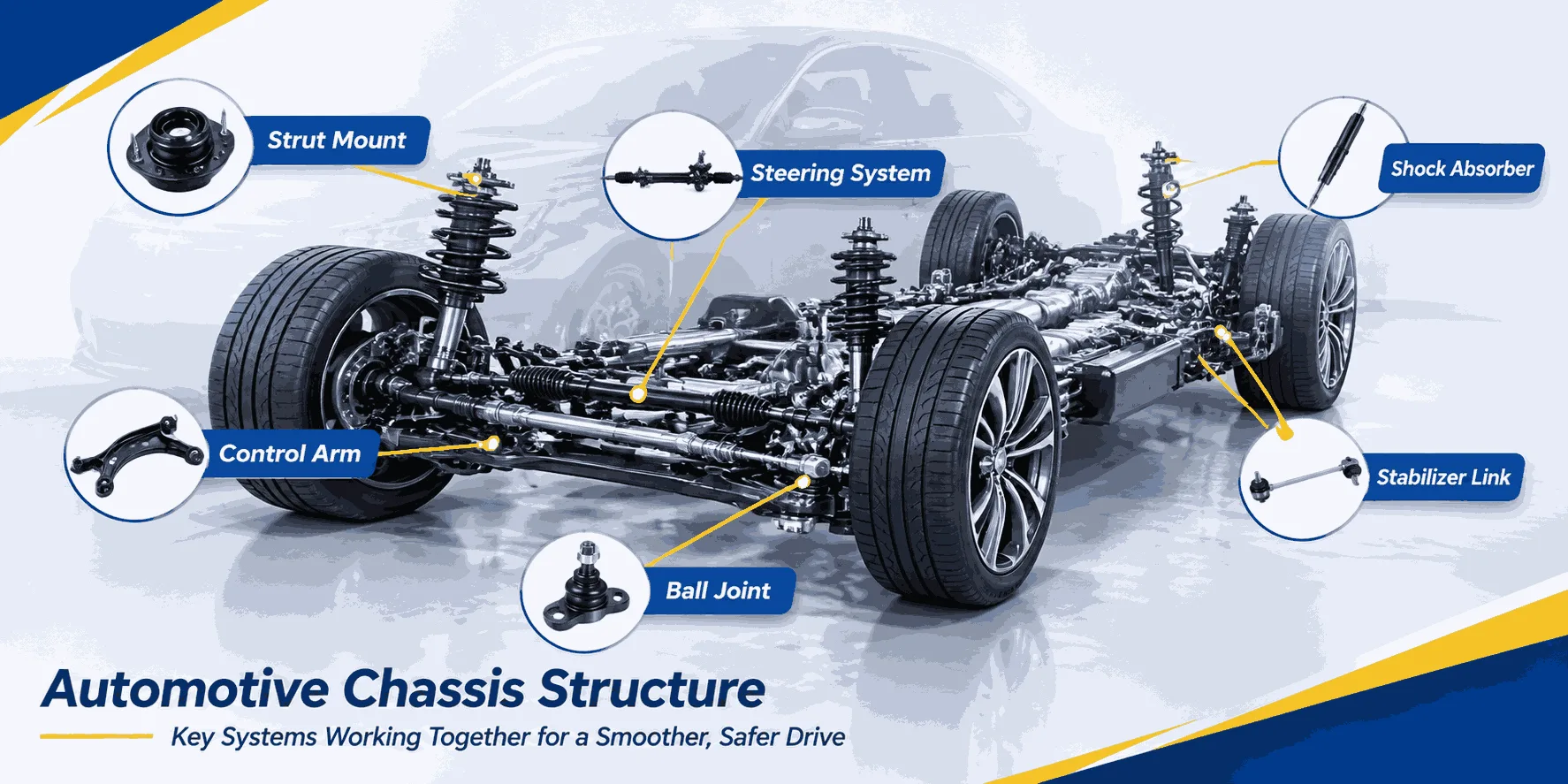
The automotive chassis is the foundation that supports the vehicle and connects its major mechanical systems. It plays an important role in vehicle stability, handling, and overall driving performance.
A typical chassis includes several major systems:
- Suspension system: Controls wheel movement and helps absorb road impacts.
- Steering system: Controls the direction of the vehicle.
- Braking system: Slows down or stops the vehicle.
- Drivetrain: Transfers engine or motor power to the drive wheels.
Each system has a specific job, but none works completely independently. Their components must remain properly connected and move within their designed operating ranges.
2. How Does the Steering System Control Wheel Direction?
The steering system converts the driver's input into movement at the front wheels. Most modern passenger cars use a rack-and-pinion steering mechanism.
The main components include:
- Steering wheel
- Steering column
- Pinion gear
- Steering rack
- Inner tie rod ends
- Outer tie rod ends
- Steering knuckles
When the driver turns the steering wheel, the steering column transfers this movement to the pinion gear. The pinion moves the steering rack from side to side.
The inner tie rods transfer this linear movement to the outer tie rod ends. The outer tie rod ends then push or pull the steering knuckles, changing the direction of the front wheels.
This process depends on accurate connections between every component. Excessive wear or looseness in the steering linkage can affect steering response and vehicle control.
3. How Do Steering and Suspension Systems Connect?
The steering and suspension systems work together through mechanical connections around the wheel assembly.
The steering knuckle is an important connection point in many independent suspension designs. It connects to the wheel hub, suspension components, and steering linkage.
Several components play important roles in this arrangement.
Control Arms
Control arms connect the vehicle's subframe to the steering knuckle. They guide wheel movement as the suspension travels over bumps and uneven surfaces.
They usually work with suspension bushings and ball joints to provide controlled movement while maintaining the designed suspension geometry.
Ball Joints
Ball joints provide flexible mechanical connections between the control arms and steering knuckles in common suspension designs.
Their ball-and-socket structure allows connected components to move through different angles as the wheels turn and the suspension moves.
A properly functioning ball joint helps maintain the connection between suspension components while allowing the necessary articulation.
Inner and Outer Tie Rod Ends
Tie rod ends belong to the steering system, but their movement must accommodate suspension travel.
The inner tie rod connects to the steering rack, while the outer tie rod end connects to the steering knuckle.
Together, they transfer steering force and allow the wheels to change direction without restricting normal suspension movement.
These connections show why steering and suspension components should be considered as part of an interconnected system rather than as completely separate parts.
4. Do Different Suspension Designs Use Different Connections?
Yes. Different suspension designs use different component arrangements to control wheel movement and maintain vehicle stability.
Three common designs are found in passenger cars.
MacPherson Strut Suspension
MacPherson strut suspension is widely used in front-wheel-drive passenger cars.
Its main components include a strut assembly, lower control arm, ball joint, steering knuckle, and outer tie rod end.
The lower control arm connects to the steering knuckle through a ball joint. The strut assembly supports the vehicle and controls suspension movement, while the steering linkage controls wheel direction.
The strut mount connects the strut assembly to the vehicle body. It is not a direct steering-force transfer component.
Double Wishbone Suspension
Double wishbone suspension uses upper and lower control arms to guide wheel movement.
In common designs, both arms connect to the steering knuckle through ball joints. This arrangement provides greater control over wheel geometry during suspension travel.
The steering linkage connects to the steering knuckle separately and transfers the driver's steering input.
Multi-Link Suspension
Multi-link suspension uses several links to control wheel movement.
Each link has a specific function, and the arrangement varies depending on the vehicle design. Bushings, ball joints, and other connecting components help control movement and isolate vibration.
The exact configuration depends on the vehicle manufacturer and suspension layout.
5. What Happens When Steering or Suspension Components Wear Out?
Wear in steering and suspension components can affect vehicle handling, stability, and driving comfort.
Common warning signs include:
- Knocking noises when driving over uneven roads
- Loose or inaccurate steering response
- Steering wheel vibration
- Uneven tire wear
- Unusual movement or play in suspension connections
- Noise when turning the steering wheel
However, these symptoms do not always indicate the same faulty component.
For example, worn inner or outer tie rod ends may cause steering looseness or knocking noises. Damaged control arm bushings may produce vibration or unusual suspension movement. Worn ball joints can also affect the stability of the wheel assembly.
A proper inspection should identify the actual source of the problem before replacement.
It is also important to inspect related components rather than replacing parts based on noise alone.
6. What Should You Check When Buying Automotive Chassis Parts?
For automotive parts distributors, wholesalers, and repair businesses, choosing the correct replacement part is just as important as understanding its function.
Several factors should be considered before purchasing chassis and steering components.
1. OE Number Compatibility
The OE number is one of the most useful references for identifying the correct replacement part. Different versions of the same vehicle may use different components depending on the production year, engine, or configuration.
2. Vehicle Fitment Information
Check the vehicle make, model, production year, engine type, and installation position. These details help reduce the risk of incorrect applications.
3. Product Specifications
Dimensions, thread sizes, mounting structures, materials, and connection designs should match the required application.
4. Manufacturing and Quality Management
Buyers should evaluate the supplier's production capability, inspection procedures, and quality management system. Consistent manufacturing and reliable product data are important for long-term business relationships.
5. OEM and ODM Support
For importers and private-label brands, suppliers offering OEM production, ODM development, custom packaging, and mixed-product supply can provide greater flexibility.
Final Thoughts
The steering and suspension systems perform different functions, but they depend on each other to maintain vehicle control and stability.
Control arms, bushings, ball joints, and tie rod ends form important mechanical connections around the wheel assembly. Their correct fitment and proper working condition help maintain the intended steering and suspension performance.
For automotive parts buyers, understanding these connections makes it easier to identify replacement requirements and evaluate suppliers.
If you are looking for more information about automotive chassis components and their applications, explore the automotive chassis and steering systems guide published by DPANS.
DPANS, available through Zzwelcom, focuses on automotive chassis and steering-related parts for passenger cars and SUVs, with OEM, ODM, and custom packaging support.