Introduction
Introducing artificial intelligence into a business is not just a technology decision. It also changes how people complete tasks, find information, collaborate with colleagues, and make decisions.
A company might invest in an AI assistant to improve productivity, introduce automation to reduce repetitive work, or develop an intelligent application for customers. However, these investments can fall short when employees do not understand how to use the tools or how the technology fits into their daily responsibilities.
The challenge is not necessarily that people are unwilling to use AI. Sometimes, they have not received enough guidance. In other cases, the technology does not fit their workflow, produces unreliable results, or creates uncertainty about who remains responsible for the work.
Businesses can address these problems by preparing their teams before introducing new AI systems. When employees understand the purpose of the technology, have opportunities to learn, and know where human judgment remains important, AI adoption becomes easier to manage.
Start by Understanding How Employees Work
Before introducing AI, businesses should examine the tasks employees perform throughout the day.
Some activities involve judgment, creativity, negotiation, or personal communication. Others involve repetitive steps such as collecting information, reviewing documents, preparing summaries, updating records, or answering similar questions.
These routine activities can reveal practical opportunities for AI assistance.
For example, a finance team might spend considerable time organizing information before preparing reports. A support team may repeatedly answer questions about company policies. A sales team might manually summarize customer conversations before meetings.
Instead of introducing a tool simply because it is available, businesses should understand which tasks create the most friction and why.
Employees are often the best source of this information because they experience these challenges directly. Their feedback can help identify opportunities that management might otherwise overlook.
Explain Why the Business Is Introducing AI
Employees are more likely to understand a new technology when they know what the organization wants to achieve.
If management simply announces that a department must start using AI, employees may see the change as another requirement rather than a useful improvement.
A better approach is to explain the purpose clearly.
For example, a company might introduce AI to reduce repetitive data entry, make internal knowledge easier to access, or help employees prepare customer responses more efficiently. These objectives provide a clear reason for adopting the technology.
Businesses should also communicate what AI is not intended to do. Employees need realistic expectations about what the system can handle, where it can make mistakes, and which responsibilities will remain with them.
Clear communication helps create a more practical understanding of AI and reduces confusion during implementation.
Build AI Skills Through Everyday Tasks
AI training does not need to begin with technical theory or complicated terminology.
For most employees, practical learning is more useful. They need to understand how to use approved tools, provide clear instructions, evaluate responses, protect confidential information, and recognize when an output needs further review.
A customer service employee, for example, may benefit from learning how to use AI to summarize previous conversations or prepare a response draft. A project manager may need guidance on organizing meeting notes and extracting action items. An analyst may need to learn how to verify AI-generated summaries against the original data.
Training should reflect the responsibilities of each role.
Businesses can begin with a few everyday tasks and gradually introduce more advanced capabilities as employees become comfortable with them. This approach makes learning manageable and helps employees recognize where the technology genuinely improves their work.
Help Employees Understand the Limits of AI
AI can produce useful results, but it does not guarantee accuracy.
A system may misunderstand a question, overlook important context, generate incorrect information, or produce an answer that sounds confident despite being wrong.
Employees need to understand these limitations before relying on AI for important work.
For example, an AI-generated report summary may be useful as a starting point, but the employee should verify important figures before sharing it with management. Similarly, an AI-generated customer response may need editing to ensure it accurately reflects company policies.
Organizations should establish clear expectations about when employees can use AI-generated output directly and when they need to review it.
The NIST AI Risk Management Framework provides a useful reference for organizations working to identify and manage risks associated with AI systems.
The goal is not to discourage AI use. It is to help employees use it responsibly and confidently.
Make AI Part of Existing Workflows
One reason employees struggle with new technology is that it introduces additional steps instead of making existing work easier.
Imagine that an employee must open a separate application, copy information from a business system, enter a prompt, review the output, and then transfer the result back into the original application.
That process may create more work than it removes.
Businesses should therefore think about where AI fits within existing workflows.
An internal assistant might be more useful when employees can access it through their existing knowledge portal. A customer service application might benefit from AI-generated summaries appearing directly within the support interface.
These decisions require both user-experience planning and technical integration.
AI Development Companies can help businesses connect AI capabilities with existing applications, databases, APIs, and internal systems. The important consideration is whether the resulting application makes work easier for the people expected to use it.
Create Clear Rules for Using AI at Work
As employees begin using AI, questions naturally arise about data, privacy, approved tools, and accountability.
Can an employee upload an internal document to a public AI service? Is it acceptable to use AI-generated text in customer communications? Which applications are approved for handling sensitive information? Who should review important outputs?
Without clear answers, employees may either avoid useful tools or use them in ways that create unnecessary risks.
Businesses should establish straightforward guidelines that explain which tools are approved, what information can be shared, how AI-generated results should be checked, and when human approval is required.
The OECD AI Principles offer an additional reference for considering responsible AI, transparency, robustness, accountability, and human-centered practices.
These guidelines should be easy for employees to understand and apply. A practical policy is more useful than a lengthy document that people rarely consult.
Give Employees Opportunities to Experiment Safely
Employees often learn more by solving real problems than by attending a general presentation about AI.
Businesses can encourage small experiments within approved boundaries. A team might test whether AI can summarize routine reports, help organize project documentation, or prepare an initial response to common customer questions.
Each experiment should have a clear objective and a way to evaluate the result.
Employees can compare how long a task takes with and without AI, review the quality of the output, and identify situations where the system creates additional work.
This gives the organization practical evidence about where AI helps and where it does not.
It also encourages employees to contribute ideas instead of treating AI adoption as something managed entirely by the technology department.
Choose Specialized Support When Needed
Some AI projects require expertise that an organization may not have internally.
A business might need to build an internal knowledge assistant, connect AI with enterprise software, automate a document-heavy workflow, or create a customer-facing application. These projects may involve data engineering, system architecture, security, model evaluation, and ongoing maintenance.
When evaluating Generative Ai Development Companies, businesses should look for experience building applications that connect language models with reliable business information, rather than focusing only on content generation.
The right provider should understand the intended users, the information the system needs, and the safeguards required to make it useful.
Likewise, businesses considering AI Agent Development Companies should evaluate whether the provider understands multi-step workflows, tool access, permissions, error handling, monitoring, and human approval.
AI agents may help coordinate connected business tasks, but employees need to understand what these systems can do independently and which actions require their involvement.
Consider the Development Partner's Ability to Support Adoption
A development partner should not focus exclusively on delivering software.
Successful implementation may also require employee training, documentation, workflow adjustments, feedback collection, and support after launch.
When researching AI Development Companies In India, businesses can evaluate providers based on their technical expertise, communication, integration experience, documentation, and ability to support users as the system evolves.
Organizations comparing AI Development Companies In USA can consider the same factors, alongside any particular enterprise, security, or operational requirements their projects involve.
The provider's location matters less than whether the team understands the business problem and can support the solution throughout its lifecycle.
A well-built application is important, but it creates more value when employees know how to use it effectively.
Measure Adoption and Business Results
AI adoption should be evaluated through more than the number of employees who have access to a tool.
Businesses need to understand whether the technology is improving the work it was intended to support.
For example, a company introducing an AI assistant might measure how quickly employees find internal information. A customer support team could assess the time needed to prepare responses. An operations department might evaluate document-processing time and the number of corrections required.
Employee feedback is also useful. It can reveal whether the system feels intuitive, whether its output can be trusted, and whether the application creates unexpected problems.
Combining performance measures with feedback provides a clearer picture of the technology's value.
If an AI tool receives frequent use but makes little difference to the underlying process, the business may need to adjust the workflow or reconsider the use case.
Prepare Managers to Lead the Change
Managers have an important role in successful AI adoption.
Employees often turn to their managers when they are unsure whether a task should be automated, whether an AI-generated answer is acceptable, or how the technology affects their responsibilities.
Managers therefore need more than a basic understanding of AI tools. They should know the intended business outcomes, the limits of the systems being introduced, the organization's usage rules, and the process for reporting problems.
They can also help teams identify useful opportunities and share lessons from early implementations.
When managers treat AI as a tool for improving work rather than a requirement to be followed blindly, employees are more likely to engage with the change constructively.
Keep Learning After Implementation
AI adoption does not end when the application launches or the initial training session finishes.
Employees may discover new use cases after using the technology in real situations. Business processes may change, and AI applications may need updates or additional safeguards.
Organizations should create a regular process for reviewing performance, collecting feedback, updating guidance, and sharing practical examples between teams.
They should also be willing to change or discontinue an application that does not deliver the expected results.
This ongoing learning helps the business build its capabilities over time instead of treating every AI project as an isolated experiment.
Conclusion
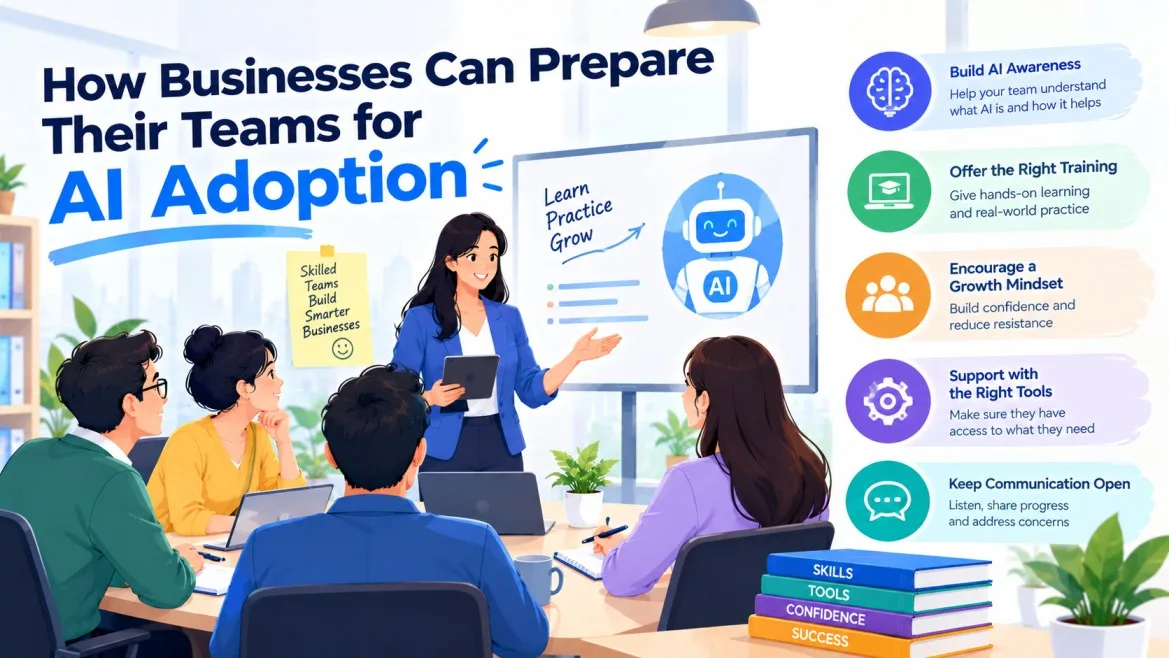
Preparing employees for AI adoption requires more than giving them access to new tools. Businesses need to understand existing workflows, explain the purpose of the technology, provide role-specific training, establish clear usage policies, and make sure AI fits naturally into daily work.
They also need to help employees understand the limitations of AI and identify when human judgment remains necessary.
AI Development Companies can support implementation by building solutions around real business needs. Organizations evaluating AI Development Companies In India or AI Development Companies In USA should also consider communication, training, integration, documentation, and long-term support. For specialized applications, Generative Ai Development Companies may help build knowledge-driven systems, while AI Agent Development Companies can support workflows involving multiple connected actions.
Ultimately, successful AI adoption depends on the relationship between technology and people. When employees understand the purpose of AI, know how to use it responsibly, and can see how it improves their work, the organization has a stronger foundation for achieving lasting results.