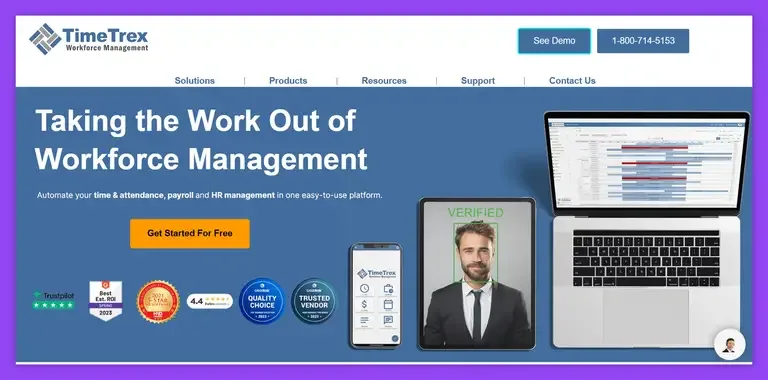
Managing employee attendance and payroll accurately has become one of the most important challenges for businesses today. Traditional punch cards and manual time sheets are not only outdated but also prone to errors, buddy punching, and time theft. As organizations move toward automation and digital transformation, advanced attendance solutions are becoming essential. One of the most powerful innovations in this space is the biometric time clock app for payroll, which is reshaping how companies track working hours and process salaries.
Why Businesses Are Moving Toward Biometric Systems
Modern businesses operate in fast-paced environments where accuracy and efficiency matter. Manual attendance systems often lead to disputes between employees and management, especially when overtime, breaks, or shift changes are involved. This is where biometric technology steps in.
A biometric system uses unique physical characteristics such as fingerprints, facial recognition, or even iris scans to verify employee identity. This eliminates the possibility of “buddy punching,” where one employee clocks in for another. It also ensures that every recorded time entry is authentic and secure.
When integrated with payroll software, these systems automatically calculate wages based on actual hours worked. This reduces administrative workload, minimizes payroll errors, and ensures employees are paid fairly and on time.
The Role of Automation in Payroll Accuracy
Payroll processing is not just about calculating salaries—it involves tax deductions, overtime calculations, attendance tracking, and compliance with labor laws. Even a small mistake can lead to employee dissatisfaction or legal issues.
The biometric time clock app for payroll plays a critical role in automating these complex tasks. Instead of relying on HR staff to manually input attendance data, the system collects real-time information and syncs it directly with payroll software. This automation improves transparency and ensures that all records are accurate and up to date.
Moreover, businesses can generate detailed reports showing employee productivity, attendance trends, and overtime costs. These insights help managers make informed decisions about workforce planning and budget allocation.
Key Benefits of Biometric Attendance Solutions
One of the biggest advantages of adopting biometric technology is the improvement in workplace accountability. Employees are more punctual when they know their attendance is being tracked accurately. This leads to a more disciplined and productive work environment.
Another important benefit is cost savings. By reducing time theft and payroll errors, companies can significantly cut unnecessary expenses. Over time, this leads to better financial control and improved profitability.
Security is also a major advantage. Since biometric data is unique to each individual, it is nearly impossible to duplicate or manipulate. This ensures that only authorized employees can access the system, making it highly reliable.
Integration with Modern Business Systems
Today’s businesses rely on multiple digital tools such as HR management systems, accounting software, and project management platforms. A modern biometric time clock app for payroll can easily integrate with these systems, creating a seamless workflow.
For example, when an employee clocks in using a fingerprint scan, the system automatically updates their attendance record, calculates working hours, and sends the data to the payroll system. This reduces the need for manual intervention and ensures consistency across all departments.
In addition, cloud-based solutions allow managers to access attendance data from anywhere, making it ideal for remote teams and multi-location businesses.
Future of Workforce Tracking
As technology continues to evolve, biometric systems are expected to become even more advanced. Artificial intelligence and machine learning are being integrated to predict attendance patterns, detect anomalies, and improve workforce efficiency.
Mobile-based solutions are also gaining popularity, allowing employees to clock in using smartphones with biometric verification. This is especially useful for field workers and remote teams who do not work from a fixed location.
In the coming years, the biometric time clock app for payroll will likely become a standard tool for businesses of all sizes, replacing traditional systems entirely.
Conclusion
Accurate attendance tracking and payroll processing are essential for maintaining a productive and satisfied workforce. Biometric technology offers a reliable, secure, and efficient solution that eliminates common issues associated with manual systems. By adopting a biometric time clock app for payroll, businesses can streamline operations, reduce errors, and build a more transparent workplace culture.
As organizations continue to embrace digital transformation, biometric systems will play a key role in shaping the future of workforce management.