Enterprise companies receive thousands of PO's and invoices, update inventory, and handle hundreds of procurement records daily. Although Enterprise Resource Planning (ERP) systems can streamline this process, numerous companies still need to manually input data from Amazon Business into their ERP system. This is time-consuming, expensive, and leads to unnecessary human mistakes.
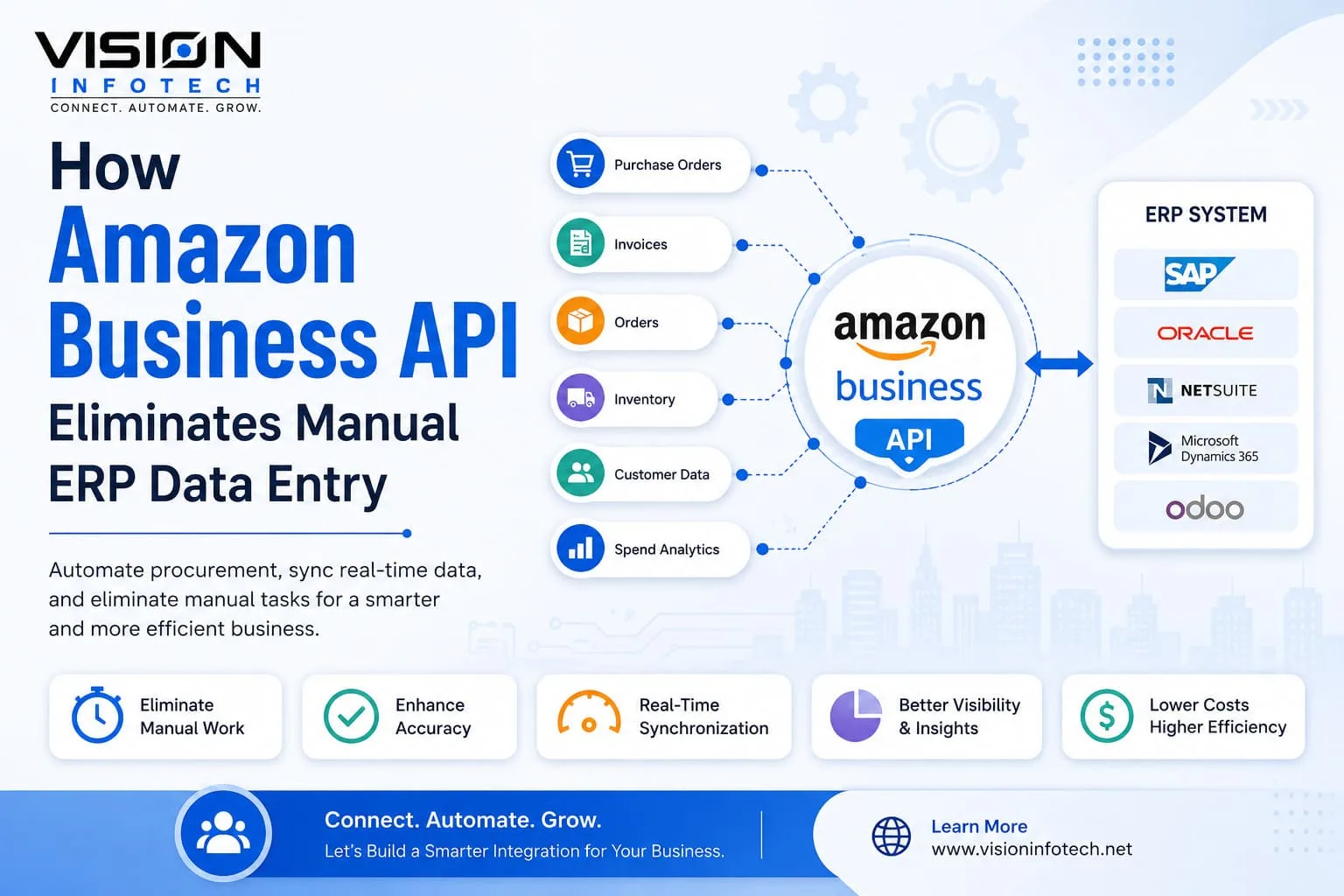
The Amazon Business API services simplify this by allowing for data to be securely exchanged between Amazon Business and ERP systems in an automated manner. Organizations can synchronize information in real-time, which eliminates the need for manual work like copying purchase details, updating inventory, and reconciling invoices, leading to more accuracy and efficiency in procurement and finance processes.
API-driven automation is not just a convenience; it's a competitive tool for ERP decision makers and procurement professionals. Automating procurement processes can help businesses to save time, minimize processing delays, and ensure more accurate reporting, freeing up staff time for strategic initiatives.
What are Amazon Business API Services
Amazon Business API services are a secure integration platform that allows Amazon Business to integrate with enterprise systems like ERP, procurement platforms, accounting software, and inventory management systems. Business data can be automatically transferred between systems, rather than having to export spreadsheets or manually enter purchase information.
The API is capable of supporting several procurement activities such as:
- Purchase order synchronization
- Invoice management
- Order status tracking
- Product catalog access
- Business account management
- Spend analytics
- Approval workflow integration
This automation guarantees that procurement data is consistent throughout departments and decreases administrative burden.
Why Manual ERP Data Entry Creates Business Challenges
Many organizations continue to rely on employees to manually enter procurement information into ERP systems. While this process may appear manageable initially, it becomes increasingly inefficient as transaction volumes grow.
Human Errors Increase Operational Risk
Manual entry often results in incorrect product quantities, duplicate purchase orders, pricing inconsistencies, or invoice mismatches. Even small errors can affect inventory planning, financial reporting, and supplier relationships.
Delayed Information
When procurement teams manually update ERP systems, there is often a delay between placing an order and recording it internally. Decision-makers may work with outdated information, making forecasting less reliable.
Higher Administrative Costs
Employees spend significant time entering repetitive information rather than focusing on vendor management, procurement strategy, or business analysis.
How Amazon Business API Eliminates Manual ERP Data Entry
The Amazon Business API service replaces repetitive manual processes with automated data synchronization between Amazon Business and enterprise systems.
Instead of employees entering purchase information line by line, the API transfers data automatically as transactions occur.
Automated Purchase Order Synchronization
Purchase orders generated through Amazon Business can automatically appear inside ERP systems without requiring manual intervention.
This automation ensures procurement teams always work with accurate purchasing records while reducing administrative effort.
Real-Time Order Updates
Order confirmations, shipment tracking information, delivery status, and cancellations are automatically synchronized across connected systems.
Real-time visibility helps procurement managers make faster operational decisions.
Invoice Automation
Invoices generated through Amazon Business can be transferred directly into ERP or accounting platforms.
Finance teams spend less time matching invoices manually and can accelerate payment processing.
Inventory Synchronization
Inventory-related purchasing information updates automatically across connected systems.
This helps businesses avoid stock shortages, over-ordering, and inaccurate inventory reporting.
Financial Data Accuracy
Every procurement transaction is automatically recorded inside financial systems, improving budgeting accuracy and simplifying month-end reconciliation.
Key Benefits of Amazon Business API Integration
Organizations implementing Amazon Business API integrations experience improvements across procurement, finance, and operations.
Reduced Manual Work
Automation eliminates repetitive data entry tasks, allowing employees to concentrate on strategic responsibilities rather than administrative work.
Improved Accuracy
Since data flows directly between systems, organizations reduce transcription mistakes and duplicate records.
Faster Procurement Processes
Purchase requests, approvals, invoices, and order updates move through workflows much faster than manual processes.
Better Compliance
Automated workflows maintain consistent procurement records, supporting audit requirements and internal compliance policies.
Real-Time Business Insights
Decision-makers gain immediate access to procurement data for reporting, forecasting, and financial planning.
ERP Systems That Benefit from Amazon Business API
The Amazon Business API integrates with many leading ERP platforms, allowing organizations to automate procurement without replacing their existing infrastructure.
Popular ERP platforms include:
- SAP
- Oracle ERP
- Oracle NetSuite
- Microsoft Dynamics 365
- Odoo ERP
- Sage
- Acumatica
Regardless of the ERP platform, automation helps eliminate duplicate work while improving operational visibility.
Business Functions Improved Through API Automation
Procurement Teams
Procurement professionals gain faster purchasing workflows, automated approvals, and accurate supplier records.
Finance Departments
Finance teams benefit from automated invoice synchronization, improved expense tracking, and simplified reconciliation.
Operations Teams
Operations managers receive real-time purchasing visibility that supports inventory planning and supply chain management.
IT Departments
IT teams spend less time maintaining manual integrations while improving system reliability through standardized API connectivity.
Real-World Use Cases of Amazon Business API Integration
Organizations across various industries are using the Amazon Business API to automate procurement processes and eliminate manual ERP data entry. Here are a few examples of how businesses benefit from API-driven automation.
Manufacturing
Manufacturers purchase raw materials, safety equipment, maintenance supplies, and production tools from multiple vendors. By integrating the Amazon Business API with their ERP system, purchase orders, invoices, and inventory records are automatically synchronized. This minimizes procurement delays and helps maintain accurate stock levels.
Healthcare
Hospitals and healthcare organizations manage thousands of medical supplies every month. Manual procurement can lead to delayed orders or inventory shortages. API integration enables real-time order tracking and automated invoice synchronization, helping healthcare providers maintain uninterrupted operations.
Retail and E-commerce
Retail businesses require constant inventory replenishment. Connecting Amazon Business with ERP software ensures that purchase information is updated automatically, giving inventory managers accurate stock visibility and reducing the risk of overstocking or stockouts.
Educational Institutions
Universities, schools, and research organizations frequently purchase office supplies, laboratory equipment, and technology products. Automated procurement simplifies purchasing while providing finance teams with accurate expense records.
Enterprise Organizations
Large enterprises often process hundreds or thousands of procurement transactions daily. Manual ERP data entry becomes impractical at this scale. The Amazon Business API enables secure, high-volume data synchronization that improves operational efficiency across departments.
Amazon Business API vs. Manual ERP Data Entry
Manual ERP Data EntryAmazon Business APIRequires manual inputFully automated synchronizationHigh risk of human errorsAccurate data transferTime-consuming processReal-time updatesDelayed reportingInstant visibilityDuplicate data entrySingle source of truthHigher operational costsReduced administrative expensesLimited scalabilitySupports enterprise growthFor organizations planning digital transformation initiatives, API automation offers a clear advantage over traditional manual processes.
How Amazon Vendor API Services Complement ERP Automation
While the Amazon Business API focuses on procurement automation for Amazon Business customers, Amazon Vendor API Services help organizations that sell products directly to Amazon as vendors.
These services automate several critical business operations, including:
- Purchase order management
- Inventory synchronization
- Shipment confirmation
- Invoice processing
- Product catalog updates
- Financial reconciliation
- Vendor performance reporting
Businesses using both procurement and vendor workflows can create an end-to-end automated ecosystem where purchasing, inventory management, order fulfillment, and financial reporting operate seamlessly.
Professional Amazon Vendor API Services ensure that ERP systems remain synchronized with Amazon Vendor Central, reducing manual work while improving operational accuracy.
Best Practices for Successful Amazon Business API Integration
To maximize the value of your integration, businesses should follow several best practices.
Define Integration Goals
Identify which procurement processes should be automated, such as purchase orders, invoices, inventory updates, or approval workflows.
Ensure ERP Compatibility
Verify that your ERP platform supports secure API integrations and determine the required data mappings before implementation.
Maintain Data Quality
Clean and standardize procurement data before synchronization to reduce duplicate or inconsistent records.
Implement Strong Security
Protect sensitive procurement and financial information using secure authentication, encrypted communication, and role-based access controls.
Monitor Integration Performance
Regularly review API performance, synchronization logs, and error reports to ensure uninterrupted business operations.
Why Choose Vision Infotech?
Vision Infotech specializes in enterprise API integration solutions that help businesses automate procurement, finance, and operational workflows.
Our team delivers customized Amazon Business API integration services tailored to your existing ERP ecosystem. Whether your organization uses SAP, Oracle, NetSuite, Microsoft Dynamics 365, Odoo, or another ERP platform, we build secure, scalable integrations that eliminate manual data entry and improve operational efficiency.
Our expertise also extends to Amazon Vendor API Services, enabling vendors to automate Vendor Central operations, synchronize inventory, manage purchase orders, and streamline financial reporting.
With a focus on reliability, security, and long-term scalability, Vision Infotech helps organizations accelerate digital transformation while reducing operational costs.
Conclusion
Manual ERP data entry is one of the most common sources of procurement inefficiencies in modern enterprises. It consumes valuable employee time, increases the risk of human errors, delays reporting, and limits business scalability.
The Amazon Business API provides a smarter alternative by automating procurement workflows and synchronizing purchase orders, invoices, inventory updates, and financial records with enterprise ERP systems in real time. Organizations benefit from improved accuracy, faster operations, reduced administrative costs, and better visibility across procurement and finance teams.
For businesses that also sell directly to Amazon, Amazon Vendor API Services further enhance automation by streamlining Vendor Central operations and eliminating repetitive manual processes.
FAQs
1. How does Amazon Business API eliminate manual ERP data entry?
The API automatically synchronizes purchase orders, invoices, order status, inventory information, and procurement records between Amazon Business and ERP platforms, eliminating repetitive manual work.
2. Which ERP systems support Amazon Business API integration?
Common ERP systems include SAP, Oracle ERP, Oracle NetSuite, Microsoft Dynamics 365, Odoo, Sage, Acumatica, and several custom enterprise platforms.
3. What are the benefits of Amazon Business API integration?
Benefits include improved data accuracy, faster procurement workflows, real-time reporting, reduced administrative costs, enhanced compliance, and better operational visibility.
4. What are Amazon Vendor API Services?
Amazon Vendor API Services help businesses automate Vendor Central operations, including purchase order processing, shipment management, inventory synchronization, invoicing, and reporting.
5. Is Amazon Business API suitable for small businesses?
Yes. Businesses of all sizes can benefit from procurement automation, especially those processing frequent purchase orders or managing multiple suppliers.