
Cars are getting smarter and smarter. Modern cars can monitor the tire pressure, detect nearby obstacles, recommend maintenance and even warn drivers when certain components are starting to behave abnormally.
Battery technology is headed in the same direction now.
Conventional battery monitoring relies extensively on voltage , current and temperature measurements . The next generation of systems takes this a step further, using artificial intelligence and machine learning to analyze how batteries perform over time.
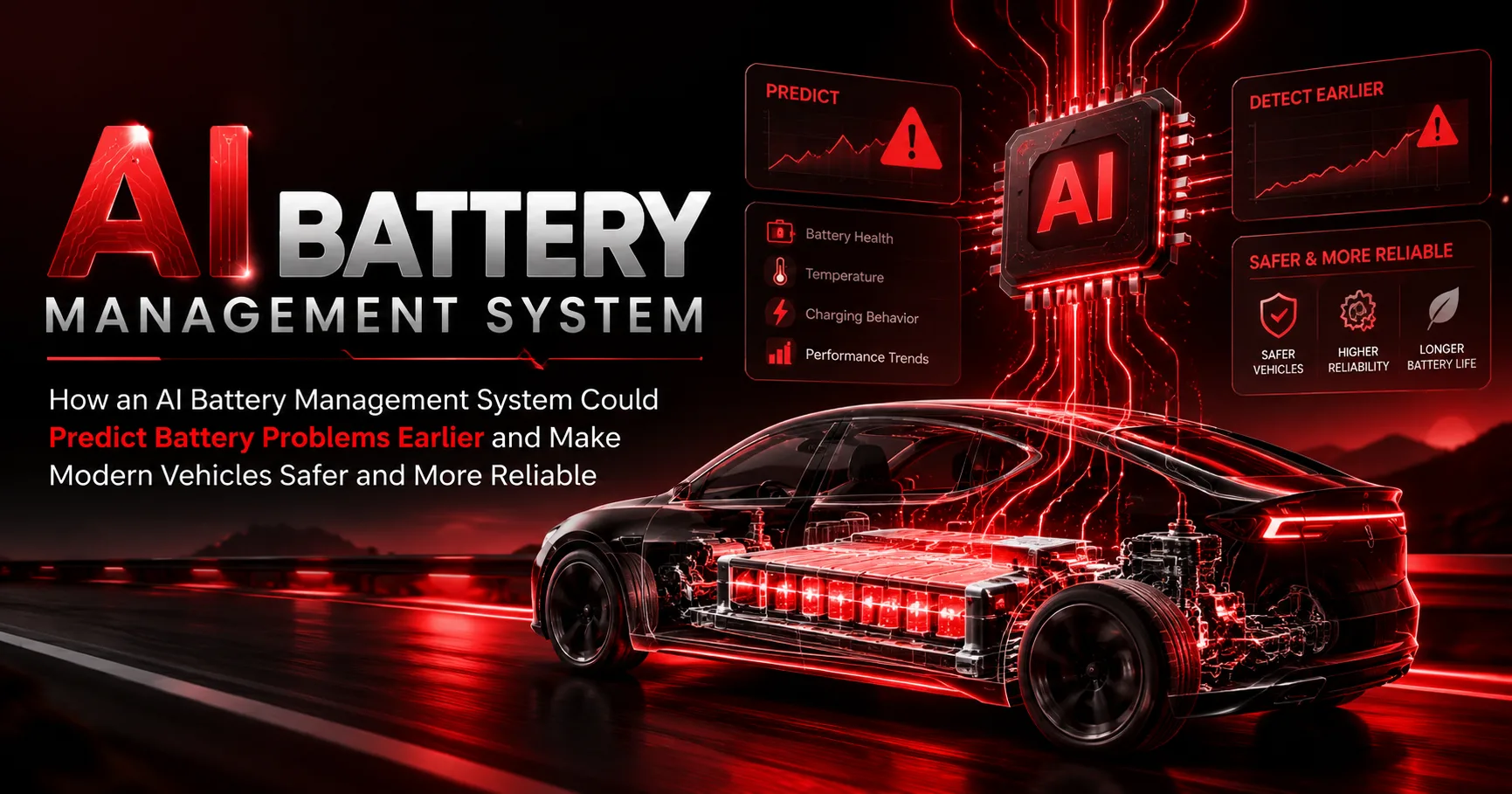
An AI Battery Management System might learn the patterns that signal battery deterioration before it’s apparent to the driver.
Recent publications in 2026 demonstrate the increasing integration of artificial intelligence for electric vehicle battery health estimation, charging management, degradation prediction and preventive maintenance.
So What Does a Battery Management System Do?
A battery management system, or BMS for short, is the electronic watchdog of a battery pack.
Its task is to continuously monitor critical operating conditions such as voltage, current, temperature and state of charge.
This is especially important for electric vehicles, as the battery cells must be operated within carefully controlled limits. Extreme heat , overcharging , deep discharge or imbalance between cells can also affect battery performance and life .
A traditional BMS responds to measurements of the battery.
Artificial intelligence will mean future systems will not only respond to problems but will start to predict them.
AI is able to Learn Age of Battery
Battery degradation is usually not the same for all vehicles.
The rate at which a battery degrades is influenced by driving habits, surrounding temperature, frequency of charging, vehicle use and battery chemistry.
Machine-learning systems are able to evaluate huge amounts of historical battery data and find patterns that would be difficult to detect with just simple measurements.
Research into next-generation battery management systems has shown that machine-learning techniques can be applied to estimates such as state of charge, state of health and remaining useful battery life.
But future vehicle systems could not only tell a driver how much charge is left, but also give a much clearer picture of the battery’s own aging.
Predictive Maintenance Could Help Prevent Unexpected Battery Issues Most drivers today are only reacting to battery problems when symptoms appear. The vehicle could crank slowly, display an electrical warning, or not crank at all.
Predictive diagnostics try to turn that process around.
Instead of waiting for a complete failure, a smart monitoring system can look at changing battery behavior and detect conditions that indicate deterioration.
For example, slow changes in charge patterns, internal resistance, temperature behavior or voltage stability may give an early warning that the battery performance is on the way down.
Safety can also improve with better monitoring
Battery monitoring is more than just extending battery life.
It can also improve safety. Temperature has a significant impact on Li-ion batteries and they must be maintained within safe operating conditions.
In June 2026, Texas Instruments announced an automotive battery monitor using electrochemical impedance spectroscopy to enable diagnostics in real time and earlier detection of conditions related to thermal runaway.
Technologies like this show that battery monitoring is evolving from simple measurement to much deeper diagnostic intelligence.
AI Won’t Make Physical Battery Testing Obsolete
“Artificial intelligence can assist with diagnostics, but it does not replace the need for proper inspection.”
There are several things that can prevent a vehicle from starting. It could be a weak battery, but poor terminal connections, charging system faults, electrical drains or other problems can cause similar symptoms.
"The vehicle electronics data can help narrow down the cause, but physical testing is still important to confirm the condition of the battery.”
For motorists who experience an unexpected starting problem, mobile car battery testing in the UAE can help identify if it is time to replace the battery or if another electrical problem is to blame.
This is getting more and more important, as vehicles have more electronics and interconnected control systems.
AI Battery Management Could Be a Game Changer in EVs
Driving and charging an electric car generates a large amount of battery data.
Every trip produces data on battery temperature, energy consumption, charging behavior and cell performance.
This information can be interpreted continuously by artificial intelligence.
A recent work published in Scientific Reports addressed the implementation of a cloud-connected battery framework that integrates machine learning for state-of-health estimation and intelligent charging optimization.
Eventually, such systems could help vehicles figure out not just how much energy is left, but also how charging behaviors could affect battery life.
Charging Might Get More Personalized
Not all drivers use their vehicles in the same way.
Some people walk short distances every day, others drive hundreds of kilometers regularly.
In the future, vehicle use may be considered to adapt charging strategies in smart battery systems.
Instead of just charging every vehicle the same way, the software might be able to take into account things like driving schedules, battery age, temperature and planned trips.
This could lead to more efficient energy management and better long-term performance of the battery.
Batteries are becoming data-driven components of vehicles.
For decades people mostly thought of batteries as just electrical devices.
That perception is shifting. More and more the modern battery is a source of continuous operational data.
The voltage behavior, charge cycles, temperature variations and degradation behaviors of the battery condition can be learnt well before a total failure occurs.
Artificial intelligence offers a means of interpreting that data at a scale that would be hard to achieve through manual analysis.
But research additionally emphasizes the challenges of battery AI, including data quality, model transparency, and real-world deployment.
Car Battery Care: The Future
Scheduled maintenance is gradually being replaced by condition-based and predictive monitoring of vehicle maintenance.
AI could speed that up.
Rather than discovering battery problems only when a vehicle stops working, drivers can get increasing early warning that the battery is losing performance.
Intelligent diagnostics could also give more information to workshops and roadside technicians before physical inspection starts.
Software-based monitoring combined with professional testing may ultimately provide a more accurate approach to vehicle battery maintenance.
Artificial intelligence will not solve battery problems, but it can radically change the way such problems are detected.
An AI Battery Management System can look at how a battery behaves, predict how bad the deterioration will get and possibly spot warning signs sooner than traditional monitoring methods.
As electric cars, hybrid vehicles and ever more computerized conventional cars enter the mainstream, so too will battery diagnostics become ever more sophisticated.
So the future of vehicle maintenance may be less about waiting for something to fail, but more about recognizing the warning signs early enough to prevent the breakdown in the first place.