Running a cloud kitchen looks simple from the outside. There is no dining area, fewer front-of-house employees, and orders arrive digitally. But behind every delivered meal is a fast-moving operation involving inventory, food preparation, staff, delivery partners, customer demand, and multiple ordering channels.
That complexity is where artificial intelligence can make a real difference.
For cloud kitchens, the opportunity is particularly interesting. A delivery-first model generates large amounts of operational data every day. The goal is not to replace kitchen teams with technology. It is to help them make better decisions, faster.
AI-powered cloud kitchen operations can forecast demand, improve inventory planning, personalize customer experiences, automate routine tasks, and identify operational bottlenecks before they become expensive problems.
This is also changing the role of cloud kitchen software development. Instead of building software that simply records orders and inventory, businesses can now create intelligent systems that learn from operational data and support real-time decision-making.
So, where does AI actually fit into a cloud kitchen?
Let's look at the five use cases that can have the biggest operational impact.
Top 5 Use Cases of AI in Cloud Kitchen Software
AI has applications across almost every part of a cloud kitchen. However, some use cases are more directly connected to everyday operations than others.
1. AI-Powered Demand Forecasting
One of the biggest challenges for a cloud kitchen is knowing how much food to prepare.
Prepare too much, and ingredients or prepared food may go to waste. Prepare too little, and popular items may become unavailable during peak ordering periods.
AI demand forecasting helps solve this problem by analysing historical order data and identifying patterns that are difficult to spot manually.
A demand forecasting model can consider:
- Previous order volumes
- Day and time patterns
- Seasonal demand
- Holidays and local events
- Promotions and discounts
- Menu popularity
- Weather conditions
- Location-specific ordering behaviour
- Delivery trends
For example, if a kitchen regularly receives a spike in biryani orders on Friday evenings, an AI system can identify that pattern and recommend an appropriate preparation quantity.
This makes forecasting less dependent on guesswork.
2. Smart Inventory and Food Waste Management
Inventory is another area where small inefficiencies can become expensive.
A cloud kitchen handles ingredients with different shelf lives, storage requirements, purchase cycles, and consumption rates. When demand changes unexpectedly, manual inventory planning can quickly become inaccurate.
AI can connect sales data with inventory records to identify what is likely to be needed and when.
For example, the system could detect that:
- Chicken consumption is rising by 15% week over week.
- A particular sauce is consistently overstocked.
- A low-selling ingredient is approaching its expiry date.
- A promotional campaign is likely to increase demand for a particular dish.
One outlet is consuming an ingredient much faster than another.
AI can then generate recommendations for purchasing, stock levels, and preparation.
This becomes even more useful when multiple cloud kitchen brands operate from the same facility.
Instead of managing each brand independently, the system can analyse combined consumption patterns and help operators allocate inventory more efficiently.
The result is a more data-driven approach to cloud kitchen inventory management.
And there is a practical reason to care. Food waste is not simply a sustainability issue. It directly affects food costs and margins.
3. AI-Powered Order and Kitchen Workflow Management
During a busy lunch or dinner rush, the challenge is not simply receiving orders.
It is keeping every order moving through the kitchen at the right pace.
A cloud kitchen may receive orders simultaneously from its own website, mobile app, food delivery marketplaces, and other digital channels
For example, if three orders arrive within a minute but one contains a meal requiring significantly longer preparation, the system can account for that difference when organising the kitchen workflow.
AI can also identify recurring bottlenecks.
If a particular preparation station regularly delays orders between 7 PM and 9 PM, the system can highlight the pattern. Managers can then adjust staffing, preparation schedules, or kitchen workflows.
This is where AI becomes more than an analytics tool. It becomes an operational assistant.
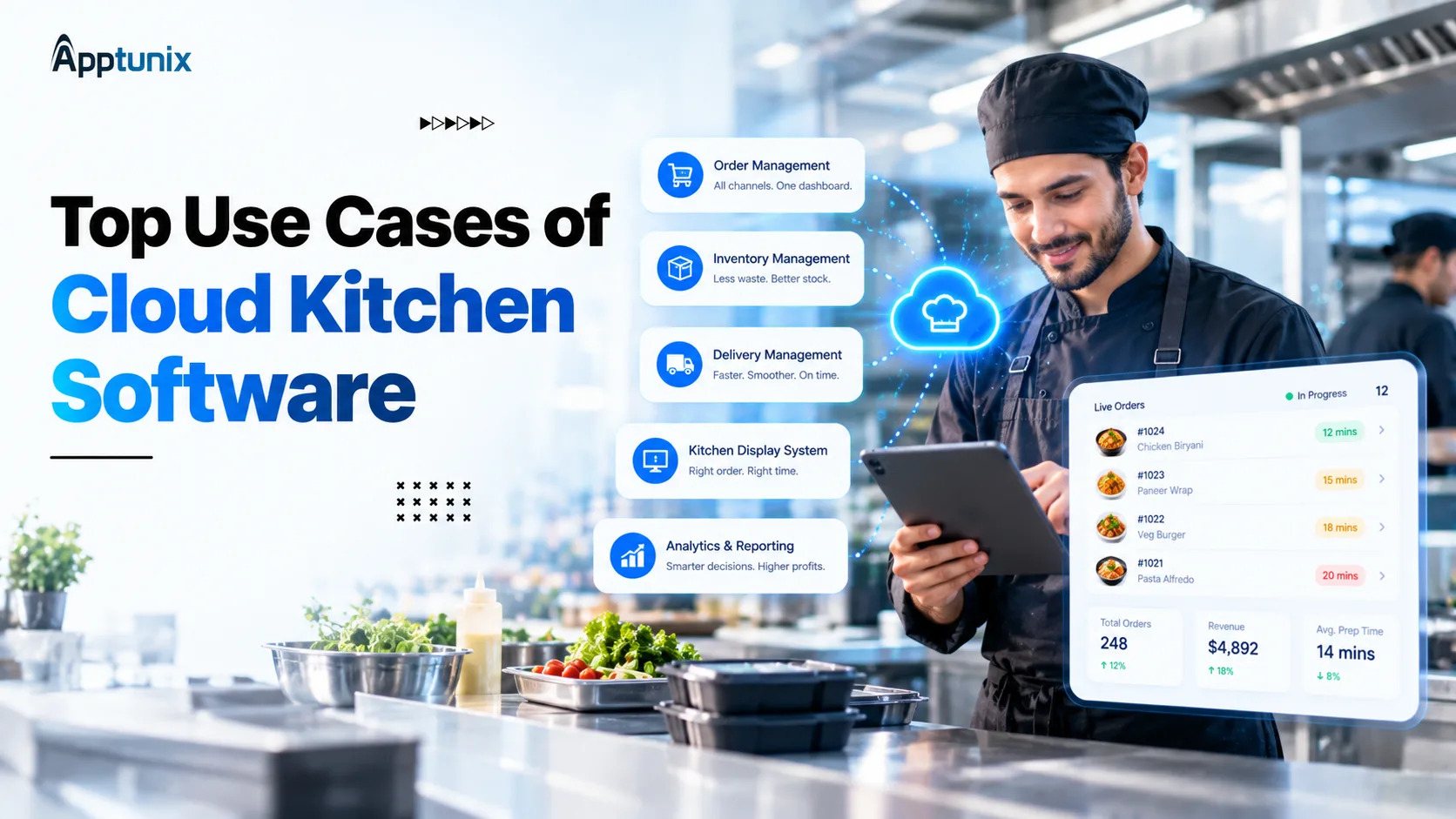
Combined with a kitchen display system, POS, order management platform, and delivery integrations, AI can help create a connected cloud kitchen order management system.
4. AI-Based Customer Personalisation and Menu Optimisation
Cloud kitchens do not have a dining room where staff can speak directly with customers.
That makes digital customer data even more valuable.
AI can analyse previous orders, purchase frequency, preferred cuisines, average order value, time of purchase, and responses to promotions.
Based on these patterns, businesses can create more personalised experiences.
For example, a customer who frequently orders high-protein meals could receive recommendations for similar dishes.
Another customer who regularly orders family meals on weekends could receive relevant bundle suggestions before the weekend.
AI can also help operators understand menu performance.
Instead of looking only at total sales, the system can analyse:
- Which dishes attract repeat purchases
- Which items increase average order value
- Which combinations are frequently ordered together
- Which products perform poorly after promotions
- Which dishes have high preparation costs
Which menu items generate frequent complaints
This can support AI menu optimisation and help operators make more informed decisions about pricing, bundles, promotions, and menu design.
The important point is that AI should support the operator's decision rather than blindly automate it.
A popular dish with a low margin may need a pricing change. A low-selling dish may simply need better positioning. Context still matters.
5. AI-Powered Analytics and Predictive Operations
Traditional restaurant dashboards usually tell operators what already happened.
AI can help answer a more useful question:
What is likely to happen next?
Predictive analytics can identify patterns across sales, inventory, delivery performance, labour, customer behaviour, and operational costs.
As the number of locations increases, manually reviewing every operational metric becomes difficult. AI can surface the exceptions that actually require attention.
That makes predictive analytics one of the more scalable applications of AI in cloud kitchen management.
Benefits of AI for Cloud Kitchen Operations
AI is not valuable simply because it is new technology. Its value comes from what it helps operators do better.
1. Better Demand Planning
AI can analyse more variables than a person can reasonably track manually.
This helps cloud kitchens make better preparation and purchasing decisions, particularly when demand changes frequently.
2. Lower Food Waste
Better forecasting can reduce unnecessary preparation and over-ordering.
It can also identify ingredients that are being underused or approaching expiry, allowing operators to take action earlier.
3. Faster Order Processing
AI-supported order prioritisation can help kitchens manage high-volume periods more effectively.
When connected with kitchen displays and order management systems, it can provide teams with a clearer view of what needs to be prepared next.
4. Improved Customer Experience
Customers do not see the AI running behind the scenes. They see shorter waiting times, fewer unavailable items, more relevant recommendations, and more consistent orders.
That is where the technology becomes meaningful.
5. Smarter Inventory Management
AI can connect inventory movement with actual sales patterns. Instead of relying solely on fixed reorder levels, operators can use demand signals to make purchasing decisions.
6. More Informed Business Decisions
AI-powered dashboards can turn large amounts of operational data into actionable insights.
This can help operators decide when to change a menu, adjust staffing, modify promotions, or investigate a recurring bottleneck.
7. Easier Multi-Brand Management
A single facility may operate several virtual restaurant brands.
AI can help analyse their combined performance while still identifying brand-level trends.
This makes it easier to understand which concepts are driving revenue and where operational resources are being consumed.
8. Scalable Operations
As a cloud kitchen grows from one location to several, the volume of operational data grows with it.
An AI-enabled technology infrastructure can process this information without requiring managers to manually review every transaction.
That makes AI particularly useful for businesses planning long-term expansion.
How To Set Up Your Own Cloud Kitchen
AI works best when it is built on top of a well-structured operation. You do not need to implement every AI capability on day one. In fact, trying to automate everything immediately can create unnecessary complexity.
Start with the fundamentals:
1. Choose Your Cloud Kitchen Model
First, decide what type of operation you want to build.
You could operate:
- A single-brand cloud kitchen
- A multi-brand facility
- A virtual restaurant
- A shared commercial kitchen
- A franchise-based cloud kitchen
A multi-location delivery kitchen
Your model will determine your technology, staffing, inventory, and delivery requirements.
2. Define Your Target Market
Identify the customers you want to serve and understand their ordering behaviour.
Look at cuisine preferences, average order values, peak ordering hours, delivery radius, competition, and local demand.
This information will eventually become valuable data for your AI systems.
3. Build a Practical Menu
Do not start with an unnecessarily large menu.
Focus on dishes that can be prepared consistently, travel well, and have workable food costs.
Once enough sales data is available, AI can help identify which items deserve more attention.
4. Plan Your Kitchen Infrastructure
Your physical setup should support fast and repeatable preparation.
Consider:
- Cooking stations
- Storage
- Refrigeration
- Food preparation areas
- Packaging
- Order pickup
- Hygiene controls
Delivery rider access
The technology should support this workflow rather than complicate it.
5. Connect Your Digital Ordering Channels
Your cloud kitchen may receive orders through several channels.
A connected technology ecosystem can bring these orders into a central workflow.
Depending on your business model, this could include your website, mobile application, POS, food delivery marketplaces, payment systems, kitchen display system, and delivery management tools.
6. Introduce AI Where It Solves a Real Problem
This is the step many businesses get wrong. Do not add AI simply because competitors are talking about it.
Start with a measurable problem:
- If food waste is high, begin with demand forecasting.
- If orders are frequently delayed, look at workflow optimisation.
- If inventory is difficult to control, consider predictive inventory management.
- If repeat purchases are low, explore personalisation.
The technology should follow the business problem.
7. Track the Right KPIs
Before and after implementing AI, measure the outcomes. Useful cloud kitchen KPIs can include:
- Order preparation time
- Order accuracy
- Food cost percentage
- Food waste
- Inventory turnover
- Stockout frequency
- Average order value
- Repeat order rate
- Delivery time
- Customer ratings
- Contribution margin
These metrics help you determine whether the technology is actually improving the operation.
8. Build for Future Growth
If you expect to operate multiple brands or locations, plan the technology architecture accordingly.
Your system should be capable of connecting data from different outlets, brands, ordering channels, and operational systems.
This is where professional cloud kitchen software development can become valuable.
Instead of stitching together disconnected tools as the business grows, operators can build a technology ecosystem around their actual workflows, integrations, data requirements, and future expansion plans.
Final Thoughts
AI is changing cloud kitchen operations by moving businesses from reactive management toward more predictive decision-making.
Demand forecasting can help operators prepare for changing order volumes. AI-powered inventory management can support smarter purchasing. Intelligent order workflows can help kitchens handle busy periods.
But AI is not a magic button.
The quality of the outcome depends on the quality of the data, processes, integrations, and business rules behind it.
That is why the most practical approach is to start with one
operational challenge, measure the result, and expand from there.
For businesses planning to launch or scale a technology-driven cloud kitchen, Cloud Kitchen Software Development can provide the foundation for bringing these AI capabilities together with ordering, inventory, POS, kitchen operations, analytics, payments, and delivery integrations.
The real opportunity is not simply to build a “smart kitchen.”
It is to build a kitchen that can learn from its own operations and use that knowledge to make better decisions every day.