The financial services industry is evolving rapidly as digital technologies continue to redefine how banks and lending institutions operate. Borrowers no longer want to wait days or weeks to know whether their loan has been approved. They expect fast, convenient, and transparent lending experiences that can be completed from any device. To meet these expectations while maintaining strict risk management standards, financial institutions are increasingly adopting Artificial Intelligence (AI) to enhance Credit Decisioning in Loan Origination.
Credit decisioning is the backbone of every lending process. It determines whether a borrower qualifies for a loan, the amount they can receive, the interest rate they should be offered, and the overall level of risk involved. Traditional credit decisioning methods have relied on manual underwriting, predefined lending rules, and historical credit scores. While these methods have served the industry for decades, they often lack the flexibility and speed required in today's digital lending environment.
AI is changing this by introducing intelligent automation, predictive analytics, and machine learning into the loan origination process. Instead of relying solely on historical financial data, AI evaluates a much broader range of information, enabling lenders to make quicker, more informed, and more consistent decisions.
Why Credit Decisioning Is Critical in Loan Origination
Every loan application carries a certain level of financial risk. Before approving funding, lenders must determine whether an applicant has the ability and willingness to repay the loan. This process is known as credit decisioning.
A strong Credit Decisioning in Loan Origination process helps financial institutions:
- Minimize lending risks
- Reduce loan defaults
- Improve underwriting consistency
- Accelerate loan approvals
- Enhance customer satisfaction
- Maintain regulatory compliance
Without an effective decisioning process, lenders may either reject qualified applicants or approve loans that carry unnecessary financial risk.
Limitations of Traditional Credit Decisioning
Traditional lending systems typically evaluate a borrower's creditworthiness using fixed rules and limited financial indicators. Although these systems are familiar and well-established, they often struggle to keep pace with modern lending requirements.
One major limitation is their dependence on credit scores. While credit scores provide valuable insight into borrowing history, they don't always reflect a person's current financial situation. Individuals with limited credit histories, freelancers, startup founders, or self-employed professionals may appear riskier than they actually are.
Manual underwriting also increases processing times. Loan officers often spend hours reviewing income statements, tax returns, bank records, and employment documents before making a final decision. This slows down approvals and increases operational costs.
Fraud is another growing concern. Digital lending has made loan applications more accessible, but it has also created opportunities for identity theft, document manipulation, and synthetic fraud.
These challenges have encouraged lenders to explore AI-powered alternatives.
How AI Enhances Credit Decisioning in Loan Origination
Artificial Intelligence enables lenders to evaluate borrower profiles using far more information than traditional underwriting models.
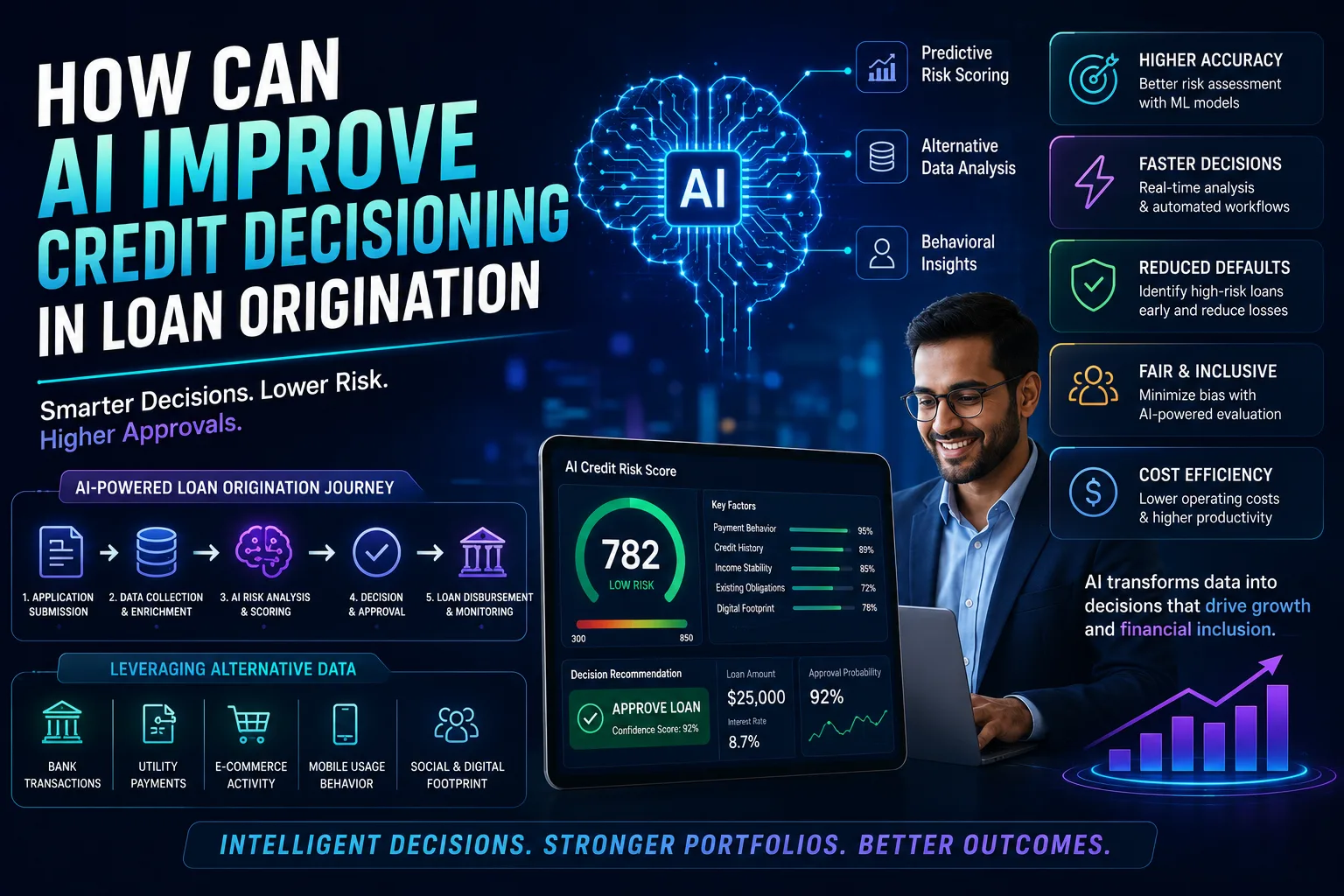
Rather than relying on a handful of financial metrics, AI analyzes thousands of data points simultaneously, creating a comprehensive picture of an applicant's financial health.
This intelligent approach improves both speed and decision accuracy.
Intelligent Credit Scoring
AI-powered credit scoring models go beyond conventional credit reports by incorporating additional financial information, including:
- Banking transactions
- Income consistency
- Employment history
- Savings patterns
- Debt obligations
- Cash flow trends
- Utility payments
- Alternative financial records
This allows lenders to assess applicants more fairly while expanding access to responsible credit.
Faster Application Processing
One of the biggest advantages of AI is automation.
AI can automatically perform tasks such as:
- Identity verification
- Income validation
- Document analysis
- Affordability calculations
- Credit risk scoring
- Decision recommendations
By automating these processes, financial institutions can reduce approval times from several days to just a few minutes for many applications.
Predictive Risk Analysis
Machine learning algorithms continuously analyze historical lending data to predict future borrower behavior.
Instead of evaluating only past financial activity, AI estimates the probability of repayment based on multiple behavioral and financial indicators. This enables lenders to make proactive lending decisions while reducing portfolio risk.
Fraud Prevention
Fraud detection has become an essential component of modern lending.
AI-powered fraud detection systems identify suspicious application patterns, detect forged documents, recognize unusual device activity, and flag duplicate identities before loans are approved.
Because AI models continuously learn from new fraud attempts, they become more effective over time.
Improving Operational Efficiency
Beyond improving lending decisions, AI significantly increases operational efficiency across the loan origination process.
Routine administrative tasks that once required manual effort can now be completed automatically. This reduces workloads for underwriting teams while allowing employees to focus on higher-value responsibilities.
Automation also minimizes human error, improves consistency, and reduces the cost of processing loan applications.
For financial institutions handling thousands of applications each month, these efficiency gains can translate into substantial cost savings.
Delivering a Better Borrower Experience
Today's borrowers value convenience as much as competitive interest rates.
AI improves customer experiences by providing:
- Faster approvals
- Digital document submission
- Real-time application updates
- Personalized loan recommendations
- Reduced paperwork
- Quicker communication
Many lenders also use AI-powered chatbots and virtual assistants to answer customer questions, guide applicants through the lending process, and provide support throughout the application journey.
These improvements increase customer satisfaction while encouraging higher loan completion rates.
AI Supports Smarter and More Inclusive Lending
One of AI's most valuable contributions is its ability to promote financial inclusion.
Traditional underwriting often excludes individuals with limited credit histories despite their ability to repay loans. AI evaluates alternative financial data, allowing lenders to assess applicants based on actual financial behavior rather than relying exclusively on traditional credit scores.
This approach enables responsible lending while creating opportunities to serve a broader customer base, including freelancers, gig workers, entrepreneurs, and young professionals.
Future Trends in Credit Decisioning in Loan Origination
The future of lending will be driven by increasingly intelligent technologies.
Several innovations are expected to reshape Credit Decisioning in Loan Origination, including:
- Explainable AI for greater transparency
- Open Banking integrations for real-time financial insights
- Generative AI to assist underwriters
- Continuous borrower risk monitoring
- Advanced behavioral analytics
- Hyper-personalized lending recommendations
These technologies will enable financial institutions to improve lending accuracy while delivering faster and more customer-centric services.
Conclusion
Artificial Intelligence is redefining Credit Decisioning in Loan Origination by helping financial institutions move beyond traditional underwriting methods. Through intelligent automation, predictive analytics, fraud detection, and comprehensive borrower analysis, AI empowers lenders to make faster, more accurate, and more confident lending decisions.
As competition in digital lending continues to increase, adopting AI is no longer simply an innovation—it is becoming a business necessity. Financial institutions that invest in AI-powered loan origination solutions will be better equipped to reduce operational costs, strengthen risk management, improve compliance, and deliver exceptional customer experiences in an increasingly digital financial landscape.