Type the same search into two different boxes, and you can end up in two different worlds. A colleague of mine tried this recently, half by accident. She searched for information on one browser tab using regular Google, and out of habit, opened the same query in an AI-powered search assistant on her phone. The two results barely overlapped. Different sources, different framing, even a different sense of what the "answer" actually was. It is a small, easy experiment, and once you try it yourself, it is hard to un-see. Even something as ordinary as someone researching an SEO course in Kolkata might find that a traditional Google search, an AI Overview and a conversational AI tool each point them toward a slightly different set of pages, recommendations or explanations. Nobody planned for search to work this way. It simply grew into it, one product launch at a time.
That single observation is the reason this article exists. Search is not becoming one thing. It is splitting into several overlapping systems that behave differently, retrieve differently and reward different kinds of content. For anyone who has built a career around SEO, or is thinking about learning it, this raises an obvious question: is the discipline dying, or is it just getting more complicated?
The honest answer is neither, exactly. SEO is not disappearing. But the version of SEO built purely around getting a blue link to rank first on a results page is already looking dated.
How AI Is Changing the Way People Search
Search used to be a fairly narrow act. You typed two or three words, scanned ten blue links, clicked one, and if it did not help, you went back and tried again. AI-powered search interfaces have stretched that behaviour in several directions at once.
People now type longer, more conversational queries because they can. Instead of "best laptop under 50000", someone might ask a chatbot to compare two specific models for video editing and battery life, then follow up with a second question refining the first. That back-and-forth pattern, natural in conversation, was never really possible with a traditional results page. Google's own generative AI features are built around this shift, aiming to handle more complex, multi-part questions and follow-up context within a single session rather than forcing a fresh search each time.
The practical effect is that a chunk of simple, factual queries, "what year did X happen", "how many grams in a cup", now get answered directly on the results page or inside a conversational interface, without a click to any website at all. The Pew Research Center tracked the browsing behaviour of a sample of 900 US adults through March 2025 and found that 58 percent of them encountered a Google AI Overview at least once that month. Within that sample, people clicked through to a traditional result in just 8 percent of visits when an AI Overview appeared, compared with 15 percent when no summary was shown, and only 1 percent clicked a link inside the summary itself. This is one study, of one country's users, on one platform, so it should not be read as a universal law of how everyone searches everywhere. But it is a useful, well-documented signal that a meaningful share of straightforward informational searches can be resolved on the page itself rather than sending anyone onward.
None of this means people have stopped searching, or stopped clicking altogether. Complex decisions, purchases, comparisons and anything requiring judgement still tend to pull people toward full websites, reviews and original sources. What has changed is the shape of the funnel. Simple queries get absorbed by the interface. Harder ones still travel outward.
Search Results Are Becoming More Fragmented
Here is the part that catches most people off guard: there is no longer a single "search results page" to optimise for. There are several, and they do not behave identically.
Google's own AI Overviews are drawn from its regular Search index and, according to Google's public documentation, are not governed by a separate ranking system or special markup. But a tool like Perplexity or ChatGPT's search feature works differently under the bonnet, running its own retrieval process across its own mix of sources. Industry research from BrightEdge, analysing citation patterns across Google AI Overviews, Google AI Mode, Gemini, ChatGPT and Perplexity, found substantial differences in which sources each system pulled from for comparable questions. That kind of vendor research is useful as a directional signal, since it is based on large, real-world datasets that few outside the industry have access to, but it is not peer-reviewed in the way academic work is, and its methodology is not always published in full, so it is worth treating as a strong hint rather than settled science.
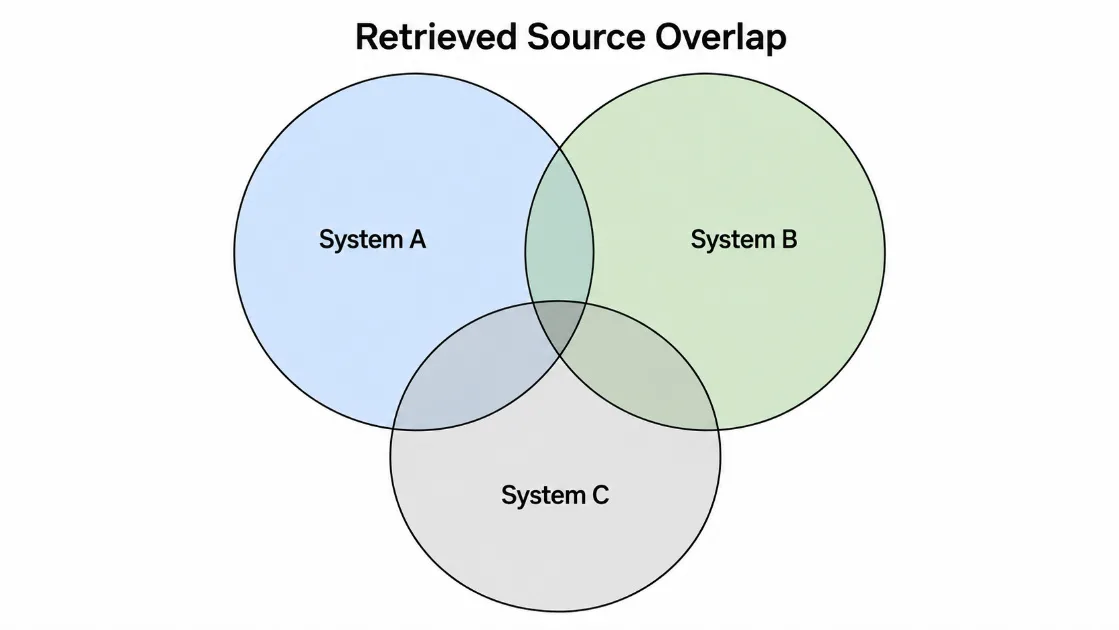
The more rigorous evidence on this point comes from an academic study presented at the 2026 SIGIR conference, in which researchers built a benchmark of 11,500 real user queries and compared the sources retrieved by Google's traditional search results, Google's AI Overviews, and Gemini Flash 2.5 for each one. Even though all three systems belong to the same company, the overlap in retrieved sources was consistently low, with an average Jaccard similarity below 0.2 across the dataset. In plain terms, for a typical query, roughly four out of five sources pulled by one system were absent from what another system pulled for that same question. It is worth being precise about what that figure does and does not show. It measures overlap in the sets of sources retrieved, not whether the systems disagreed about the underlying facts. Two engines can draw on almost entirely different sources and still land on broadly the same answer. What the low overlap does confirm is that the pool of pages being read, credited and potentially rewarded with visibility varies sharply depending on which system is doing the searching.
That is a genuinely strange state of affairs if you are used to thinking about "ranking number one." Number one where, exactly? On Google's traditional results, in an AI Overview, inside a chatbot's answer, or as a brand mention without any link at all? Visibility now has several separate, only loosely connected surfaces, and doing well on one does not guarantee doing well on another.
For publishers and businesses, the implication is uncomfortable but important to sit with. A page can be well optimised, technically sound and genuinely useful, and still be invisible on one AI platform while performing well on another, purely because of how that system retrieves and weighs information. This is not a flaw to be patched with a single trick. It is closer to how different newspapers, at different times, chose different stories to put on their front page, based on their own editorial judgement about what mattered.
Why the Same Query Can Produce Different Sources
The mechanics behind this vary by platform and are not fully public in every case, so it is worth being careful about overclaiming here. What research does support is that these systems differ in how they retrieve candidate pages, how they weigh signals like freshness, structure, authority and topical depth, and how they decide what to cite versus what to quietly draw on without attribution. Several analyses of AI search behaviour point to the same broader pattern: different systems can retrieve more sources than they ultimately cite, meaning the pages that shaped an answer and the pages visibly credited to the reader are not necessarily the same set.
This is worth sitting with for a moment, because it explains a lot of confusion that businesses feel when they check their AI visibility. A page can genuinely influence what an AI system tells a user without that business ever seeing a referral, a click, or even a mention. That is a fundamentally different relationship between content and outcome compared with traditional SEO, where a ranking and a click were tightly linked.
There is a useful, more detailed breakdown of why different AI search engines can surface different sources for identical questions, covering the retrieval and evaluation research behind this pattern in more depth, for anyone who wants to go further into the mechanics than this article has room for.
The takeaway is not that any one platform is right and the others are wrong. It is that "ranking" has quietly become several separate, imperfectly correlated outcomes, and a strategy built for only one of them is a strategy with a shrinking audience.
What AI Means for Traditional SEO
None of this makes the fundamentals of SEO irrelevant. If anything, most of them matter more, because the margin for being lazy has shrunk.
Search intent still decides whether content gets used at all, by a human or a machine reading on that human's behalf. Crawlability and clean technical foundations still determine whether anything can be indexed or retrieved in the first place, and a system that cannot fetch or parse your page cannot cite it either. Some recent research into AI Overviews has pointed specifically to crawler access as a factor worth watching, since a page blocked to the crawlers these systems rely on simply cannot enter the pool of candidate sources, however well written it is. Internal linking and site structure still help both search engines and AI systems understand what a page is actually about and how it relates to the rest of a site. Page experience, load speed and mobile usability have not become optional just because a chatbot can summarise text.
What has changed is emphasis, not existence. Where older SEO advice sometimes treated ranking as the finish line, the newer environment treats it as one of several checkpoints. A page needs to be findable, readable by both people and machines, structured clearly enough to be extracted and quoted accurately, and trustworthy enough that a system judging source quality has a reason to prefer it. Google's own guidance on generative AI features on Search puts it plainly: there is no separate playbook for appearing in AI features beyond producing content that is genuinely useful, demonstrates a clear point of view and satisfies the person reading it. That is a familiar instruction dressed in newer language.
AI, Content Quality and Originality
There is a difference between producing more content and producing something worth reading, and AI has made that gap far easier to see.
Generating text at scale has never been simpler. Generating something a reader could not have easily found ten other places is a different exercise entirely. Google has been explicit that automation, including AI, is not against its guidelines, and that its ranking systems do not penalise content simply because a machine helped produce it. What its documentation does flag, repeatedly, is content produced primarily to manipulate rankings, or pages that add little to no value beyond what already exists elsewhere. Its search quality guidelines specifically ask evaluators to look for "scaled content abuse" and material created with little effort, originality or added value, regardless of whether a human or a tool typed the words.
This is where first-hand experience starts to matter in a very practical way, not as a nice-to-have but as genuine differentiation. Original data, a specific case that only your business has seen, a nuance a generic AI-written summary would not know to include, these are the things that make a piece worth citing rather than skimming past. Google's own guidance repeatedly points back to the same idea, encouraging a clear, unique point of view rather than a rehash of what is already available elsewhere. That guidance is not a numbers game so much as a reminder that systems designed to synthesise information still need something distinctive to synthesise from.
None of this means AI-assisted writing is dishonest or doomed. It means the writing has to earn its place the same way it always did, just under closer scrutiny from systems that are, in effect, reading everything and comparing it against everything else instantly.
The Growing Importance of Human Expertise
There is a slightly counterintuitive pattern showing up as AI makes content production cheaper: human judgement is becoming more valuable, not less.
When the cost of producing an article drops close to zero, the scarce resource stops being words on a page and becomes something harder to fake, actual knowledge, verified facts, a defensible opinion, an example drawn from doing the work rather than describing it. Someone who has actually run a local campaign, actually built a technical migration, actually spoken to customers, brings something that a well-prompted model working from public information cannot easily replicate. That is not a comforting platitude. It is closer to a market correction. When supply of generic explanation goes up, the value of specific, verified, experienced knowledge goes up with it.
This shows up in fairly mundane, practical ways. Someone checking a competitor's claim before publishing it. Someone flagging that an AI-drafted paragraph has quietly misstated a statistic. Someone deciding that a topic genuinely needs a fresh interview rather than another summary of other people's summaries. None of it is glamorous. All of it is becoming the actual differentiator.
How SEO Professionals Are Adapting
The job itself has not shrunk. It has spread outward.
Technical SEO, content strategy and search intent research remain core skills, but they now sit alongside newer responsibilities: understanding how entities and brands get recognised and connected across different platforms, keeping an eye on how a business is represented in AI-generated answers as well as traditional rankings, and using AI tools to speed up research without letting them replace judgement about what is actually true or useful. Monitoring has become more layered too. Instead of one rank tracker, many practitioners now watch multiple discovery surfaces at once, comparing how a brand appears in classic search results against how, or whether, it turns up in AI-generated summaries.
This is not a fixed list, and anyone claiming to know the definitive future skill set for SEO in five years is guessing. What seems more solid is the direction: the role is becoming broader and more analytical, less about a single ranking metric and more about understanding an entire, messier discovery ecosystem.
What Businesses Should Focus On
Faced with all this fragmentation, the temptation is to chase every new platform individually. A steadier approach usually works better.
Build a website that is genuinely useful to the people it is meant to serve, not just structured to satisfy an algorithm. Publish content that demonstrates real expertise rather than reformatting what everyone else has already written. Keep information accurate and updated, since outdated pages are increasingly easy for both users and AI systems to spot and discount. Maintain the technical basics, fast loading, clean structure, accessible markup, because none of the AI-era changes removes the requirement that content actually be reachable. Pay attention to local search signals if location matters to the business, since local intent queries remain some of the most commercially valuable and are handled somewhat differently across platforms. And treat AI tools as an aid to research and drafting, not a replacement for someone checking the output against reality.
None of this is exotic advice. It has simply become less optional, because the systems evaluating content are now more numerous and, in some respects, less forgiving of shortcuts.
What SEO Beginners Should Learn
Anyone starting out in SEO today is entering a field that looks different from the one described in older training material, and that is worth acknowledging honestly rather than glossing over.
The fundamentals have not gone away. Keyword research, understanding search intent, on-page optimisation, technical SEO, basic analytics and comfort with tools like Google Search Console remain the backbone of the discipline. What has changed is the framing around them. Learning SEO today means less time memorising a fixed list of ranking factors and more time understanding how search actually works as a system, how information gets retrieved, evaluated, and presented across different interfaces, and how user behaviour shifts depending on which of those interfaces someone is using.
It also increasingly rewards a habit that used to be optional: evaluating information critically rather than accepting a single source at face value. Someone learning SEO now benefits from understanding how AI-assisted workflows can speed up research and drafting, while also learning to spot when an AI-generated summary has quietly gotten something wrong. That combination, technical grounding plus critical judgement, is arguably a more transferable skill set than the old approach of chasing individual algorithm updates.
Is SEO Becoming Harder?
In some ways, yes. In others, it depends what you mean by "harder."
Producing content has become easier than at any point in the industry's history. Getting that content discovered, read and trusted has arguably become more competitive, not less, because everyone else has the same easier production tools. The bottleneck has shifted from "can we make enough content" to "can we make content worth someone's attention in a space full of content that looks similar."
There is also a distinction worth drawing between visibility and outcome. Appearing in an AI-generated answer, even as a cited source, does not automatically translate into a website visit, the way ranking well used to reliably generate at least some click-through. Some early studies and industry analyses suggest that AI-referred visitors can behave differently from conventional organic visitors once they do arrive, since they have often already been given context before clicking. But conversion patterns like this vary substantially by site, industry and intent, and it would be a mistake to treat any single figure as representative of how AI traffic behaves everywhere. Businesses chasing AI visibility purely for its own sake, without a plan for what happens after someone actually lands on the page, are likely to be disappointed even if the citations look impressive.
What the Future of SEO May Look Like
Nobody can say with confidence exactly what search will look like in five or ten years, and any article claiming otherwise is guessing with more confidence than the evidence supports. What current patterns do support is a few cautious directions.
Conversational, multi-turn search seems likely to keep growing rather than reverse, since the underlying technology keeps improving and user comfort with it keeps rising. AI-generated summaries and answers are likely to remain a fixture of major search interfaces rather than a passing experiment, given how deeply Google, Microsoft and others have already built them into core products. Discovery is likely to stay spread across multiple surfaces rather than consolidating back into one, simply because different tools serve genuinely different use cases and audiences. Trusted, well-sourced, clearly structured content seems likely to keep earning an advantage across most of these surfaces, even as the exact mechanics of "trust" continue to be refined by each platform. And measuring visibility is likely to keep getting more complicated, requiring businesses to track several distinct surfaces rather than a single rank position.
Beyond that, specifics get speculative fast, and it is more honest to say so than to dress up a guess as a forecast.
Visibility Is Becoming More Than Rankings
The uncomfortable, useful truth sitting underneath all of this is that SEO was never really about tricking a single algorithm. It was always about making information findable, understandable and trustworthy enough that someone, or something, would choose to surface it. AI has not erased that goal. It has multiplied the number of systems trying to achieve it, each with its own quirks, blind spots and preferences.
That is a harder environment to master by shortcut, and a more forgiving one for anyone genuinely committed to doing useful, accurate, well-structured work. The businesses and practitioners who treat this moment as a reason to get better at the fundamentals, rather than a reason to chase whichever platform is loudest this month, are likely to be the ones still visible, in whatever form visibility takes, once the current wave of change settles into something more familiar.