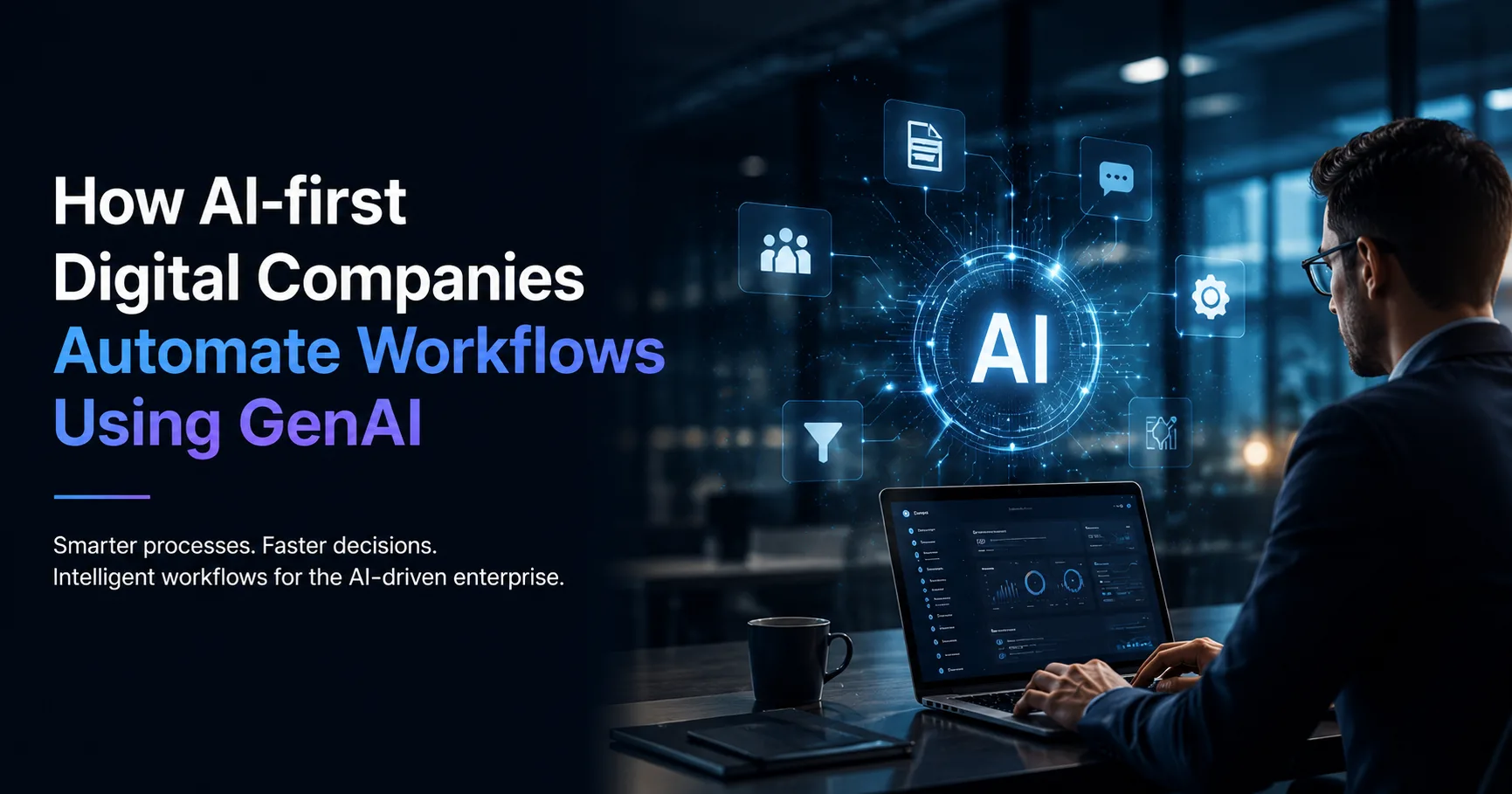
In today's rapidly evolving digital economy, companies need to automate, automate faster, and decrease inefficiency while making smarter decisions. The initial automation efforts at organizations centered on simple, rule-based workflows; however, enterprises today are progressing toward intelligent automation leveraging Generative AI (GenAI).
This shift is being spearheaded by AI-first digital companies, integrating AI in a manner that influences daily operations, software engineering, customer interactions, and internal processes. While some companies make AI an add-on or an afterthought, others create their systems, workflows, and delivery models with AI in mind from the beginning.
The result of this is that automation has become faster, smarter, and more adaptable to meet the needs of its businesses.
So, how does workflow automation fit into today’s AI-focused world?
What Is Workflow Automation in the AI-first Era?
Workflow automation is the use of technology to streamline the automation of repeated business tasks, approvals, communication, reporting, and operational tasks. Traditionally, these automations, based on a defined logic and ruleset, were rule-based.
This is where GenAI has changed things entirely.
The capabilities brought by Generative AI mean workflows are not confined to a set of repetitious rules. AI systems today can understand context, generate responses, analyze documents, summarize data, generate reports, assist with decision making, and also interact across different systems while learning from past behavior patterns. This way, not only simple repetitive processes but also knowledge-based processes that usually require human intervention can be automated.
Why AI-first Companies Are Investing in GenAI for Automation?
AI-first enterprises will experience an increase in operational speed, consistency, and scalability while using fewer human resources than would be typically needed to manage everyday departmental tasks in traditional businesses by focusing on the creation of operational systems that constantly improve upon themselves and rely less on human labour to use intelligent workflow systems supported by AI.
Organizations are implementing GenAI-based automation platforms for 4 main reasons:
- Speed to Create Operational Efficiencies: Manual workflows normally take a long time between departments when completing functions; however, creating automated workflows using AI allows companies to have instant access to respond to incoming requests, build a response, and send the request to the relevant department, allowing them to respond up to 10 times quicker.
- Less Reliance on Human beings: Many working hours are consumed by completing and submitting forms, writing emails, and answering support requests on behalf of employees, so automating these repetitive tasks using GenAI will drastically reduce the amount of time employees spend performing them.
- Improved Decision Making: Businesses generate an enormous amount of data as part of their day-to-day operations; therefore, automated workflows using AI will allow businesses to extract insights and context from data to enable management to make more timely, effective, and informed decisions.
- Better Customer Experience: Businesses will be able to respond faster to customer service inquiries, provide a higher quality of customer service through interactions, and employ intelligent AI agents to provide round-the-clock customer service.
- Scalable Digital Operations: As businesses scale, operational demands also grow proportionally. However, by using an AI-first automation workflow, it becomes possible to expand business operations with minimal increase in manpower.
How GenAI Is Transforming Business Workflows?
Across all business functions, Generative AI is making an impact. The following are some of the prominent areas where AI-first companies are using automated workflows.
1. Intelligent Customer Support Automation
Customer support workflows often include repeating the same answers to the customer's requests, ticket classification, and response generation. These can be automated through GenAI-powered AI agents, while maintaining context. Some of the ways AI agents can help:
- Generate personalized responses to customers
- Summarize the customer’s issue and context
- Intelligently route tickets
- Provide support agents with recommendations
- Provide help to the agents themselves
Unlike typical chatbots, these agents understand natural language and make adaptive responses based on the context of the user's intent.
2. AI-Powered Software Development Workflows
An AI-first company would rely on GenAI in most of its engineering work. This also makes engineering departments become AI-first. Automation in the development workflow:
- Code Generation
- Automated documentation generation
- Identification of bugs and code errors
- Automated test cases generation
- Assistance in Sprint Planning and Task Assignment
- Optimizing DevOps workflows
The result is not only improved speed of delivery but also a significant decrease in boring manual work. Most enterprises would consult an AI agent development company to build personalized and efficient AI systems based on their needs.
3. Automated Business Documentation
Documentation is often one of the most time-consuming tasks within an enterprise. It can include meeting summaries, SOPs, internal documents, and reports. By having the documentation created automatically, you can save valuable time that employees would otherwise be spending on such redundant tasks. GenAI can automate the generation of:
- Meeting summaries
- Technical documents
- Project reports
- SOPs
- Internal knowledge documents
- Business proposals
4. AI-driven HR and Recruitment Automation
Human resources departments often have a large number of HR-related tasks that must be performed manually. GenAI can automate many HR-related workflows for you. Examples include:
- Automated resume screening
- Candidate communication
- Automated interview scheduling
- Assistance for new joiners
- Answers to queries related to company policy
- Performance review summaries
5. Workflow Automation in Finance and Operations
Financial departments have traditionally been seen as less reliant on automation when it comes to knowledge-based work. However, even this field is rapidly changing. GenAI-powered finance workflows are improving everything from:
- Invoice processing
- Financial reporting
- Expense categorization
- Risk analysis
- Contract summarization
- Compliance documentation
The Rise of AI Agents in Enterprise Automation
One of the most significant changes to enterprise automation today is the rise of AI agents. AI agents are systems that are capable of performing actions by themselves, without human intervention. They achieve this through their inherent logic, understanding of the context provided to them, and business rules. It's different from current automation because they reason through things. So instead of simply moving a file from one folder to another based on a set of rules, AI agents can actually:
- Read incoming emails
- Understand the request
- Access internal systems
- Generate responses
- Create tickets
- Notify stakeholders
- Track progress automatically
With such sophisticated task execution, enterprises are increasingly exploring the possibility of building their own AI systems with their own specialized AI Agent development company.
Key Technologies Behind AI Workflow Automation
The smart workflows at AI-first companies rely on several sophisticated technologies:
- Large Language Models
- AI Agents
- Cloud native AI infrastructure
- API Integrations
- MCP-based AI integration
Challenges Businesses Face During AI Workflow Adoption
Despite the benefits of AI-powered workflows, there are certain challenges that businesses face during implementation:
- Data security and compliance issues
- Complex integration with old enterprise systems
- AI governance issues
- Management of change within the organization
Ensuring that AI does not make errors during automation process and does not create mistakes when performing operations.
Best Practices for Implementing GenAI Workflow Automation
AI-first organizations avoid a 'everything at once' approach to GenAI workflow automation and implement automation in strategic phases.
- Begin with high-impact tasks: Instead of automating everything at once, organizations typically begin with the most repetitive and time-consuming workflows.
- AI Assistant: Build systems that are assisted by AI, not totally AI-dependent. Human intervention will still play a crucial role.
- Prioritize integration-first: AI systems must have the ability to connect and seamlessly work with other business systems and workflows.
- Use real business data carefully: The quality of the business data used will have a direct impact on the quality and relevance of the automated output.
- Optimize and iterate: Automated workflows, with the help of AI, can be continuously improved with feedback and performance metrics.
How AI-First Workflow Automation Will Change the Future?
The future of workflow automation is heading in the direction of enterprise-level autonomous operations powered by AI agents, contextual reasoning, and real-time data.
In the near future, more businesses will adopt autonomously created AI workflows, multi-agent collaboration systems, AI-managed delivery governance, intelligent operations, predictive automation, and have enterprise-wide AI copilots.
Companies that embrace AI-first operational practices early will have a greater advantage in terms of long-term efficiency, scalability, and innovation than their competitors.
Conclusion
Generative AI technologies (including natural language processing) are changing the way companies automate their workflow. Instead of relying solely on conventional automation tools, AI-first digital companies are establishing intelligent operational ecosystems that include using AI agents, generative AI technologies, and cloud-based platforms to work together to increase productivity and speed up business processes.
In parallel to intelligent automation, enterprise usage of generative AI will enable organizations to build intelligent and more agile workflows than ever in the customer service, software development, human resources, finance, and enterprise operations spaces. With the infusion of AI into the enterprise via intelligent automation, its significance compared to digital transformation will increase. Organizations that take a proactive approach and implement generative AI thoughtfully into their processes will position themselves as future leaders by building highly scalable, efficient, and agile workflows.