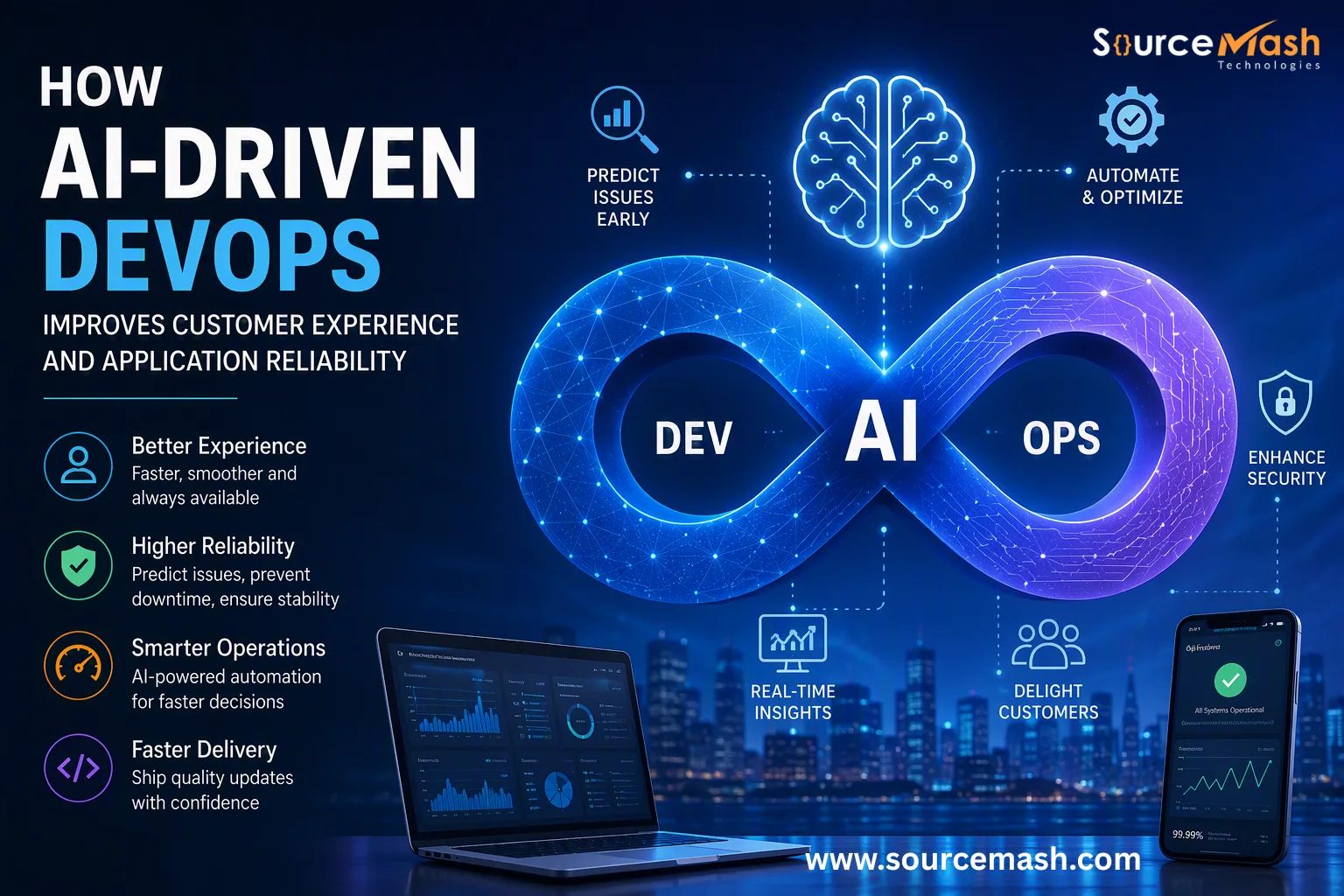
Modern applications are expected to be available around the clock, respond quickly, and deliver seamless user experiences. At the same time, organizations must release new features faster while maintaining stability and security. This challenge has led many businesses, including organizations working with Digital product engineering services in USA, to explore AI-driven DevOps as a way to improve operational efficiency and software performance.
AI-driven DevOps combines traditional DevOps practices with artificial intelligence and machine learning technologies. By analyzing large volumes of operational data, AI helps teams automate routine tasks, predict issues, and make faster decisions. The result is often better application reliability and a more consistent customer experience.
Understanding AI-Driven DevOps
DevOps is a software development approach that brings development and operations teams together to improve collaboration, automation, and delivery speed. AI-driven DevOps extends these capabilities by applying machine learning, predictive analytics, and intelligent automation throughout the software lifecycle.
Some common AI-powered DevOps capabilities include:
- Automated monitoring and alerting
- Predictive analytics for system failures
- Intelligent incident management
- Automated testing and quality assurance
- Performance optimization
- Security threat detection
- Capacity planning and resource management
Instead of relying solely on manual intervention, AI systems continuously analyze operational data and provide actionable insights.
Why Customer Experience Depends on DevOps Performance
Customers may never see the infrastructure behind an application, but they immediately notice slow performance, downtime, or errors.
For example, users can become frustrated when:
- Websites load slowly
- Mobile apps crash frequently
- Transactions fail during peak traffic periods
- Features do not work as expected
- Services become unavailable unexpectedly
Every technical issue directly affects customer satisfaction, trust, and retention. AI-driven DevOps helps reduce these problems by enabling faster detection, response, and prevention of operational issues.
How AI Improves Application Reliability
1. Predictive Issue Detection
Traditional monitoring systems often react only after a problem occurs. AI-powered systems can identify patterns that indicate potential failures before they impact users.
Machine learning algorithms analyze:
- Historical incident data
- Application logs
- Performance metrics
- Infrastructure utilization
By spotting unusual behavior early, teams can address risks before they become service disruptions.
Real-World ExampleA cloud-based application may experience increasing memory usage over several days. AI tools can detect the trend, predict a likely failure, and notify teams before the application crashes.
2. Faster Incident Response
When production issues occur, identifying the root cause can be time-consuming.
AI helps by:
- Correlating data from multiple systems
- Grouping related alerts
- Prioritizing critical incidents
- Suggesting potential causes
This reduces alert fatigue and allows engineers to focus on resolving the actual problem rather than sorting through hundreds of notifications.
3. Automated Remediation
Many repetitive operational issues can be resolved automatically.
Examples include:
- Restarting failed services
- Scaling infrastructure resources
- Reconfiguring network settings
- Replacing unhealthy containers
Automated remediation reduces downtime and improves service availability without requiring constant human intervention.
4. Smarter Testing and Deployment
Software failures often originate from defects introduced during development.
AI-powered testing tools can:
- Identify high-risk code areas
- Generate test cases automatically
- Detect anomalies during releases
- Recommend safer deployment strategies
This helps reduce the likelihood of production incidents caused by software updates.
How AI-Driven DevOps Enhances Customer Experience
Improved Application Performance
AI continuously monitors application performance and identifies bottlenecks that may affect users.
Examples include:
- Slow database queries
- API latency issues
- Resource shortages
- Network congestion
By resolving these issues quickly, organizations can deliver faster and more responsive digital experiences.
Reduced Downtime
Unexpected outages can damage customer trust and disrupt business operations.
AI-driven monitoring enables:
- Early issue detection
- Predictive maintenance
- Automated recovery actions
As a result, applications remain available more consistently.
Personalized Service Delivery
AI insights from operational data can also help organizations understand usage patterns.
Teams can use this information to:
- Optimize frequently used features
- Improve user journeys
- Allocate resources based on demand
- Prioritize enhancements that matter most to customers
While DevOps traditionally focuses on operations, AI helps connect technical performance with customer behavior.
Faster Feature Releases
Customers increasingly expect rapid innovation.
AI-assisted DevOps supports:
- Continuous integration
- Continuous delivery (CI/CD)
- Automated validation
- Deployment risk assessment
This enables teams to release updates more frequently while maintaining reliability.
Key Technologies Behind AI-Driven DevOps
Several technologies support AI-powered DevOps environments.
Machine Learning
Machine learning models analyze historical and real-time operational data to identify patterns and predict outcomes.
AIOps Platforms
AIOps (Artificial Intelligence for IT Operations) platforms use AI to automate monitoring, event analysis, and incident management.
Popular capabilities include:
- Log analytics
- Event correlation
- Root cause analysis
- Predictive alerts
Observability Solutions
Modern observability tools collect data from:
- Metrics
- Logs
- Traces
- User activity
AI processes this information to provide deeper visibility into system health.
Intelligent Automation
Automation tools execute predefined workflows when specific conditions or anomalies are detected.
This reduces operational overhead and accelerates response times.
Industry Trends Shaping AI-Driven DevOps
Growing Adoption of AIOps
Organizations are increasingly implementing AIOps solutions to manage complex cloud-native environments and large-scale applications.
Expansion of Cloud-Native Architectures
Microservices, containers, and Kubernetes environments generate vast amounts of operational data. AI is becoming essential for monitoring and managing this complexity efficiently.
Generative AI in DevOps
Generative AI tools are beginning to assist teams with:
- Code generation
- Documentation creation
- Troubleshooting recommendations
- Incident summaries
However, human oversight remains critical to ensure accuracy and reliability.
Increased Focus on DevSecOps
Security is becoming more integrated with development and operations processes.
AI-enhanced DevSecOps platforms can:
- Detect suspicious behavior
- Identify vulnerabilities
- Monitor compliance risks
- Prioritize security alerts
Challenges and Limitations
Despite its advantages, AI-driven DevOps is not a complete replacement for skilled engineering teams.
Data Quality Requirements
AI systems rely on accurate and sufficient data.
Poor-quality logs, incomplete monitoring, or inconsistent metrics can reduce prediction accuracy.
False Positives and False Negatives
AI models may occasionally generate unnecessary alerts or miss important issues. Organizations should regularly evaluate model performance.
Complexity of Implementation
Introducing AI into DevOps workflows often requires:
- Process changes
- Tool integration
- Staff training
- Governance frameworks
Successful adoption typically happens gradually rather than through large-scale transformations.
Security and Privacy Concerns
AI systems often process large volumes of operational data, making proper security controls, access management, and compliance practices essential.
Best Practices for Organizations
Businesses considering AI-driven DevOps can improve outcomes by following several practical guidelines:
Build Strong Monitoring Foundations
Ensure comprehensive collection of:
- Logs
- Metrics
- Traces
- Performance data
Quality data supports more accurate AI analysis.
Start With High-Value Use Cases
Focus initially on areas such as:
- Incident detection
- Alert management
- Capacity planning
- Automated testing
Early successes can help demonstrate value and reduce implementation risks.
Maintain Human Oversight
AI should support decision-making rather than replace experienced engineers entirely. Human review is especially important for critical production environments.
Measure Business Outcomes
Track metrics such as:
- Mean time to resolution (MTTR)
- Application uptime
- Deployment frequency
- Customer satisfaction scores
- Performance improvements
These measurements help evaluate the effectiveness of AI initiatives.
Conclusion
AI-driven DevOps is transforming how organizations build, deploy, monitor, and maintain software applications. By combining automation, machine learning, and advanced analytics, it helps teams detect issues earlier, respond faster, and improve system reliability.
The most significant benefit for end users is a smoother digital experience characterized by better performance, fewer outages, and more consistent service availability. While implementation requires careful planning, strong data practices, and ongoing oversight, AI-driven DevOps can play an important role in helping organizations meet growing customer expectations while maintaining reliable applications in increasingly complex technology environments