The question sounds simple, and the honest answer is that it depends entirely on where the sheet ends up. That is not a dodge. It is the reason decomposition claims are so easy to market and so hard to verify, and why buyers who run septic systems, off-grid cabins, campsites or hotels with aging pipework should care about the details.
Here is the practical version, without the vague promises about returning to nature.
Three Words That Get Confused
Biodegradable means microbes can break the material down into water, carbon dioxide and organic matter. It makes no promise about speed. Compostable is a narrower claim: the product breaks down under controlled composting conditions within a defined period and leaves no toxic residue. Flushable describes how fast something disperses in water so it clears plumbing, and says nothing about what happens after that.
A product can be flushable and still slow to break down, or biodegradable and not compostable. The label on the pack tells you which claim the brand chose to make, not which properties the fiber actually has.
Why Bamboo Breaks Down Faster Than Wood Pulp
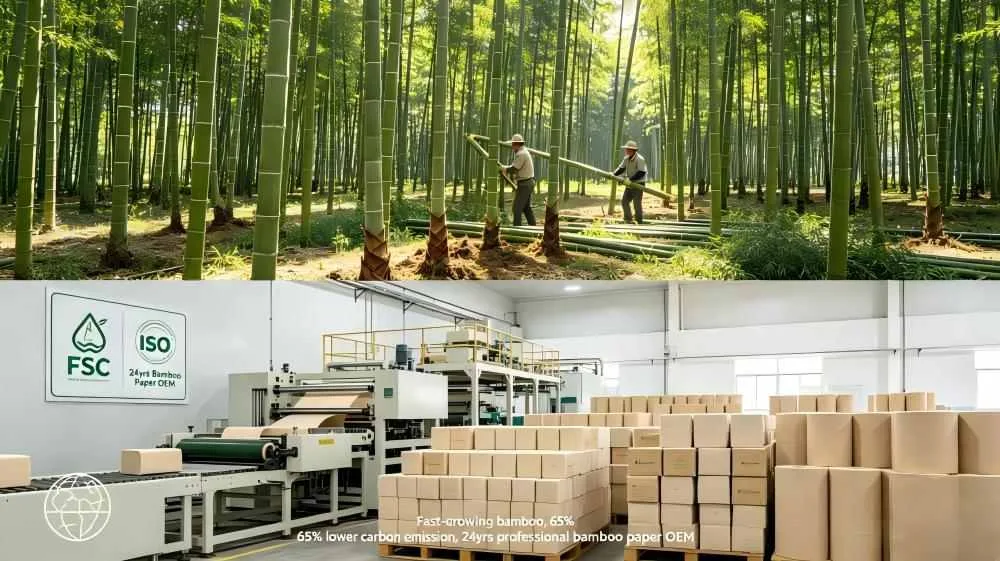
Bamboo is a grass, not a tree, and that changes the anatomy of the sheet. Its fibers are shorter and more flexible than the long, rigid tracheids found in softwood pulp, so water penetrates quickly and separates the plies instead of having to work through a dense interlocked structure. Bamboo also carries less lignin than dense hardwoods, and lignin is the polymer that most resists decay.
The manufacturing choices matter as much as the plant. Conventional tissue often relies on wet-strength resins, synthetic binders, heavy lotion and fragrance to survive use. Those additives form a barrier around the cellulose and slow the microbes that would otherwise digest it. A clean bamboo sheet, with no resin and no coating, gives those organisms direct access.
The Timeline, by Disposal Route
•Septic system: begins dispersing within hours, fully dissolved in days.
•Industrial composting: roughly 2 to 6 weeks, under sustained thermophilic conditions.
•Home compost pile: typically 1 to 3 months, depending on turning, moisture and pile size.
•Buried in soil: about 2 to 5 months, at ambient temperature.
•Landfill: several months to more than a year, because compaction removes oxygen.
The landfill number deserves emphasis. Buried under tonnes of waste, paper does not compost; it decays anaerobically, slowly, and releases methane while doing it. A product that is excellent in a septic tank is merely average in a landfill, and no fiber choice changes that.
The Four Variables That Move the Number
Moisture lets fibers swell and breaks the hydrogen bonds holding the sheet together. Temperature sets the metabolic rate of the microbes doing the work, which is why a summer pile outpaces a winter one by a wide margin. Oxygen decides whether you get fast, clean aerobic digestion or slow anaerobic decay. Additives decide whether the microbes are welcome at all.
Change any one of those and the timeline changes. This is why a supplier quoting a single figure for decomposition is either simplifying heavily or has not tested beyond one route.
So How Long Does Toilet Paper Take to Decompose, Practically Speaking?
In a working septic tank or a municipal sewer, think hours to days for the sheet to disperse and weeks for the fiber to be fully consumed. In a backyard compost pile, plan on a season. In landfill, do not count on it at all.
That is the answer most buyers actually need, and it is far more useful than a number pulled from a single lab test.
What to Verify Before You Trust the Claim
Ask for 100% virgin bamboo pulp in writing, because bamboo blend often means mixed with wood or recycled fiber. Ask which bleaching process is used and whether wet-strength resin appears anywhere in the formulation. Additive-free rolls decompose fastest, which is the same specification that qualifies a sheet as hypoallergenic toilet paper for sensitive-skin households. One specification, two benefits, and a compliance file that supports both claims.
Then ask the bamboo toilet paper supplier for the basics in a document you can keep: fiber composition, GSM, ply, bleach method, additive declaration and any dispersion or biodegradability test reference. Facilities teams putting tissue out to tender will be asked for exactly this, and having it on file turns a marketing conversation into a procurement one.
One Composting Caveat
Never compost sheets soiled with human waste in a backyard pile. Pathogens require sustained temperatures above 55°C that residential piles rarely reach uniformly. Clean scraps, wrappings and sheets used for spills are a different matter, and those are the only paper most households should be adding.
Decomposition is one of the few sustainability claims a buyer can genuinely verify. Ask where the sheet goes, then ask what it is made of. The two answers together tell you more than any badge on the pack.