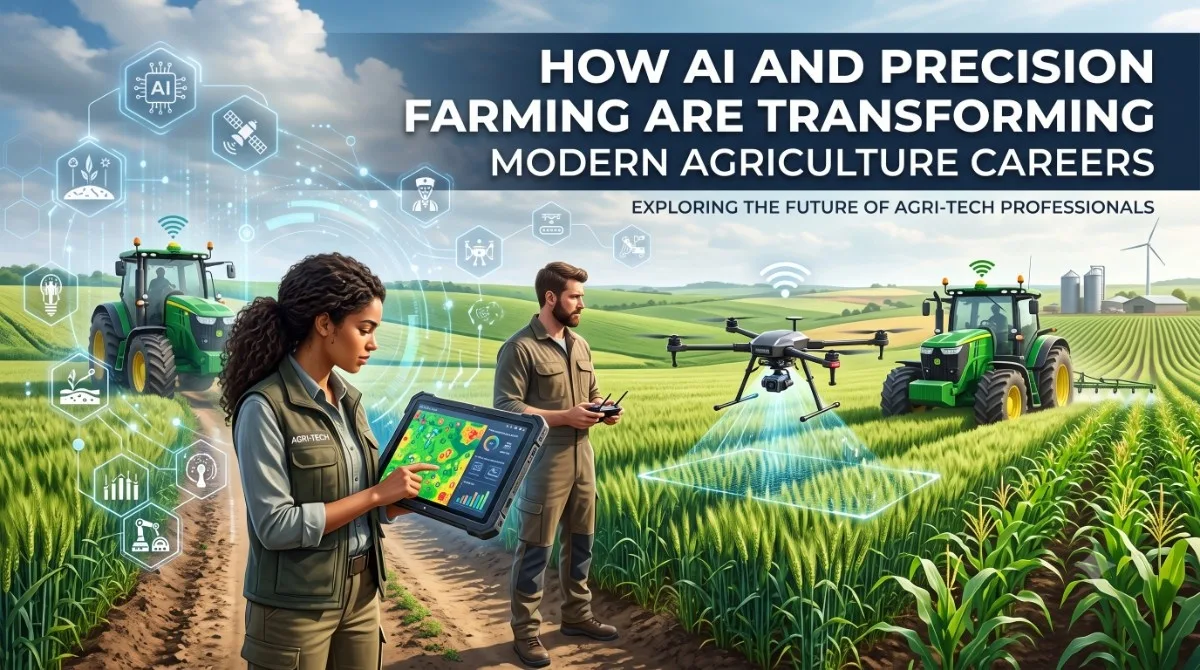
Agriculture is undergoing a paradigm shift in which technology is becoming as essential to farming as the land, water, and seeds. Artificial Intelligence (AI) and precision farming are two groundbreaking developments influencing the agricultural industry’s evolution. Additionally, these emerging trends open up a variety of exciting jobs for budding B.Sc. (Hons) Agriculture students.
How AI is used in agriculture
AI is an umbrella term that refers to a wide range of technologies that help in agricultural production processes. AI technologies make it easier to make farming decisions by analyzing the weather forecast, soil condition, crop status, and pest problems. These technologies can help in the following:
- Predicting crop diseases
- Recommending the best fertilizers and water for healthy crop growth
- Analyzing images from drones or other sources on plant development
- Forecasting crop yields
Understanding precision farming
Precision farming entails the judicious use of agricultural inputs throughout the cultivation process. Farming practices seek to meet crop needs rather than rely on traditional methods of fertilizing, sowing, pesticide application, and harvesting. This strategy enhances the quality of produce while reducing input usage, lowering costs, and promoting environmental sustainability through the use of GPS and other technologies.
Technology underlying AI and precision farming
Most of the above-plays are made possible by the following:
- Drones
- IoT-enabled sensors
- Satellite imaging
- Machine learning algorithms
- Farm management software
How AI and precision farming have changed the modern agriculture careers
Historically, careers in agriculture have been dominated by jobs in food production and the management of agricultural systems. However, these technologies have created several professions and shifted some responsibilities from traditional roles. The following are examples of new jobs in agriculture:
- Precision agriculture expert
- Drone pilot in agriculture
- Agri-tech business analyst
- Agronomist
- Agricultural analyst
- AI-powered crop management professional
- Agri-tech sales specialist
- Agronomist
Students enrolling in B.Sc. (Hons) Agriculture can benefit from various modern technology-related careers
Students pursuing B.Sc. (Hons) Agriculture at Kumaraguru Institute of Agriculture can benefit from their studies in various ways. In addition to gaining a comprehensive understanding of general agriculture, students can develop digital skills that will enable them to become preferred candidates in an increasingly technical job market. For example, they may acquire knowledge in the following areas:
- The fundamentals of artificial intelligence/data analytics
- Geographical Information Systems (GIS), remote sensing
- Drone operation and applications
- Farm management information systems
The abilities necessary to shape the future of agriculture
The following skills are necessary for students who wish to pursue technology-enabled agriculture:
- Have a fundamental grasp of artificial intelligence and data science.
- Have knowledge of remote sensing and geographical information systems (GIS).
- Interpretation of data concerning the soil, crops, and climate.
- Understanding of sustainable agriculture and how it works.
- Proficiency in communication, time management, and problem-solving skills.
The future of agriculture is bright with AI and precision farming
AI and precision farming are transforming agriculture by allowing farmers to make data-driven judgments and choices. This technology has already begun to influence agricultural production, where its applications are projected to continue to grow. It also has the potential to significantly influence future agriculture careers by generating jobs that necessitate both agricultural expertise and digital literacy. As a result, it will be critical to incorporate AI technologies in agriculture education to equip future students with the requisite skills for the evolving job market.