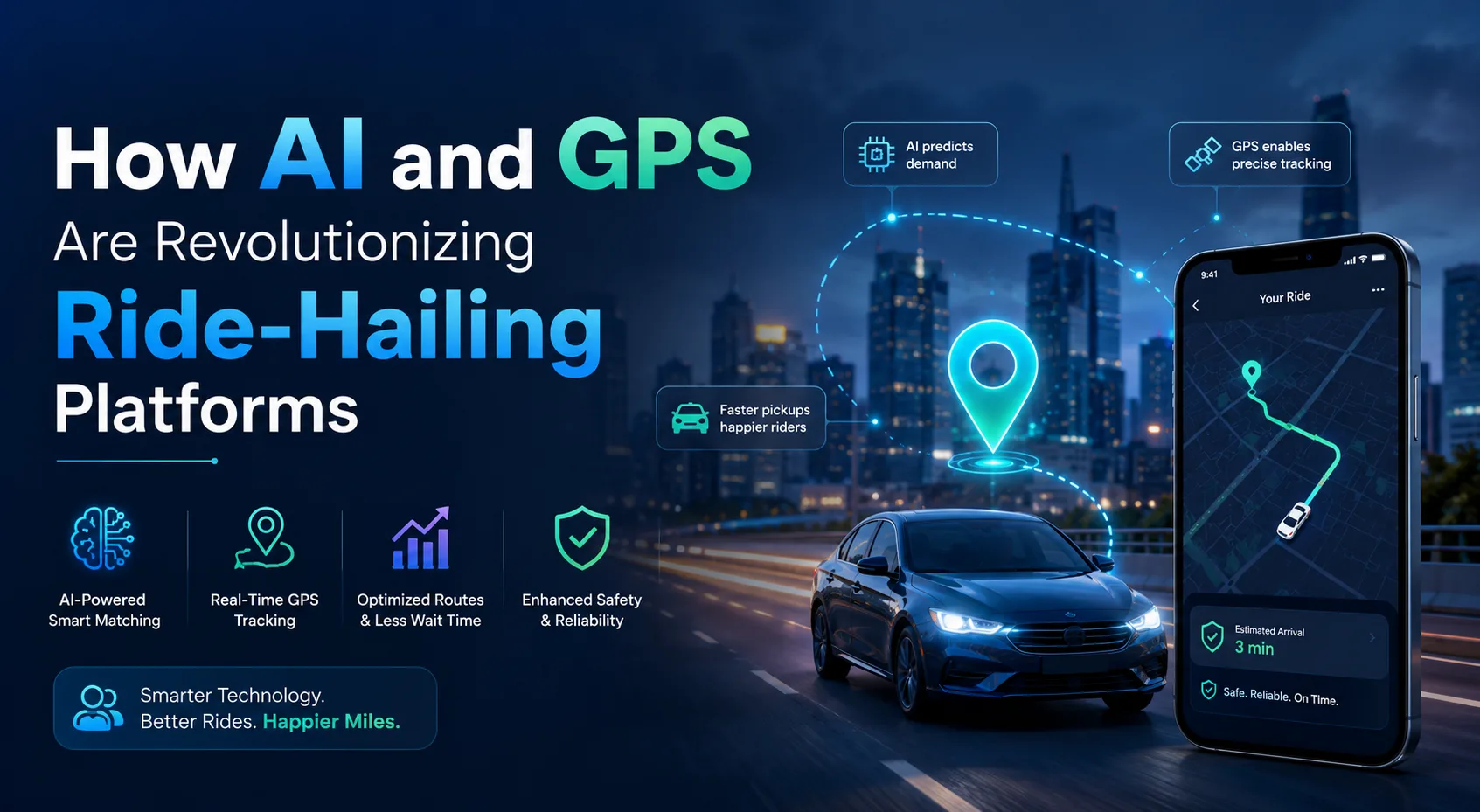
The global ride-hailing market isn't slowing down. More cities, more users, more demand for platforms that work reliably across diverse markets and operating conditions. If you're considering building a transportation platform in 2025, the opportunity is real but so is the complexity.
Here's a complete breakdown of what ride-hailing app development actually involves, from concept to launch.
What Is a Ride-Hailing App?
A ride-hailing app is a digital platform that connects passengers who need transportation with drivers who provide it — in real time, through a mobile interface. The passenger opens the app, enters a destination, confirms a booking, and a nearby driver is assigned automatically. Payment processes at trip end without cash changing hands.
That's the user experience. Behind it is a coordinated system handling live location data, intelligent driver matching, dynamic fare calculation, payment processing, and fleet oversight — all running simultaneously, all expected to work without interruption.
A ride-hailing app isn't a single product. It's a marketplace with two sides — riders and drivers — and an operator layer managing everything in between.
How Ride-Hailing App Development Works
Building a ride-hailing platform follows a defined process, even when the output is highly customized.
It starts with business requirement analysis — understanding the target market, the competitive landscape, the monetization model, and the operational workflows the platform needs to support. Then UI/UX design, where the rider app, driver app, and admin dashboard are mapped out into interfaces that are intuitive for each user type.
Backend architecture comes next — the most consequential technical decision in the entire process. This is where scalability, real-time performance, and integration capacity are determined. After architecture, frontend and backend development run in parallel, followed by third-party API integrations for maps, payments, and notifications. Then quality assurance, deployment, and post-launch support.
The full cycle for a custom build runs three to six months. White-label platforms with proven architecture can be live in seven days.
Key Components of a Ride-Hailing Platform
Every production-ready ride-hailing platform is built from the same core components, regardless of market or scale.
The rider app handles booking, tracking, payment, and communication. The driver app manages ride requests, navigation, earnings, and availability. The admin dashboard gives operators real-time visibility over every active ride, driver, fare configuration, and business metric.
Underneath these interfaces: a GPS and navigation layer processing continuous location data, a ride matching engine assigning drivers intelligently, a payment processing system handling transactions across multiple methods, a notification module keeping all parties informed at every step, and a security layer protecting user data and platform integrity across all of it.
Each component needs to perform independently and integrate cleanly with the others. A platform is only as reliable as its weakest integration point.
Step-by-Step Ride Booking Process
The ride booking flow from the user's perspective looks simple. From the platform's perspective, it's a chain of automated decisions happening in seconds.
Rider opens the app and enters pickup and destination locations. The fare estimation engine calculates a price based on distance, traffic, vehicle type, and current demand. Rider confirms the booking. The matching engine identifies and assigns the nearest suitable driver. Driver receives the request and accepts. Rider sees live driver location and ETA on the map. Driver navigates to pickup, collects the rider, completes the trip. Payment processes automatically. Both parties rate the experience.
Each step in that sequence depends on a different system component. When every component is working correctly, the whole flow feels effortless.
Essential Features for Riders, Drivers, and Admins
Feature requirements differ by user type but the principle is the same across all three — every feature should reduce friction and increase reliability.
Riders need real-time booking, live GPS tracking, fare transparency, multiple payment options, ride scheduling, trip history, in-app communication, and SOS safety tools.
Drivers need streamlined onboarding and verification, live ride request management, turn-by-turn navigation, earnings dashboards, incentive tracking, and availability controls.
Admins need complete operational visibility — active ride monitoring, driver management, fare and commission configuration, dispute resolution, promotional campaign tools, and platform-wide analytics.
The admin layer is consistently underbuilt in early-stage platforms. By the time operators realize how much they need it, retrofitting it is significantly harder than building it right the first time.
Technologies Used in Ride-Hailing App Development
The modern ride-hailing tech stack is well-established. React Native or Flutter for cross-platform mobile development. Node.js or GoLang for high-concurrency backend services. PostgreSQL for transactional data, Redis for real-time operations. AWS or Google Cloud for auto-scaling infrastructure. Google Maps API or Mapbox for geolocation and routing. Stripe or Razorpay for payment processing. AES-256 and SSL/TLS for security.
What matters isn't just which technologies you choose — it's how well they're integrated, optimized for real-world load, and monitored in production. A well-chosen stack poorly implemented underperforms a simpler stack built and maintained with discipline.
Benefits of Building a Ride-Hailing App
For businesses, the value proposition is multi-dimensional. Multiple simultaneous revenue streams — ride commissions, surge pricing, driver subscriptions, in-app advertising, corporate packages. Real-time fleet visibility. Scalable operations that grow without proportional increases in overhead.
For users, the value is convenience, transparency, and safety. Verified drivers. Fare estimates before booking. Live tracking throughout the trip. Payment without friction.
The platforms that retain both riders and drivers long-term are the ones that consistently deliver on both sides of that value equation — not just at launch, but as the platform scales.
If you want a detailed breakdown of how these benefits translate into platform architecture, the ride-hailing app development page at AppDrives covers the full component structure and what each layer is built to deliver.
Challenges in Developing a Ride-Hailing Platform
The hardest problems don't announce themselves during planning. They surface under real operating conditions.
Real-time GPS at scale requires WebSocket infrastructure and geospatial database optimization. Traffic spikes demand microservices architecture and cloud auto-scaling. Intelligent matching requires ML models, not proximity calculations. Payment reliability needs to be engineered for failure scenarios. Fraud detection needs to be operational from day one. Regulatory compliance differs by market and needs to be built into the platform architecture, not handled case by case after expansion.
None of these are insurmountable. All of them are significantly easier to address before the architecture is finalized than after.
Tips for Creating a Successful Ride-Hailing App
Start with architecture, not features. The decisions made at the foundation level determine how easily everything else is added, scaled, and maintained.
Know which side of the marketplace you're optimizing for first. Most platforms fail because driver supply is insufficient at launch — riders open the app, see long wait times, and don't come back. Nail driver onboarding and supply before scaling rider acquisition.
Choose your market entry strategy deliberately. White-label for speed and proven infrastructure. Custom development for genuinely unique operational requirements. Most businesses entering this market benefit more from launching quickly with a proven platform than spending six months building from scratch.
Build driver retention into the product from the start. Earnings transparency, fair matching, and reliable support keep supply healthy — and healthy supply is what makes rider experience possible.
Test everything under realistic load before launch. The staging environment should simulate your worst-case peak traffic, not your average day.
Final Thoughts
Ride-hailing app development in 2026 is a mature discipline with proven technology, validated business models, and well-understood operational challenges. What remains hard is execution building a platform that works reliably under real-world conditions, scales without drama, and delivers an experience that keeps both riders and drivers coming back.
The competitive advantage in this market doesn't come from the idea. It comes from how well the platform is built, how thoughtfully the operations are designed, and how consistently the experience holds up at scale.
Build the foundation right and everything else follows.