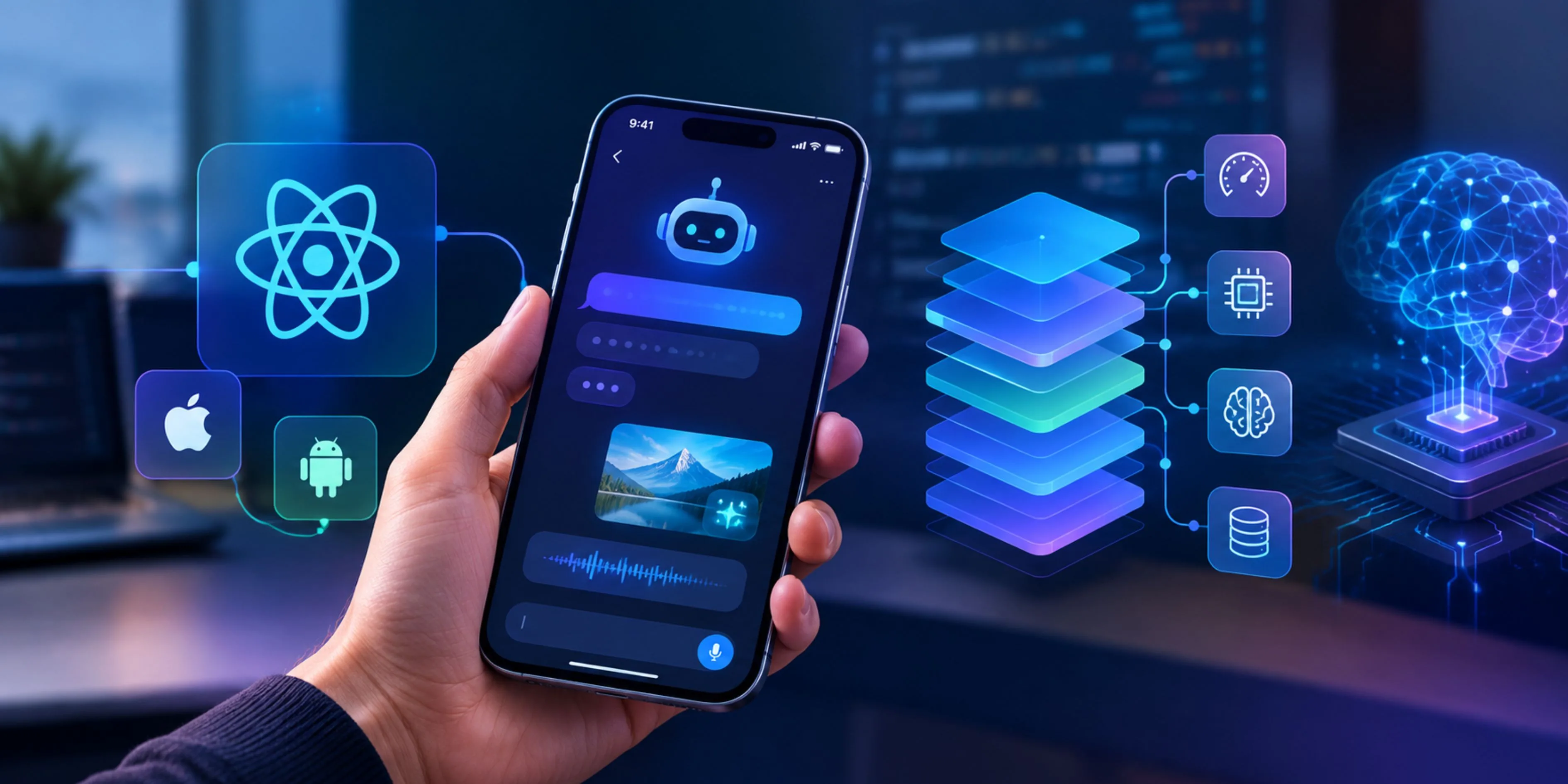
For years, mobile applications have followed the same basic interaction model: users open an app, find the right feature, complete several steps, and close it. AI agents are beginning to challenge this model by allowing users to describe what they want done rather than manually navigating how to do it.
Google is already building this direction into Android. Its AppFunctions framework allows apps to expose specific capabilities as tools that AI agents and assistants can discover and execute, while Android's broader intelligence system is designed around completing user tasks rather than simply opening applications.
This shift will have major implications for Mobile Application Development Services. The future app will not only be a collection of screens and buttons; it will increasingly become a set of capabilities that AI can understand, orchestrate, and execute.
From Opening Apps to Completing Tasks
Consider a travel application.
Today, a user may open the app, search for flights, select dates, compare options, choose a seat, and complete payment.
In a task-based experience, the user could simply say:
“Find me the cheapest morning flight to Delhi next Friday and prepare the booking.”
The agent could interpret the request, search available options, apply the user's preferences, and return an actionable result.
The application still exists, but the interface is no longer the primary entry point. The user's goal becomes the starting point.
Google describes this transition explicitly: instead of requiring users to open apps and perform tasks step by step, AI can take on more of the work, shifting success toward how effectively an application fulfills the user's intended task.
1. App Features Will Become AI-Callable Capabilities
This is one of the biggest architectural changes.
Traditional apps expose functionality through screens:
Home → Search → Product → Cart → Checkout
Agent-ready applications need to expose functionality as structured actions:
searchProduct() → addToCart() → checkout()
Android's AppFunctions provides a concrete example of this approach. Apps can register functions that authorized agents or assistants can discover and execute to complete tasks.
For developers, this means APIs, permissions, business logic, and data models will need to be designed not only for human interaction but also for machine-driven orchestration.
Instead of asking, “Which screen should we build?”, teams will increasingly ask:
“Which capabilities should an AI agent be able to invoke?”
2. Mobile UX Will Shift From Screens to Intent
AI agents will not eliminate traditional mobile interfaces. Instead, they will create another interaction layer above them.
A banking application, for example, may still have dashboards, transaction screens, cards, and account settings. But users could also say:
“Show me subscriptions I haven't used this month.”
The agent could interpret the request, retrieve transaction information, identify recurring services, and present the relevant results.
This creates a new UX principle: design around intent, not only navigation.
Developers will need to understand natural-language inputs, ambiguous requests, user context, permissions, and confirmation requirements. Traditional UX testing will therefore expand from “Can users find this button?” to “Can the agent correctly understand and complete this task?”
3. Multi-Step Workflows Will Become Agent Orchestration
Many mobile experiences involve several dependent actions.
Imagine a food-delivery application where a user asks:
“Order my usual dinner, but make it vegetarian and deliver it at 8 PM.”
An agent could potentially:
- Identify previous orders.
- Understand the user's dietary requirement.
- Search suitable restaurants.
- Compare available options.
- Select an appropriate meal.
- Schedule delivery.
- Ask for confirmation before payment.
This is different from simply adding a chatbot to an application.
The agent needs planning, tool access, memory, context, and controlled execution. Modern agent architectures can also use multiple specialized agents for complex workflows rather than relying on one model for every operation.
4. On-Device AI Will Become Important for Agentic Apps
Agentic experiences will frequently deal with sensitive information such as location, messages, calendar events, financial information, and personal preferences.
That makes the location of AI processing an important architectural decision.
Android's current AI development direction includes on-device models and hybrid orchestration, where some tasks can run locally while more complex operations can be handled through cloud models. Google's Android ADK, for example, supports combinations of cloud and on-device agents.
For iOS App Development Services, similar architectural thinking will be important: developers will need to determine which operations should happen locally for privacy, latency, and offline availability, and which require cloud-scale reasoning.
5. Cross-Platform Development Will Need Agent-Ready Architecture
Frameworks such as React Native already help teams share application logic across platforms. As agentic capabilities become more important, cross-platform architecture will need to account for another layer: platform-specific AI and system integrations.
For example, a business may use react native app development services for its core application while implementing platform-specific capabilities where deeper operating-system integration is required.
The objective will not simply be “write once, run everywhere.” It will increasingly become:
“Expose consistent business capabilities while taking advantage of each platform's AI ecosystem.”
6. Security Will Move From Login Protection to Action Protection
AI agents introduce a different security problem.
A conventional application protects data and functionality through authentication and authorization. An agentic application must additionally control what an AI agent is allowed to do.
For example, reading a user's order history might require one permission, while cancelling an order or making a payment should require stronger authorization and potentially explicit user confirmation.
AI-agent security therefore needs:
- Fine-grained permissions
- Tool-level authorization
- Secure API access
- Human confirmation for high-impact actions
- Audit logs
- Protection against prompt injection
- Continuous monitoring
Research and industry guidance increasingly emphasize keeping humans in the loop, protecting agent data, monitoring agent behavior, and maintaining transparent controls.
7. Development Teams Will Build for Agents as Well as Users
AI agents are also changing the development process itself.
Agents can assist with code generation, testing, debugging, code review, documentation, and CI/CD workflows.
Google's 2026 Android Bench 2.0 direction is particularly notable because it evaluates AI systems against longer, more realistic Android engineering tasks rather than only small coding changes.
This suggests that future Mobile Application Development Services will increasingly involve AI-assisted engineering alongside conventional software development.
What This Means for Debut Infotech
For companies such as Debut Infotech, the opportunity is not simply to add an AI chatbot to existing mobile products. The larger opportunity is to architect applications around agent-ready capabilities, contextual data, secure tool execution, and task completion.
The strongest mobile products will likely combine traditional interfaces with agentic workflows rather than completely replacing one with the other.
The app will remain the product—but users may increasingly interact with it through an AI agent that understands their intent and coordinates the underlying capabilities.
The Next Mobile App Is a Task Engine
The transition from app-based to task-based experiences will change how mobile products are planned, designed, developed, and secured.
The question will gradually move from:
“How do we get users to navigate our app?”
to:
“How can our application understand what users want and safely accomplish it?”
That change makes AI agents more than another mobile feature. They represent a new interaction and architectural model—one where successful applications are built not only around screens, but around capabilities that can be discovered, reasoned over, and executed to complete real-world tasks.