
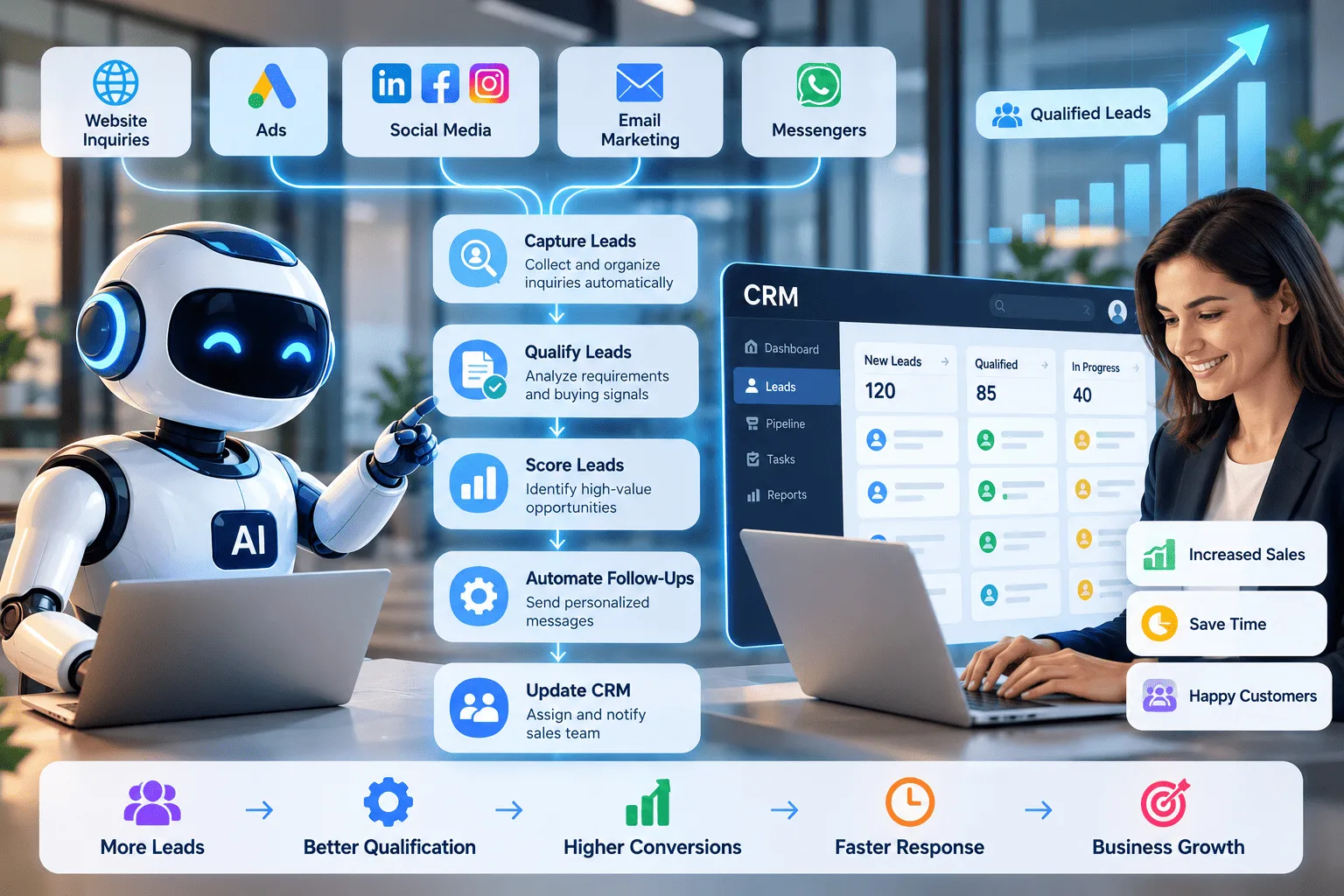
Although generating leads is important for business growth, the main concern is qualifying the prospects finding ways to respond to inquiries and guiding the sales process.
Companies are investing resources into advertising, SEO, social media marketing, email marketing and other methods to attract clients. However, leads are being lost due to delayed responses, disorganization, time spent by employees on repetitive tasks, and other issues.
AI agents and business automation can help companies streamline their lead generation and qualification process and improve sales without overloading the employees with repetitive tasks.
How AI Lead Generation Works
AI agents are software systems that utilize artificial intelligence to perform tasks, process information and make recommendations within a specified scope.
Unlike general-purpose automation tools, AI agents can analyze customer inquiries, process lead information and perform specific actions depending on the information, instructions and automation rules.
An AI lead generation agent can help businesses capture and qualify leads by:
- Collecting information from website inquiries, landing pages and marketing campaigns
- Gathering prospect information
- Processing requirements and analyzing buying signals
- Recognizing prospects that match the company's ideal customer profile (ICP)
- Generating follow-up messages
- Updating CRM data
- Notifying sales representatives
This way, businesses can qualify leads with AI tools and dedicate more time and effort to communicating with clients.
Why Traditional Ways of Lead Generation Are Inefficient
A real estate business may receive numerous customer inquiries via the company website, Google Ads, WhatsApp and other property listing platforms.
The prospects inquire about the availability of three-bedroom apartments. Although the customer inquiry is relevant, the sales executive might not reply promptly, as they are currently talking with another client.
As a result, the prospect may turn to another real estate company in search of a suitable offer. Similar situations occur in various industries: consulting, education, technology, healthcare and others.
There are three main reasons why traditional methods of lead generation are ineffective.
1. Ineffective Response to Inquiries
Prospects are interested in receiving timely responses to their inquiries. However, businesses often receive inquiries via multiple channels, where the information is processed by different departments.
In addition, the employees who received the customer inquiry may not be available at the moment. As a result, the prospect may turn to a competitor to find a solution faster.
2. Time-Consuming Qualification of Leads
Many employees spend hours analyzing customer requirements and qualifying leads to find out which prospect will respond positively to the offer.
3. Disorganization of Information About Prospects
Customer identification and personal information is kept in different systems: CRM, spreadsheets, email, messengers and others.
AI-powered automation tools can resolve these issues by integrating communication channels, removing repetitive tasks or automating them with the use of artificial intelligence.
How AI Agents Can Help With Lead Generation
1. Automatic Capture of Leads
Businesses are using multiple sources to generate leads and receive customer inquiries. The information is manually entered into a CRM or another customer database. However, automating this process can reduce the workload of marketing and sales employees and improve lead quality.
The main sources of leads include websites, social media accounts, online advertisements, email marketing, messengers and others.
An AI-powered agent can be instructed to capture the information about the prospect and place it into a CRM, where the lead will be given a status and a responsible employee.
For example, when a customer fills out a contact form on a website, an automated agent can:
- Save this lead
- Mark lead source
- Prevent duplicate entries
- Notify the responsible employee
2. AI Qualification of Leads
Not all customer inquiries are equal: some prospects are ready to make a purchase, while others will require additional convincing.
An AI lead qualification agent can help businesses analyze the requirements of prospects, their intention to purchase, budget, industry and other factors.
The qualification process typically involves a set of criteria:
- Budget (can the prospect afford the offer?)
- Authority (does the prospect have the power to make a purchase decision?)
- Need (is there a genuine need for the business's offer?)
- Timeline (when is the prospect going to make a purchase decision?)
The AI qualification agent will analyze the information provided by the prospect and the user input to identify the most suitable leads. The accuracy of qualification will depend on the depth of information and specific instructions for the AI.
Businesses that are interested in finding out how AI lead qualification works can take a closer look at AI WorksForce's AI Lead Qualifiction Agent.
3. Lead Scoring by AI
Lead qualification typically has specific criteria that lead to a "Yes" or "No" answer. However, scoring leads allows businesses to prioritize sales opportunities and dedicate more resources to the most relevant leads.
An AI lead scoring agent can analyze the following information:
- Customer's company: size and industry
- Lead qualification information
- Lead's budget
- Interaction with the company's website or email
- Readiness to make a purchase
- Correspondence with the company
- Ideal customer profile
For example, a prospect who requested a product demo and specified the implementation timeline will receive a higher score than a lead that downloaded the company's white paper.
Sales executives can prioritize higher-scored leads to increase conversion rates.
It is also important to note that lead scores should not be regarded as a guarantee of conversion.
4. Automated Follow-Up After Receiving a Prospect Inquiry
Follow-up after receiving a customer inquiry is one of the most crucial stages in the lead generation process. However, tracking each conversation and sending follow-up messages is a time-consuming endeavor for sales executives.
An AI agent can help automate the follow-up process after a prospect inquiry.
The messages will differ depending on the client's interest, which means that businesses can develop specific responses to different types of inquiries.
For example, the follow-up message about CRM automation will differ significantly from the message about lead generation services. At the same time, businesses can combine AI-generated content with pre-approved templates to ensure that the messages are relevant and personalized.
Follow-up messages after a prospect inquiry should also consider the terms of service and data privacy regulations.
5. CRM and Sales Pipeline Automation
Sales representatives can benefit from having CRM and sales pipeline automation, which will update the status of leads, assign responsible employees and prepare reports on the sales growth.
Integrating AI agents and automation with a CRM will help sales executives and managers:
- Manage and update lead records
- Designate responsible employees for each lead
- Update qualification status
- Prepare sales reports and forecasts
- Schedule follow-up messages
- Identify inactive leads
- Track the sales pipeline
For example, when a prospect has scheduled a consultation, the lead status and responsible employee can be updated with a single click. This way, the sales pipeline will reflect the actual progress made with each lead.
How Business Automation Can Help the Entire Lead Generation Process
AI agents can become an integral part of a business's lead generation process by cooperating with automation tools and CRM.
An example of a lead generation process includes the following elements: lead source, data capture, AI qualification, lead scoring, CRM, communication follow-up, sales representative and conversion.
Each step is vital to help a prospect move from a simple inquiry to a potential conversion.
The lead generation process begins with capturing data from the lead sources, which include the company's social media accounts, website, online advertisements and other sources. Then, the captured information is organized to determine whether the prospect qualifies for a "Yes" or "No" answer.
Depending on the qualification results, the AI agent can update the lead scoring system, update the CRM and schedule the next steps.
When the sales executive determines that the inquiry requires human interaction, the communication will be handed over to the sales representative, who will provide the prospect with more information and support.
This way, businesses can utilize both AI automation and sales executives.
AI Assisted Lead Management in Real Estate
A real estate agency receives around 100 customer inquiries about three-bedroom apartments. The inquiries come from various sources: the company's website, Google Ads and WhatsApp. To analyze the prospects' requirements, the employees need to check each message and add the information to a spreadsheet.
When the requirements are identified, the sales executive will need to contact the prospect to discuss the details. However, with AI assist, the lead generation and qualification process can be automated.
Step 1: Capturing Inquiries
The AI agent captures the customer inquiries from the website and WhatsApp channels and stores the information in a CRM.
Step 2: Requirements Extraction
The AI agent extracts the required information about the property from the inquiry, such as the type, preferred location and others.
Step 3: Lead Qualification
The lead qualification agent analyzes the extracted information about the prospect's requirements.
Step 4: Lead Assignment
The qualified lead is assigned to a sales executive.
Step 5:Follow-Up
The follow-up message can be sent automatically to the prospect or approved by the sales executive.
Step 6: Sales Pipeline
The real estate agency's sales pipeline will update its CRM and provide the sales executives with the necessary information about the lead.
As seen from the example, the lead management process became more organized. Businesses will need to conduct independent research to find out if automated lead qualification improves the conversion rate and reduces the cost per lead compared to the previous quarter.
The Human Touch Remains Important in AI Assisted Sales
Despite the remarkable benefits of utilizing AI agents in lead generation, human interaction remains vital in the sales process. For example, customers may have special requirements that cannot be recognized by an unstructured qualification form or need to discuss specific terms of a sale.
Humans are also essential for addressing objections, negotiating terms, discussing long-term collaboration, reviewing special cases and preparing detailed proposals.
The most efficient method to utilize AI agents in lead generation is to delegate repetitive tasks to them and involve humans in the complex sales processes.
How AI WorksForce Helps Businesses Build AI Assisted Sales Operations
There is more to building AI assisted business operations than choosing an AI agent. Companies need to analyze their current sales operations and identify the tasks that can be automated.
AI WorksForce helps businesses implement effective AI assisted business operations by focusing on AI agents, automation, data intelligence, CRM, sales operations and human experience.
Its approach revolves around the companies' requirements and needs. Depending on the industry, lead generation or qualification, sales pipeline, automation or data intelligence, AI WorksForce will assist in transforming the business processes.
How to Get Started With AI Assisted Lead Generation
Companies that want to integrate AI assisted lead generation into their sales operations should start by observing the current sales process and identifying areas that require optimization. For example, the lead qualification process can become automated when the sales executives provide the AI agent with a detailed description of an ideal prospect.
The businesses should also consider the sources of their leads and determine how to collect and organize the information automatically.
The AI assisted qualification process will reduce costs and dedicate more time to sales executives. However, it is essential to measure and analyze the performance of the process to identify weak points and improve it with the help of sales executives.
The most useful metric is the improvement of the lead qualification process itself: reduced response time and increased score-to-lead ratio.
The next step is to analyze the sales pipeline and follow-up automation to find out how to improve the customer conversation flow.
Final Thoughts
AI agents and business automation help companies organize and optimize their lead generation and qualification process. Businesses can capture, qualify and follow up on leads without overloading the sales executives. The effectiveness of AI assisted processes depends on the quality of information, rules and supervision.
Companies that are looking to improve their lead generation process should start by examining the current state of affairs and identifying points that require optimization.