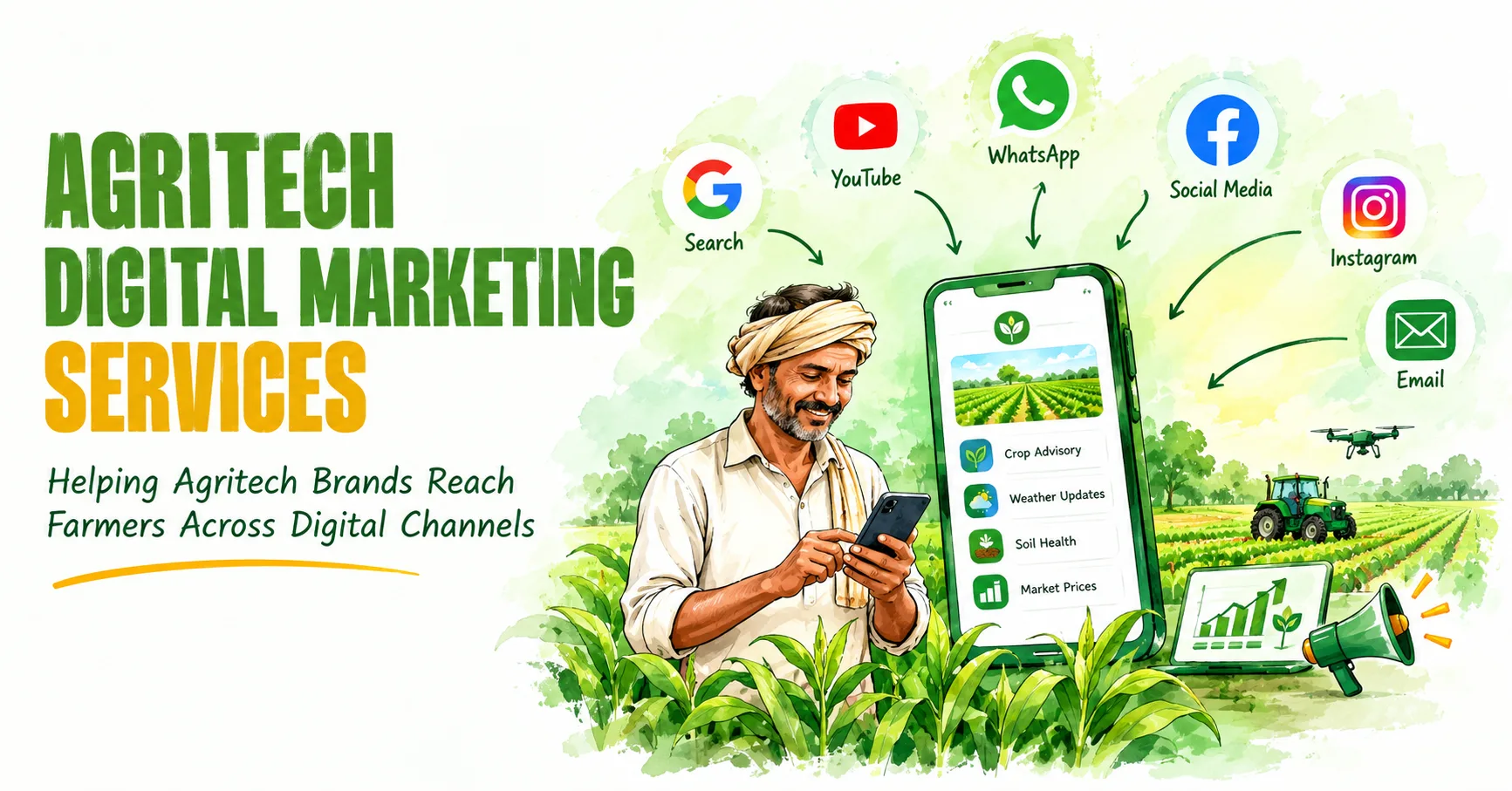
A farmer looking for a new crop advisory tool, irrigation system, or farm-management platform may not begin with a sales call.
They might search Google. They may watch a YouTube demonstration, check a WhatsApp message, ask someone in a farming group, or look for reviews before making a decision.
That change in behaviour is important for agritech companies.
A useful agritech digital marketing approach is no longer about putting the same product message on every platform. It is about understanding where farmers and agricultural businesses look for information, what questions they have, and what makes them comfortable enough to consider a new solution.
For an agritech brand, reaching the right audience is only half the job. The other half is explaining the product in a way that makes sense in a real farming environment.
Farmers Are Discovering Agricultural Solutions Differently
Agricultural technology can solve complicated problems, but complicated explanations do not necessarily help people understand those solutions.
Consider a precision farming platform. Its technical capabilities may include satellite imagery, predictive analytics, soil data, and automated recommendations. Those features may be impressive, but a farmer is more likely to ask:
Will this help me make a better decision about my crop?
That difference between technology language and user language is where marketing has an important role.
Effective digital marketing for agritech starts with the problem rather than the technology. Content should explain what the product does, where it fits into everyday work, and what users should realistically expect.
The same principle applies to agricultural equipment, farm inputs, digital marketplaces, financial technology, crop advisory platforms and supply-chain solutions.
Where Are Farmers Finding Information Online?
There is no single digital channel that works for every agricultural audience.
A farmer in one region may prefer video content, while an agri-business buyer may spend more time on Google or LinkedIn. A distributor may respond to WhatsApp communication, while a younger farm entrepreneur may research a product through Instagram or YouTube.
This is why agritech marketing services need to consider the audience before deciding on the channel.
Some of the most useful touchpoints include:
- Google Search
- YouTube
- Agricultural marketplaces
- Industry websites
- Regional-language content
- Email and direct communication
The objective is not to appear everywhere simply for visibility.
It is to be present where the audience is already looking for answers.
Search Can Capture Demand Before a Sales Conversation
Search is particularly useful when someone has a specific problem.
A person may search for:
- crop monitoring software
- smart irrigation solutions
- farm management apps
- agricultural weather technology
- soil testing solutions
- precision agriculture tools
These searches can reveal an existing need.
This is one reason digital marketing for farmers should include useful search-focused content instead of relying entirely on promotional advertisements.
A product page can explain the solution. A supporting article can answer common questions. A comparison page can help buyers evaluate alternatives. A case study can provide evidence from actual use.
Together, these pages create a more complete information path.
YouTube Has a Different Strength
Some agritech products are difficult to explain through text alone.
A 90-second demonstration can sometimes communicate more effectively than a 1,000-word product description.
For example, a video can show:
- How an application works
- How equipment is installed
- How an app is used
- What a dashboard looks like
- How a process changes after implementation
- What the product looks like in the field
Video also allows brands to show the people behind the technology.
That can matter in agriculture because trust is often built through practical proof rather than polished advertising alone.
A good video does not need to look like a television commercial. A straightforward demonstration filmed in a real operating environment may be more convincing.
WhatsApp Can Bring the Conversation Closer to the Buyer
For agricultural businesses, WhatsApp can be useful because it supports direct communication.
A potential buyer may have a question that does not justify filling out a long form.
They may simply want to ask:
“Is this suitable for my crop?”
“Do you supply this in my area?”
“How does installation work?”
“What is the minimum order?”
A digital campaign can bring that person into a conversation rather than forcing them through a complicated conversion process.
However, messaging should remain useful. Repeated promotional messages can quickly become noise.
The stronger approach is to use WhatsApp for product information, demonstrations, updates, customer support, and relevant follow-ups.
Regional Language Can Change the Quality of Engagement
India's agricultural market is linguistically diverse.
A product message that works well in English may not communicate the same value to every audience. Translating words is not always enough either. The message may need to be adapted to local terminology, farming practices, and the way people naturally discuss the problem.
This is an important part of agriculture digital marketing.
For some products, regional-language videos, explainers and social content can make the offering easier to understand. In other cases, English may remain appropriate because the target audience consists of agribusiness executives, distributors, or technology professionals.
The right choice depends on the buyer.
Product Education Should Come Before the Hard Sell
Agritech companies often have technically strong products.
The challenge is explaining those products without overwhelming the audience.
Suppose a company sells an AI-powered crop monitoring solution.
A weak message might focus on algorithms, data processing, and technical architecture.
- A stronger message might explain:
- What can the farmer see earlier?
- What decision can the information support?
- What type of crop or farm is it suitable for?
- What does implementation require?
- What should the customer expect after using it?
This is where an agritech marketing strategy needs to connect technical expertise with everyday customer questions.
The product remains technically credible, but the explanation becomes much easier to follow.
Not Every Agritech Buyer Is a Farmer
One common marketing mistake is treating “farmers” as the only audience.
The agricultural technology ecosystem includes many other buyers and influencers:
- Input companies
- Distributors
- Dealers
- FPOs
- Cooperatives
- Agri-retailers
- Food processors
- Exporters
- Large farms
- Agricultural consultants
- Government-linked programmes
- Institutional buyers
Each group may care about something different.
A farmer may focus on ease of use and practical outcomes. A distributor may care about margins and support. An institutional buyer may look for scalability, reporting and integration.
That means a single campaign rarely communicates effectively to everyone.
Building Brand Awareness Without Becoming Generic
Agritech brand awareness is often treated as a reach problem.
But recognition is not particularly useful if people cannot remember what the company actually does.
A stronger brand should gradually become associated with a particular problem, category, or promise.
For example, an agritech company might become known for:
- Irrigation intelligence
- Farm automation
- Crop advisory
- Agricultural marketplaces
- Supply-chain technology
- Precision agriculture
- Farm financial tools
The marketing should reinforce that association consistently while still allowing the brand to communicate in different formats.
What Should Agritech Content Actually Talk About?
A useful content plan begins with customer questions.
Instead of publishing articles only around broad topics such as “Benefits of AgriTech,” consider questions people might genuinely ask:
- Is this technology suitable for small farms?
- How much does implementation cost?
- Can the product work with existing equipment?
- What happens after installation?
- Does the platform require technical knowledge?
- How accurate are its recommendations?
- What support is available locally?
These questions can become articles, videos, FAQs, social posts, and sales resources.
This approach makes online marketing for agriculture more useful because the content is tied to actual decision-making.
Agriculture Brands Need Proof, Not Just Promises
Agriculture is a practical industry.
Claims about better productivity, lower costs, or improved efficiency need context.
Case studies can help because they show what happened in a real situation.
A strong case study should explain:
- The original problem
- The solution used
- How it was implemented
- What changed
- What limitations remained
- What the customer learned
Even a modest result can be valuable if it is explained honestly.
This kind of evidence can also support sales conversations because prospective buyers can see how a product works outside a marketing presentation.
How an Agriculture Marketing Company Can Connect Different Channels
An agriculture marketing company does not need to treat SEO, social media, video, and paid advertising as separate worlds.
They can work together.
- A search article may introduce a problem.
- A YouTube video can demonstrate the solution.
- A social post can highlight one practical benefit.
- A case study can provide evidence.
- A landing page can give the visitor a clear next step.
This creates a connected journey rather than expecting one advertisement to convert someone immediately.
The same content can also be adapted for different audiences without simply copying and pasting it everywhere.
What Should Agriculture Marketing Services Measure?
Reach and impressions are useful, but they are not enough.
Agriculture marketing services should also examine what happens after people see or click the campaign.
Useful measures may include:
- Relevant website traffic
- Search visibility
- Video engagement
- Product-page visits
- Qualified enquiries
- Demo requests
- WhatsApp conversations
- Dealer enquiries
- Repeat visits
- Lead-to-customer conversion
For an agritech company, the right measurement can vary significantly by product.
A consumer-facing farm app may focus on registrations, while an industrial agri-tech platform may care more about qualified demonstrations and institutional enquiries.
How Agritech Brands Can Build a Stronger Digital Presence
There is no single formula.
The better approach is to connect the product, audience, message, and channel.
A practical framework looks like this:
Start with the audience. Understand who makes or influences the buying decision.
Identify the real questions. Find out what people need to know before they trust the product.
Choose channels based on behaviour. Do not select platforms simply because they are popular.
Make technical information usable. Explain what the technology changes in practical terms.
Show evidence. Use demonstrations, customer experiences and transparent information.
Keep the message consistent. The format can change, but the core positioning should remain recognisable.
Measure business outcomes. Look beyond impressions and clicks.
That is a much more sustainable way to approach agritech digital marketing.
Where the Opportunity Is Heading
Agricultural technology is moving into a market where digital discovery will increasingly influence how products are evaluated.
Farmers and agricultural businesses can research solutions before speaking with a salesperson. They can compare providers, watch demonstrations, read reviews, and ask questions online.
For agritech brands, this creates both pressure and opportunity.
The brands that communicate clearly have an advantage because they make the technology easier to understand before the buying conversation begins.
Sociostreet, for example, can approach this space by bringing creative communication, search visibility, social content, and performance marketing together around the audience rather than treating each channel as an isolated campaign.
Even a product outside agriculture, such as Soorahi, demonstrates how much clear positioning matters when consumers encounter a brand across multiple digital touchpoints. The same basic principle applies to agritech: people need to understand what a product offers, why it matters, and whether they can trust the company behind it.
FAQs
1. What is agritech digital marketing?
Agritech digital marketing is the use of search, social media, video, content, paid campaigns, and other digital channels to promote agricultural technology products and services. The approach should connect technical solutions with the practical needs of farmers and agri-business buyers.
2. How does digital marketing for agritech work?
Digital marketing for agritech helps companies reach potential users while they research agricultural solutions online. Search content, demonstrations, social media, landing pages, and case studies can explain products before a prospect contacts the sales team.
3. What do agritech marketing services include?
Agritech marketing services can include SEO, paid advertising, social media, video marketing, content creation, landing pages, lead generation, and audience research. The mix should depend on whether the target audience is farmers, distributors, institutions, or other agri-businesses.
4. Why is digital marketing for farmers important?
Digital marketing for farmers can make agricultural solutions easier to research before purchase. Useful demonstrations, regional-language content, product explainers, and practical FAQs can help potential users understand how a technology fits their farming needs.
5. What role does agriculture digital marketing play in farmer outreach?
Agriculture digital marketing gives brands several ways to communicate with agricultural audiences, including Google, YouTube, WhatsApp, and social platforms. The strongest campaigns focus on useful information rather than repeating product promotions across every channel.
6. How should an agritech marketing strategy be developed?
An effective agritech marketing strategy should begin with the target buyer, their problems, and their information sources. From there, brands can select appropriate channels, create useful content, explain the product clearly and measure meaningful actions such as enquiries or demonstrations.
7. What is online marketing for agriculture?
Online marketing for agriculture covers digital activities used to promote agricultural products, services and technologies. Depending on the audience, it can include search marketing, social media, video, websites, email, paid advertising and direct digital communication.
8. How can agritech brand marketing build trust?
Agritech brand marketing can build trust by showing how the product works, explaining limitations honestly, using real examples, and answering practical customer questions. Demonstrations and credible case studies are often more useful than making broad claims.
9. How can an agriculture marketing company help an agritech brand?
An agriculture marketing company can help an agritech brand understand its audience, position the product, and build campaigns across search, social media, content, and paid channels. The aim is to make the technology easier to discover and understand.
10. What should businesses look for in agriculture marketing services?
When evaluating agriculture marketing services, businesses should look beyond follower counts and traffic. Ask whether the provider understands agricultural buyers, can simplify technical products, has a clear measurement framework, and can connect marketing activity with qualified enquiries and business growth.