An agricultural brand can get thousands of ad impressions and still struggle to generate enquiries worth following up. People may watch a product video, click an advertisement, or visit a website without taking the next step. The problem is not always the advertising itself. Sometimes the message attracts the wrong audience; sometimes the product information is unclear, or buyers cannot easily contact the business.
Effective agriculture advertising needs to do more than create awareness. It should help the right people recognise a relevant product, understand why it may suit their needs and feel confident enough to ask a question, request a quotation or speak with a dealer.
That process looks different across the agricultural sector. A farmer researching crop inputs may need practical usage information, while a distributor could be looking for supply details, product availability and commercial terms. An irrigation equipment buyer may want a demonstration before discussing a purchase.
For agri-brands, the real opportunity lies in connecting advertising with the decisions buyers make. When targeting, messaging, landing pages, and sales follow-up work together, attention has a much better chance of becoming a genuine business enquiry.
Why advertising attention does not always become an enquiry
A click tells you that someone showed interest in an advertisement. It does not confirm that the person needs the product, can purchase it, or is ready to speak with a sales representative.
Consider a company promoting agricultural spraying equipment. A broad advertisement featuring the product might attract students, people researching equipment for general interest, small farmers outside the service area, and commercial buyers. The campaign could generate traffic while producing very few relevant enquiries.
The first step is to understand where the gap occurs. Is the advertisement reaching the wrong people? Does the message make the product's purpose clear? Is the website answering the questions a buyer would naturally ask? Can interested visitors easily request information?
These questions are more useful than immediately increasing the advertising budget. More traffic will not solve a weak conversion process if the underlying problem remains unchanged.
A well-planned campaign gives people a relevant reason to click and a clear next step once they arrive.
How can agri-brands turn advertising clicks into genuine enquiries?
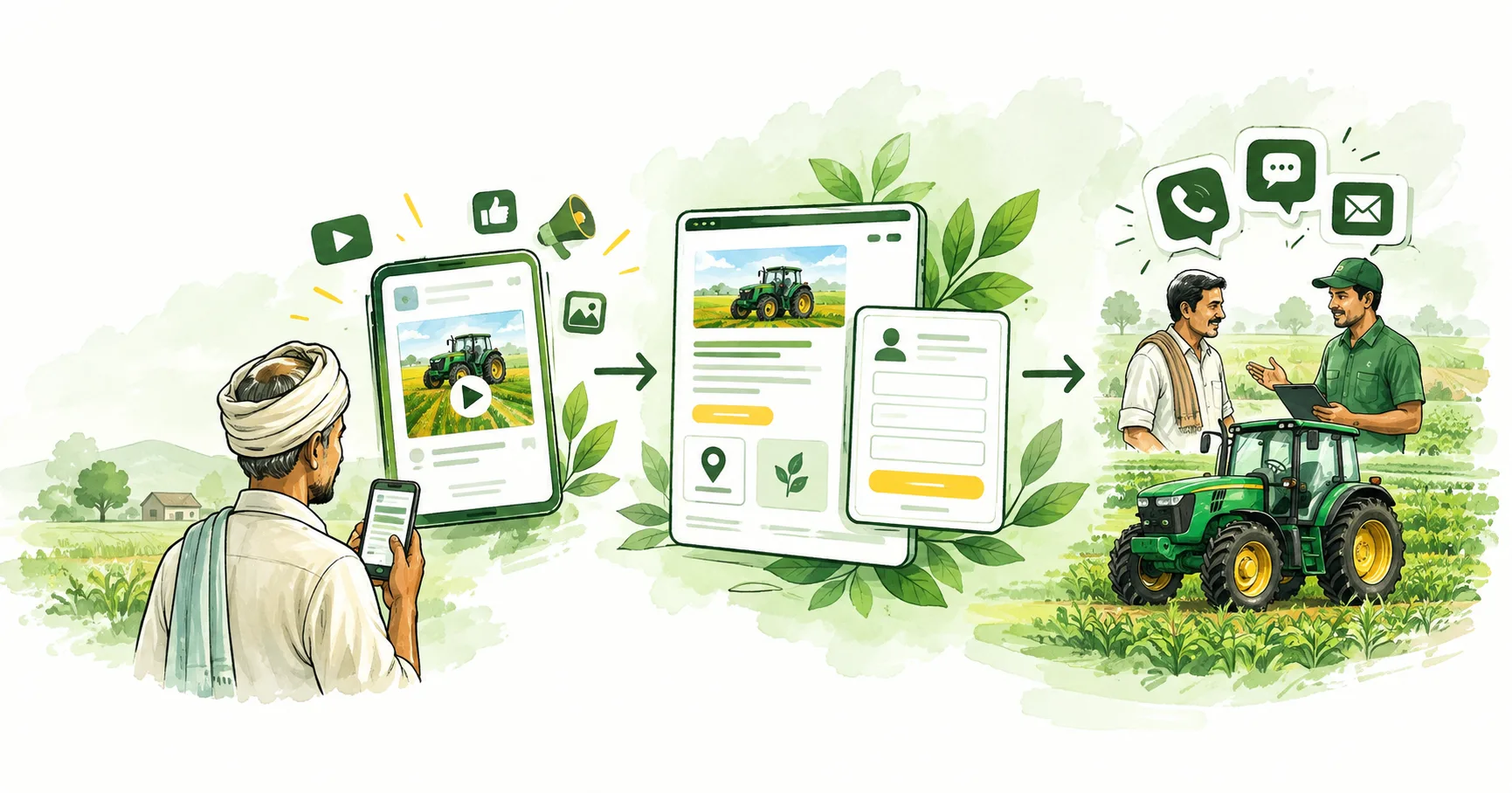
The most reliable starting point is to make the entire journey consistent. The audience sees a message, clicks because it addresses a need, finds supporting information, and receives a straightforward way to contact the business.
For example, an agricultural input company could advertise a product designed for a particular crop or application. Instead of sending every visitor to the homepage, it could direct them to a page explaining the intended use, application guidance, availability, and how to speak with an authorised dealer.
The advertisement and landing page should answer the same question. If the ad promises product details, visitors should not have to search through unrelated company information to find them.
A few practical changes can improve this journey:
- Be specific about the audience. Avoid messaging that tries to appeal to every type of agricultural buyer.
- Lead with a relevant benefit. Explain the problem the product is designed to address rather than relying on vague claims.
- Provide useful proof. Use accurate demonstrations, product specifications, suitable case examples, or independently verifiable evidence.
- Make the next step obvious. Offer a relevant action such as requesting a quotation, checking dealer availability or booking a demonstration.
- Follow up promptly. A promising enquiry can lose value if nobody responds while the buyer is still considering the product.
The aim is not to pressure every visitor into buying immediately. It is to help genuinely interested people take the next reasonable step.
Build a lead-generation process around buyer intent
Agriculture lead generation is not simply about collecting phone numbers or email addresses. It is about identifying people who have a genuine reason to consider a product and giving them a suitable way to start a conversation.
A useful enquiry form should collect enough information to help the sales team respond, without making the process unnecessarily difficult. Depending on the product, this might include the buyer's location, crop or application, product of interest, business type and preferred contact method.
For a farm equipment supplier, asking whether someone wants a demonstration or a quotation may help distinguish an immediate buying need from general interest. A business selling agricultural inputs may need to know the crop or intended application before directing the enquiry to the right representative.
The key is to ask only for information that serves a clear purpose. A long form can discourage genuine prospects, while a form that collects almost no context can leave the sales team making repeated calls just to understand the requirement.
What is the best way to generate leads for agricultural products?
The best approach depends on the product's price, buying cycle, and target audience. For products that buyers research actively, search campaigns and detailed product pages may be effective. For equipment that benefits from a live demonstration, advertising linked to a demonstration request may make more sense.
A practical process includes:
- Identify the buyer group and the problem the product addresses.
- Create a message that explains the relevant benefit.
- Direct interested people to a page with useful product information.
- Offer a clear next step, such as requesting a quotation or speaking with a dealer.
- Review enquiry quality and sales outcomes before expanding the campaign.
This process also gives the marketing team a clearer view of agriculture marketing leads. Rather than treating every response as equally valuable, the business can identify which audience groups, locations and messages are producing relevant opportunities.
Which digital marketing channels work best for agricultural lead generation?
No single channel is right for every agri-brand. The decision should follow the way prospective buyers discover products and evaluate suppliers.
Search advertising can be useful when buyers already know the type of product or solution they need. Social media advertising can introduce products to relevant audiences and demonstrate how they work. Video content can explain technical features or show a product in use, while a well-organised website can provide the details buyers need before making contact.
Email and messaging can support follow-up when people have voluntarily shared their contact details and agreed to be contacted. Dealer networks and field demonstrations may be important too, especially when the product requires installation, technical explanation, or local service.
For many businesses, digital marketing for agriculture works best as a connected system rather than a collection of unrelated activities. An advertisement creates interest, the website answers initial questions, and a representative helps the buyer decide whether to proceed.
Choose channels based on evidence, not popularity. If a platform generates many inexpensive clicks but few relevant enquiries, it may not deserve a larger share of the budget. A smaller campaign that reaches buyers with a clear need could be commercially more useful.
How can agri-input companies get more enquiries from farmers and dealers?
Farmers and dealers often evaluate the same product from different perspectives. Farmers may want to understand suitability, application, availability, and expected performance. Dealers may need information about supply, product demand, margins, sales support, and the manufacturer's distribution arrangements.
One advertisement is unlikely to address all those concerns effectively. Separate campaigns or landing pages can make the message more relevant to each audience.
For farmers, explain the product's intended use and provide accurate, understandable information. Where appropriate, direct them to a local dealer or qualified representative who can answer product-specific questions.
For dealers, make the commercial purpose clear. A distributor enquiry form might ask for the business location, current product categories, and preferred contact details. This helps the sales team route the enquiry to the right person.
The same principle applies to regional campaigns. Before advertising in a new area, check whether the product is available there and whether the business has the capacity to serve incoming demand. Generating enquiries in a region without suitable distribution can create frustration for buyers and waste the campaign budget.
Why do agriculture advertising campaigns get clicks but few enquiries?
When a campaign attracts traffic but few enquiries, resist the temptation to change everything at once. Look at each stage of the journey to identify where people are losing interest.
Common causes include:
- The audience is too broad. The advertisement attracts people who are curious but unlikely to buy.
- The promise is unclear. Visitors cannot quickly understand what the product does or who it is for.
- The landing page is difficult to use. Important information is missing, contact details are hard to find, or the form is inconvenient.
- The call to action asks for too much. A visitor who is still researching may not be ready to request a sales call.
- The offer does not match the ad. The advertisement promises product information, but the page provides only general company details.
- The business responds too slowly. Interested buyers move on while waiting for a reply.
Check campaign data alongside feedback from actual enquiries. If visitors leave the landing page quickly, review its relevance and usability. If forms are completed but the leads are unsuitable, revisit targeting and qualification. If good enquiries do not progress, the problem may lie in sales follow-up, pricing, or product availability rather than the advertising.
This kind of diagnosis helps the team make targeted improvements instead of repeatedly increasing spend.
How can agricultural businesses improve the quality of advertising leads?
Lead quality improves when advertising sets accurate expectations before someone contacts the business. The message should make clear what the product is designed for, which buyers it serves, and what information is available.
This is where qualified leads for agri-businesses become more valuable than raw enquiry volume. A qualified lead is someone who broadly matches the business's target market and has a relevant need or interest. It does not automatically mean the person is ready to purchase, so qualification criteria should reflect the actual sales process.
Marketing and sales teams should agree on what makes an enquiry worthwhile. For one company, that might mean a dealer seeking distribution opportunities. For another, it could be a farm owner requesting an equipment quotation for a specific location.
Record the source of enquiries and ask the sales team to report whether each lead was relevant, reachable, and worth pursuing. Over time, these insights can show which messages and channels attract stronger prospects.
This is also a practical part of agricultural customer acquisition: the goal is not just to attract people, but to understand which interactions are most likely to develop into business relationships.
How can agricultural brands convert website visitors into potential customers?
A website should make the next step easy for someone who has arrived with a specific question. Visitors should be able to understand the product, find relevant details, and contact the business without navigating through several unrelated pages.
Start with the basics. Make the product name and purpose clear. Include accurate specifications, relevant usage information, service or dealer details where applicable, and a visible contact option. On mobile devices, forms and telephone links should be easy to use.
The call to action should suit the visitor's level of interest. Someone comparing products may prefer to download a specification sheet or ask a question. A buyer who has already shortlisted a solution may want a quotation or demonstration.
Trust matters as well. Keep claims factual, explain limitations where necessary, and use genuine product images or demonstrations. Avoid testimonials or performance figures that cannot be verified.
A useful way to assess the page is to ask someone unfamiliar with the product to complete the intended action. If they cannot quickly explain what the product offers or how to enquire, the page may need clearer messaging.
How can an agriculture advertising agency help generate qualified leads?
An experienced agriculture advertising agency should connect campaign planning with the commercial outcome the business wants to achieve. That includes understanding the audience, choosing suitable channels, developing relevant creative, improving the enquiry journey and reviewing lead quality.
The agency should also work with the sales team. Without feedback about which enquiries progress, marketing decisions may rely too heavily on clicks and form submissions. Regular discussions can reveal whether the campaign is reaching the right buyers and what needs to change.
For brands operating across multiple regions, the agency should consider local demand, language, distribution and service availability before expanding campaigns. A larger audience is not automatically a better audience.
Google's guidance for AI search features continues to emphasise helpful, original content and established SEO fundamentals. For agricultural brands, that means providing genuinely useful product information and answering buyers' questions clearly, not simply repeating keywords or publishing generic pages.
Final thoughts
Turning advertising attention into genuine enquiries requires more than an attractive creative or a bigger media budget. Agricultural brands need to understand their buyers, explain product value accurately and make it easy for interested people to take the next step.
Start with a clearly defined audience, connect each advertisement to relevant information, and track what happens after an enquiry arrives. Use feedback from farmers, dealers and sales representatives to improve the campaign rather than judging success by clicks alone.
When agriculture advertising is planned around real buyer needs, it becomes easier to identify which channels deserve investment and which changes can improve enquiry quality. The strongest results come when marketing and sales work towards the same goal: helping the right prospects move from initial interest to a meaningful conversation.