Agencies prove billable hours most effectively with task-level time records tied to deliverables, presented in a clear client-facing hours report. A time tracker with screenshots can support that evidence in specific situations, but screenshots on their own rarely settle a billing question.
Strong agency billing evidence answers three things: what work was done, how long it took, and why it took that long. When a client asks for proof, they are usually asking for those answers, not for images of someone's screen.
This guide covers what clients really mean when they ask for proof, how different types of evidence compare, how to build an hours report clients trust, and how to handle a billing dispute without damaging the relationship.
Key Takeaways
- Requests for proof usually signal a budget, visibility, or trust concern, not a demand for surveillance.
- Task-level time is the strongest billing evidence; screenshots and activity levels are supporting data at best.
- A good hours report maps time to deliverables the client recognizes and explains variances before anyone asks.
- Disputes are resolved with context and options, not with a folder of screenshots.
- Screenshots help in narrow cases and backfire in creative work, multi-client environments, and privacy-sensitive markets.
What Clients Are Actually Asking For When They Ask for Proof
"Can you show us proof of the hours?" sounds like a request for data. In most agency relationships, it is a signal that something else has gone wrong. Reading that signal correctly decides whether you send a useful report or an awkward pile of evidence.
What the Client Says What They Usually Mean Evidence That Helps "Why is this invoice so high?" The bill exceeded what they expected Hours vs. budget, with variances explained "What did the team actually do?" Much of the work was invisible to them Time broken down by deliverable and task "Our finance team needs backup." A new stakeholder or procurement review Approved timesheets and a standard report "This took longer than we agreed." Scope or revision rounds grew Change requests and revision time, itemized "We need to see proof." Trust has slipped after a missed deadline Consistent reporting plus a process fix
Much of what agencies do is invisible to clients by nature: strategy sessions, internal reviews, research, revision rounds, and project management. When that work is not surfaced in reporting, the invoice feels inflated even when every hour is legitimate. Agencies that report this work proactively get far fewer proof requests. Teams that track time for creative and marketing agencies benefit most when hours are logged against client deliverables from the first day of a project.
Screenshots vs. Activity Levels vs. Task-Level Time
Agencies typically have three types of time evidence available. Each answers a different question, and only one of them answers the question clients care about most.
- Screenshots are periodic images of an employee's screen, captured at set or random intervals while the tracker is running.
- Activity levels measure how much of a tracked period included keyboard or mouse input, usually shown as a percentage.
- Task-level time records how many hours were spent on a specific task, deliverable, or project phase for a specific client.
Activity levels are the weakest evidence for billing. A designer sketching concepts on paper, a strategist on a client call, or a copywriter thinking through a headline may all show low activity during some of the most valuable hours of the project. Presenting those numbers to a client invites the wrong conversation.
Task-level time is the strongest because it maps directly onto the invoice. If a client sees 14 hours against "homepage redesign, round two revisions," they can judge the number against something they recognize.
Building a Client-Facing Hours Report
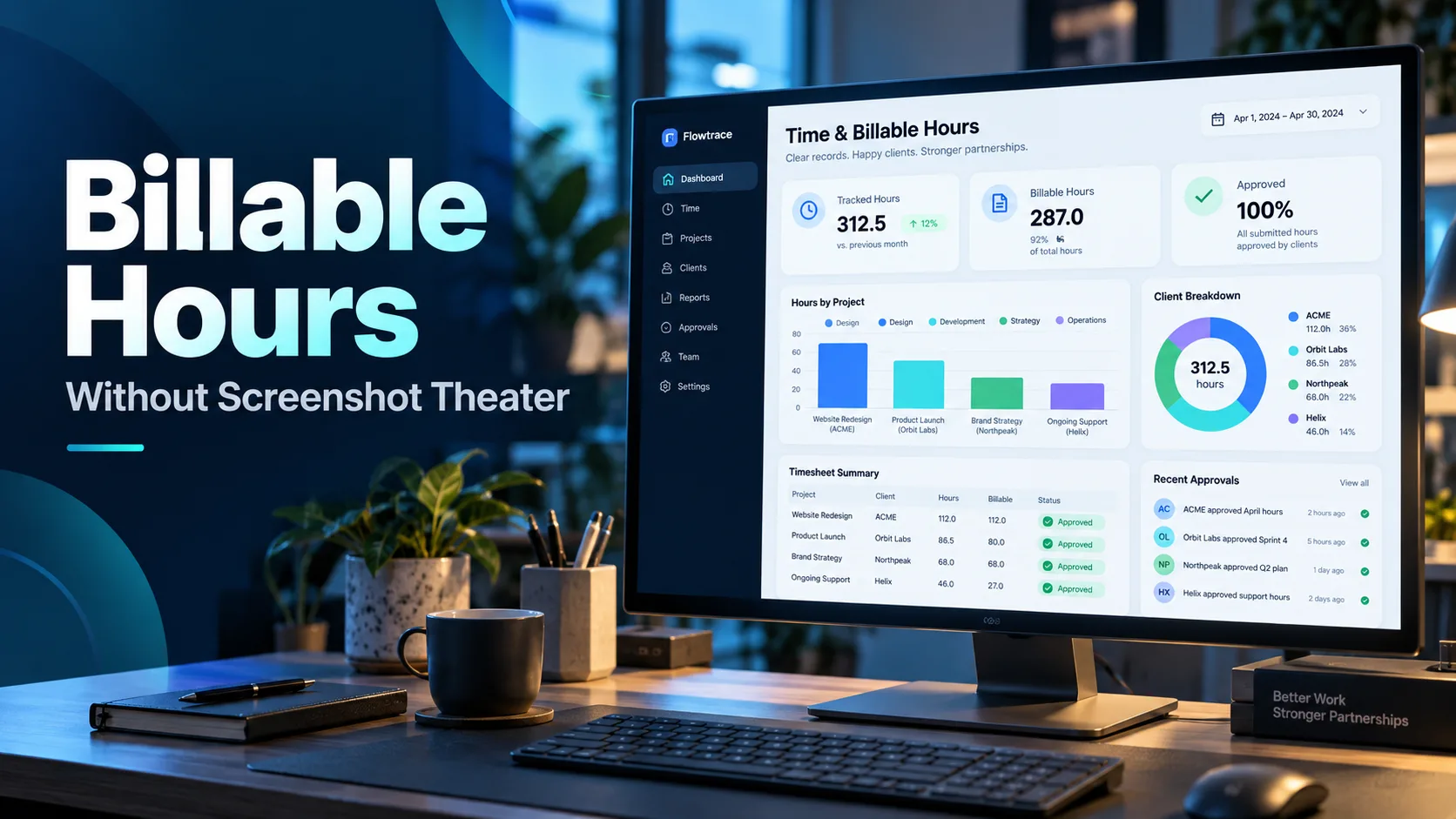
A client-facing hours report should let a busy stakeholder understand the invoice in under two minutes. Build it from approved online timesheets so the numbers match what was billed, and structure it around the client's view of the project, not your internal task list.
What to include
- Summary line: hours used vs. hours budgeted for the period, and for the engagement to date.
- Breakdown by deliverable or phase: the core of the report, using names the client already knows.
- Breakdown by role: strategy, design, development, copy, and project management, if billing rates differ.
- Out-of-scope work: change requests and extra revision rounds, listed separately with approval dates.
- Variance notes: one or two sentences explaining anything that ran over estimate.
- Forecast: expected hours for the next period, so there are no surprises.
A simple example
Deliverable Budgeted Hours Actual Hours Note Campaign strategy 12 11 Landing page design 20 26 Third revision round requested on 14 May Ad copy (6 variants) 8 8 Project management 6 7 Total 46 52 6 hours over; 5 relate to the extra revision round
Notice that the variance is explained on the same line where it appears. The client does not have to ask. That single habit prevents most disputes before they start.
How often to send it
Send reports weekly or biweekly for retainers and active projects, and at each milestone for fixed-scope work. Consistency matters more than frequency. A report that arrives on the same day every period builds trust in a way that one detailed report after a complaint never will.
Handling the Dispute Conversation
Even with good reporting, some clients will challenge an invoice. How the agency responds often matters more than the dollar amount in question. A client who feels heard during a dispute often stays for years; a client who feels stonewalled over a few hours usually starts looking for a new agency, whatever the records show.
- Clarify the specific concern. Ask which line items or deliverables feel wrong. A vague dispute cannot be resolved with vague evidence.
- Pull the task-level records. Share the hours for the disputed items only, with dates and the people involved.
- Explain the context. Link overruns to what caused them: extra revision rounds, late feedback, changed requirements, or an underestimate on your side.
- Own what is yours. If the team underestimated or worked inefficiently, say so plainly.
- Offer options. A partial credit, a write-down, or a scope adjustment for the next period gives the client a path forward.
Fix the process. Agree on how change requests will be approved in writing so the same dispute does not recur.
One thing to avoid: responding to a dispute by sending a large set of screenshots. It signals defensiveness, shifts attention from the work to the worker, and can expose information the client should never see.
Where Screenshot Evidence Helps and Where It Backfires
Screenshots are not useless. Used with intent, a time tracker with screenshots gives agencies a verification layer in situations where task-level time alone is not enough. The key is knowing when that layer adds trust and when it removes it.
Where screenshots help
- Contract or regulatory requirements. Some clients, especially in regulated industries, require visual verification of work.
- Freelancers and subcontractors. Agencies can verify hours billed to them before passing costs to clients.
- Internal quality review. Managers can check how time was spent on a task that ran far over estimate.
Specific, timestamped disputes. A single screenshot can confirm that work happened on a given date, when that fact is in question.
Where screenshots backfire
- Creative and strategic work. Screens rarely capture thinking, sketching, or discussion, which is where much agency value is created.
- Multi-client environments. A screenshot taken for one client may show another client's campaign, data, or credentials. Sharing it can breach confidentiality.
- Bulk sharing with clients. Sending folders of screenshots overwhelms the client and invites nitpicking of individual moments.
- Team morale. Staff who feel watched tend to perform for the tracker instead of focusing on the work.
- Privacy rules. In the EU and UK, GDPR requires transparency and data minimization, and several US states, including New York, require notice of electronic monitoring.
The practical rule: configure screenshots by role, blur them where possible, restrict who can view them, and never send raw screenshots to clients. Summarize what they show instead.
Best Practices for Agency Billing Evidence
- Tag every hour to a client and deliverable at the time of entry, not at the end of the week.
- Name tasks the way clients name them, so reports need no translation.
- Track revision rounds as separate tasks so scope growth is visible.
- Approve timesheets before invoicing so reports and invoices always match.
- Write a short tracking policy covering what is captured, who sees it, and what is shared with clients.
Common Mistakes Agencies Make
- Leading with screenshots instead of task-level time.
- Sharing activity percentages that clients misread as productivity scores.
- Reporting only when asked, which makes every report feel like a defense.
- Bundling out-of-scope work into general project hours.
- Letting one screenshot expose another client's data.
Conclusion
Clients who ask for proof want confidence, not surveillance. Agencies earn that confidence with task-level time, reports that explain variances before anyone asks, and a calm, specific approach to disputes. Screenshots have a place, but as a narrow verification tool configured with care, not as the centerpiece of agency billing evidence.
Get the reporting right, and most requests for proof simply stop arriving.
Frequently Asked Questions
What is the best way for an agency to prove billable hours?
Share task-level time records tied to deliverables in a consistent client-facing report, with variances explained. This is the most credible form of agency billing evidence.
Should agencies send screenshots to clients?
Rarely. Screenshots can expose other clients' information and rarely answer billing questions. Summarize what they show instead of sharing raw images.
When is a time tracker with screenshots useful for agencies?
When contracts require visual verification, when checking subcontractor hours, for internal quality reviews, or to confirm a specific timestamped fact in a dispute.
Are activity levels good evidence of billable work?
No. Activity levels measure keyboard and mouse input, not the quality or relevance of work. Strategy, calls, and creative thinking often show low activity.
How often should agencies send hours reports to clients?
Weekly or biweekly for retainers and active projects, and at each milestone for fixed-scope work.