For businesses operating in Egypt's fast-growing markets, financial and compliance risk rarely announces itself in advance. A trusted supplier can quietly accumulate legal disputes. A long-standing customer can appear on a sanctions list overnight. Without visibility into these developments, companies expose themselves to losses that could have been avoided with the right information at the right time. This is where adverse information becomes a critical tool for risk management.
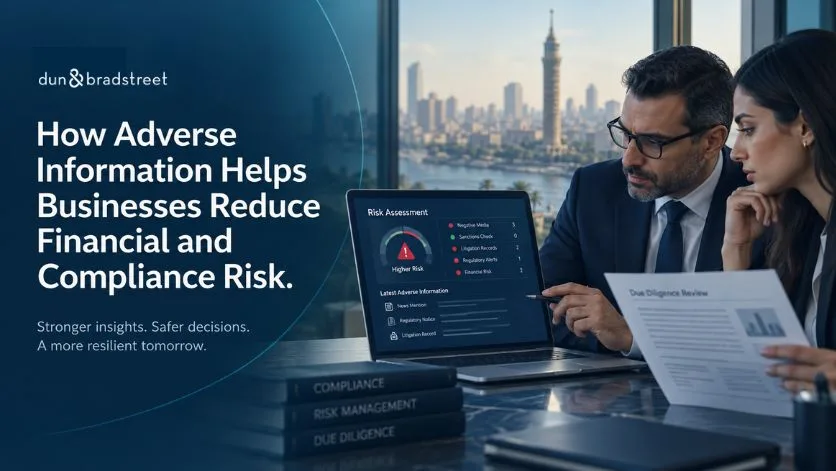
Adverse information refers to negative, publicly available data about a company or individual that may signal heightened risk. This includes litigation records, regulatory sanctions, bankruptcy filings, negative media coverage, and involvement in fraud or financial crime. When integrated into due diligence and onboarding processes, adverse information gives businesses an early warning system that protects both financial performance and regulatory standing.
What Adverse Information Actually Covers
Adverse information spans a wide range of risk indicators, not just financial distress. Key categories include:
- Legal and regulatory actions. Court judgments, regulatory fines, and enforcement actions reveal whether a company has a history of noncompliance.
- Financial distress signals. Bankruptcy filings, insolvency proceedings, and payment defaults point to elevated credit risk.
- Sanctions and watchlists. Inclusion on government or international sanctions lists can create serious legal exposure for any business that continues a relationship without proper screening.
- Negative media coverage. Reports of fraud allegations, environmental violations, or ethical misconduct often surface before formal regulatory action does, making media screening a valuable early indicator.
- Criminal associations. Links to money laundering, corruption, or organized financial crime represent the highest tier of risk and typically require immediate escalation.
Each category serves a distinct purpose in a risk assessment, and mature compliance programs weigh them differently depending on industry, geography, and the nature of the business relationship in question.
Why Adverse Information Matters for Egyptian Businesses
Egypt's business environment is shaped by expanding trade corridors, an evolving regulatory landscape, and a growing base of small and mid-sized enterprises entering formal credit and supply chain relationships for the first time. This growth brings opportunity, but it also increases the likelihood of onboarding counterparties whose risk profile is not immediately visible.
Companies that skip adverse information screening during onboarding often discover problems only after a financial loss has occurred, a regulatory inquiry has begun, or a reputational issue has surfaced publicly. Retrofitting due diligence after the fact is far more costly than screening at the point of engagement.
Adverse information screening also supports compliance with anti-money laundering and know your customer obligations that Egyptian financial institutions and increasingly non-financial businesses are expected to uphold. Regulators are placing greater emphasis on demonstrable due diligence processes, and adverse information checks form a core part of that evidence trail.
How Adverse Information Reduces Financial Risk
The connection between adverse information and financial risk is direct. A supplier with a recent history of payment defaults is statistically more likely to disrupt your supply chain. A customer facing litigation may struggle to meet contractual payment terms. By surfacing these signals before a contract is signed, adverse information allows credit and procurement teams to make informed decisions rather than reactive ones.
This is particularly valuable when combined with broader risk indicators such as a company's PAYDEX Score or Financial Stress Score. Adverse information adds a qualitative layer to these quantitative measures, capturing risks like fraud allegations or ownership disputes that may not yet be reflected in payment behavior or financial statements.
How Adverse Information Strengthens Compliance Programs
Compliance teams face constant pressure to demonstrate that due diligence is thorough, consistent, and well documented. Adverse information screening supports this in several ways.
First, it creates a defensible audit trail. When regulators or auditors ask how a business assessed a counterparty, screening records provide clear evidence of process.
Second, it enables risk-based prioritization. Not every relationship carries the same level of risk, and adverse information helps compliance teams focus deeper investigation on higher-risk cases rather than treating every counterparty identically.
Third, it supports ongoing monitoring rather than a single-point-in-time check. Adverse events can emerge at any point in a business relationship, so continuous screening ensures risk exposure is tracked throughout the relationship lifecycle, not just at onboarding.
Fourth, it strengthens beneficial ownership analysis. Understanding who ultimately controls a company is essential to assessing true risk exposure, and adverse information often reveals ownership-related red flags that would otherwise go unnoticed.
Building Adverse Information Into Your Risk Framework
Businesses looking to strengthen their risk posture should treat adverse information screening as a standard component of onboarding and periodic review, not an occasional exercise. This means:
- Screening new counterparties before formal engagement begins, rather than after contracts are signed.
- Establishing clear escalation paths when adverse information is identified, so findings translate into action rather than sitting unreviewed.
- Reviewing existing relationships periodically, since risk profiles change over time even for long-standing partners.
- Integrating adverse information with financial and compliance data, so decisions are based on a complete picture rather than isolated data points.
Conclusion
Adverse information is not simply a compliance checkbox. It is a practical tool that helps Egyptian businesses protect revenue, avoid regulatory penalties, and make sound decisions about who they choose to work with. As Egypt's economy continues to attract new trade relationships and financial partnerships, the businesses that build systematic adverse information screening into their processes will be better positioned to manage risk proactively rather than respond to it after damage is done.