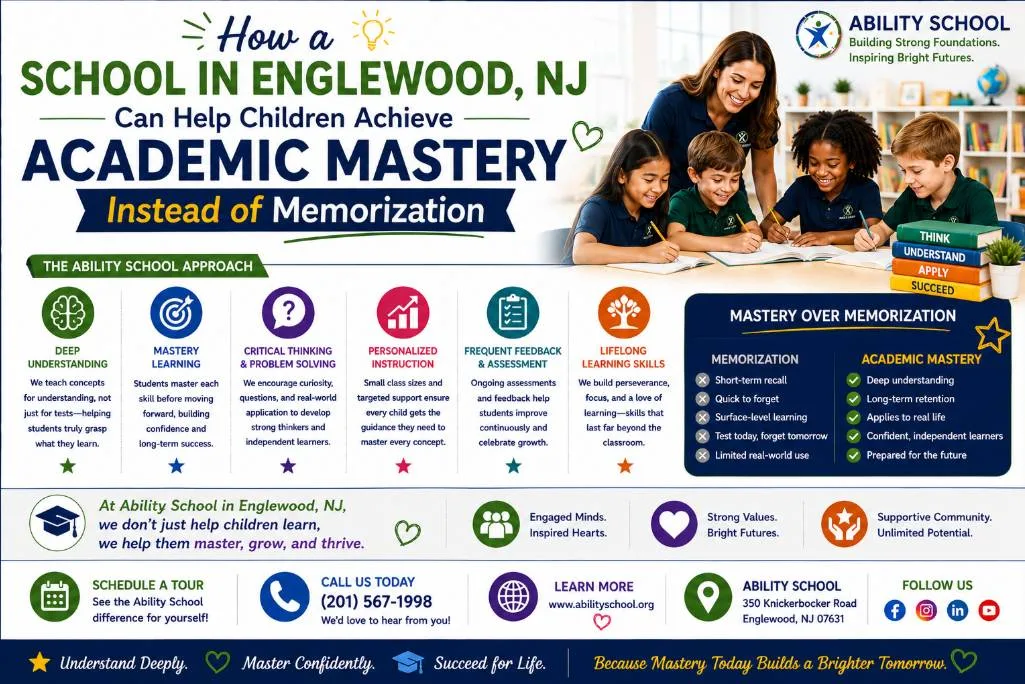
Why do some children do well on a test, then struggle to explain the same topic a few days later? In many cases, the problem is not intelligence or effort. The problem is the way they were taught. A strong school in Englewood, NJ, does not treat short-term recall as the final goal. It pushes students toward real comprehension.
That difference shapes how children read, write, solve problems, and respond to harder coursework later on. Parents comparing Englewood, NJ schools often look at academics, class size, and curriculum. They should also ask a deeper question. Does the school help children retain and apply knowledge, or does it train them to repeat information for the next quiz?
Why Memorization Stops Working
Memorization can help with facts, vocabulary, formulas, and dates. But once the work becomes more analytical, memorization starts to crack. A child may remember an answer without understanding why that answer is correct. That weakness shows up later in reading comprehension, structured writing, math reasoning, and class discussion.
A thoughtful school in Englewood, NJ, builds learning in a different way. It expects students to explain concepts, connect lessons across subjects, and use knowledge in new settings. That approach produces stronger academic habits because students do not move forward with half-learned material.
This is where academic mastery becomes important. Mastery asks for full command, not partial recall. Students strengthen the foundation before they step into more advanced work. Over time, that process reduces learning gaps that often stay hidden in traditional classrooms until the work becomes more demanding.
What Helps Children Move From Recall To Mastery
Children do not reach mastery by accident. Schools need the right structure, teaching model, and classroom conditions. That is why families should look beyond surface claims when comparing programs.
An effective school in Englewood, NJ, will help to foster mastery in several ways:
- Small classes that allow the teacher to see confusion early on.
- Individualized pacing for a child when reinforcement is indicated
- High-quality reading and writing instruction and support throughout the school day.
- Ongoing teacher feedback rather than "grading"
- Students learn in a hands-on way, using knowledge to perform tasks
- A culture that promotes accuracy, revision, and independent work within the school context
Ability School NJ reflects many of these qualities through its emphasis on individualized progress, literacy development, and a mastery-based academic structure. That model gives students more than exposure to content. It gives them time and support to actually learn it.
Why Literacy And Independence Need More Attention
Parents often separate literacy from other academic goals, but schools should not. Reading, writing, and communication affect performance in every subject. A student who reads with precision usually follows instructions better, understands context faster, and produces stronger written work. A student who writes clearly also tends to think more clearly.
That is one reason many Englewood, NJ schools are evaluated on more than test preparation alone. Families want classrooms that build students who can process information, express ideas, and work with greater independence. Those abilities do not come from repetition. They come from practice, correction, and sustained engagement with the material.
Ability School NJ also stands out for combining academics with broader developmental experiences such as the arts, creative work, and active learning. That type of environment can improve how children connect ideas and stay engaged in the learning process.
What Parents Should Compare Before Making A Decision
Many schools describe themselves as rigorous or student-centered. Those phrases mean little unless parents understand what happens inside the classroom each day. The better approach is to compare specific academic signals.
What Parents Should AskWhat The Answer RevealsHow does the school respond when a student does not grasp a lesson the first time?Whether the school closes gaps or moves ahead too fastDo teachers expect students to explain answers, not just give them?Whether the school values reasoning over recallHow strong is the reading and writing program?Whether literacy supports all subjectsHow much individual feedback does each child receive?Whether the learning process gets personal attentionAre students expected to work independently over time?Whether the school is building lasting academic habitsThese questions help parents judge substance instead of marketing language. They also make it easier to identify a program built on a real academic discipline rather than fast coverage.
Conclusion
Academic mastery does not come from rushing through content or training children to remember isolated facts. It comes from patient instruction, close feedback, strong literacy, and a school model that requires real understanding before progress. For families evaluating a school in Englewood, NJ, that difference deserves careful attention.