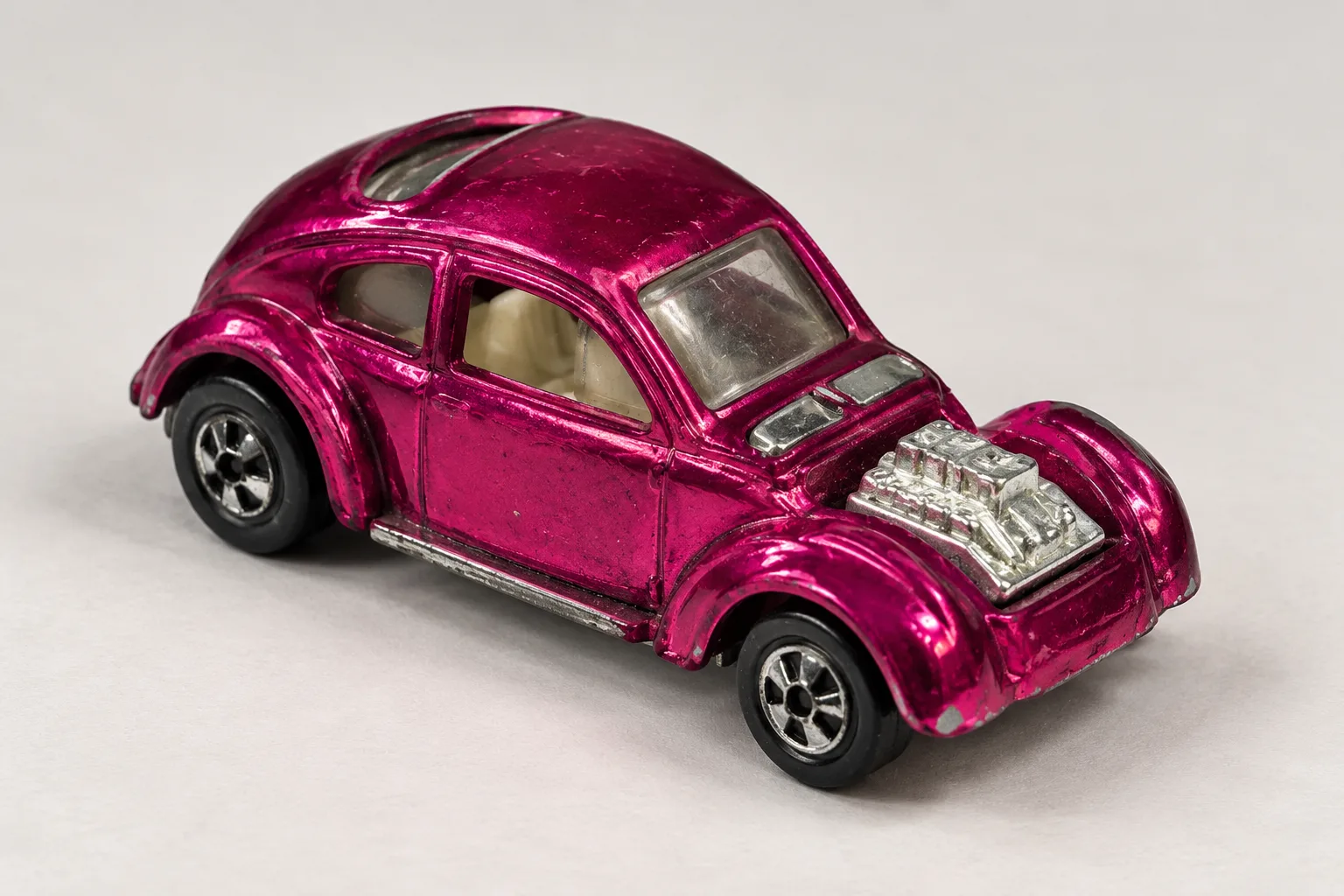
Finding a few old Hot Wheels in a childhood box can lead to a much bigger question: what exactly do you have? Redline collecting becomes much easier once you understand the basic clues, from the red stripe around the tires to the casting, color, base, wheels, and condition.
You do not need to memorize hundreds of models to get started. You need to learn what to look for and, just as importantly, what not to assume.
What Makes a Hot Wheels a Redline?
Original Redline Hot Wheels were produced from 1968 through 1977. The name comes from the thin red stripe around the tires, which became one of the defining visual features of the early cars.
These cars were part of Mattel's first generation of Hot Wheels and included many of the models that established the brand's identity. The earliest releases are commonly associated with the original Sweet 16, while later Redlines introduced additional castings, colors, and production variations.
If you are just starting, a useful first step is learning the basic characteristics of vintage hot-wheels cars. Not every old-looking Hot Wheels car is a Redline, and not every car with a red-looking tire stripe is automatically an original 1960s or 1970s example.
Age needs to be established through several details rather than appearance alone.
Start With the Casting, Not the Price
One of the most common beginner mistakes is finding a similar-looking car online and immediately assuming it has the same value.
Start by identifying the casting.
Look at the body shape, opening features, interior, base, wheels, and any distinctive accessories. Early Redlines can have variations that are easy to miss if you only compare the overall silhouette.
The Custom Camaro, Python, Custom Mustang, Deora, Beatnik Bandit, and other early castings can appear in multiple colors and production configurations. Identifying the exact version gives you a much better starting point than searching for the model name by itself.
If you are dealing with an unfamiliar casting, photograph the car from the top, side, front, rear, and underside. The base often provides information that is impossible to see from above.
Learn to Read the Base
Turn the car over.
For beginners, the base is one of the most useful places to start because it can contain the manufacturer's name, copyright information, country of manufacture, and other details that help establish the car's production history.
USA and Hong Kong production can matter when comparing early Redline examples. Base details can also help distinguish variations that otherwise look almost identical.
Do not assume that a USA marking automatically makes a car valuable or that a Hong Kong marking makes it less desirable. These details are identification clues. Their significance depends on the specific casting and variation.
This is also where you need to be careful with later reproductions and reissues. A car can copy the appearance of an older Hot Wheels model without being an original Redline-era example.
Color Is More Important Than Beginners Expect
Once you know the casting, examine the paint.
Original Redlines are famous for Spectraflame finishes, which have a distinctive translucent appearance over the metal body. Common colors include shades such as red, blue, aqua, and green, while less frequently encountered colors and unusual variations can attract considerably more collector attention.
But color alone does not establish value.
Look for fading, scratches, chips, toning, oxidation, and areas where the paint may have been touched up. A rare color with heavy damage may be less desirable than a more common color in exceptional original condition.
This is one reason experienced collectors do not assign a value simply from a photograph showing the top of the car.
Check the Wheels and Axles
The wheels can tell you a lot about an early Hot Wheels car.
Inspect the redline tires for wear and look closely at the wheel style, axle condition, and whether the wheels appear consistent with the casting.
Heavy play can leave scratches, worn redlines, bent axles, or damaged wheels. Replaced wheels can also affect originality.
If you are unsure whether a wheel setup is correct, do not replace it just because it looks worn. An original worn component is still useful evidence about the car's history.
Preserving what is there is usually safer than trying to make the car look new.
Condition Can Change the Conversation
Two examples of the same casting can be very different collectibles.
Collectors generally look at factors such as:
- Original Spectraflame paint
- Paint chips and scratches
- Bright or worn redlines
- Clear or damaged windows
- Intact interiors
- Original wheels and axles
- Original rivets
- Base condition
- Missing or damaged accessories
- Signs of repainting or restoration
A car that spent decades in a display case can look dramatically different from one that was pushed across a driveway in 1972.
That history is part of what makes Redline collecting interesting. You are not simply identifying an old toy. You are examining an object that has survived decades of handling, storage, and sometimes modification.
How to Tell if a Redline Is Original
Originality is one of the most important concepts for a new collector to understand.
Look for consistency across the entire car. Does the paint appear appropriate for the casting? Do the wheels match the expected configuration? Are the rivets untouched? Does the interior make sense for the version? Does the base correspond with the production details?
Be cautious when a car looks unusually perfect without an obvious storage history. Reproduction parts, repainted bodies, replacement wheels, and other modifications can make an older car appear more original than it actually is.
When you are unsure, compare the casting against documented examples and learn how to identify original Hot Wheels before making any changes to the car.
When you are uncertain, document the car rather than modifying it. Clear photographs of the body, base, wheels, interior, and any unusual details are much more useful for later identification.
When Should You Start Looking at Value?
Only after identification.
Once you know the casting, color, production details, condition, and originality, you can start comparing the car with documented examples and a Hot Wheels Redline Price Guide.
Even then, avoid treating one online asking price as proof of value. Asking prices are not necessarily completed sales, and an exceptional example should not automatically be used to value an ordinary one.
Value can depend on the combination of:
- Casting
- Color
- Factory variation
- Condition
- Wheel configuration
- Originality
- Completeness
- Provenance
- Collector demand
This is why two cars that appear identical at first glance can ultimately be worth very different amounts.
Do Not Restore a Redline Just Yet
One of the biggest mistakes beginners can make is trying to improve a car before understanding it.
Do not polish the paint, repaint chips, replace worn wheels, clean aggressively, or open the rivets simply because the car looks old.
Those changes can remove evidence of originality and make future evaluation more difficult.
If a car is dirty, damaged, or incomplete, document its condition first. Preservation is usually more useful than cosmetic improvement when you are dealing with an older collectible.
Build Your Collection Around What Interests You
You do not need the rarest Redline to become a serious collector.
Some collectors focus on the original Sweet 16. Others prefer muscle cars, custom designs, unusual colors, racing models, or a particular casting. Some collect only examples in exceptional original condition.
Start with something you actually enjoy looking at.
As your knowledge grows, you will naturally become better at spotting unusual colors, production variations, and cars that deserve closer examination.
The team at Redline Archeology often approaches collections the same way: identify what is actually there before making assumptions about what it is worth.
The Best Beginner Habit: Look Before You Value
Redline collecting gets complicated when you try to jump straight to prices.
Instead, make identification your first habit. Find the casting, inspect the base, check the color, examine the wheels, assess the condition, and look for signs of restoration or replacement parts.
Once those pieces are understood, valuation becomes much more meaningful.
That approach also prevents one of the most common beginner mistakes: seeing a headline price for a rare Redline and assuming the car in your hand must be the same.
In Redline collecting, the details are the story. Sometimes the smallest factory difference is exactly what separates an ordinary old Hot Wheels car from one worth taking a much closer look at.