
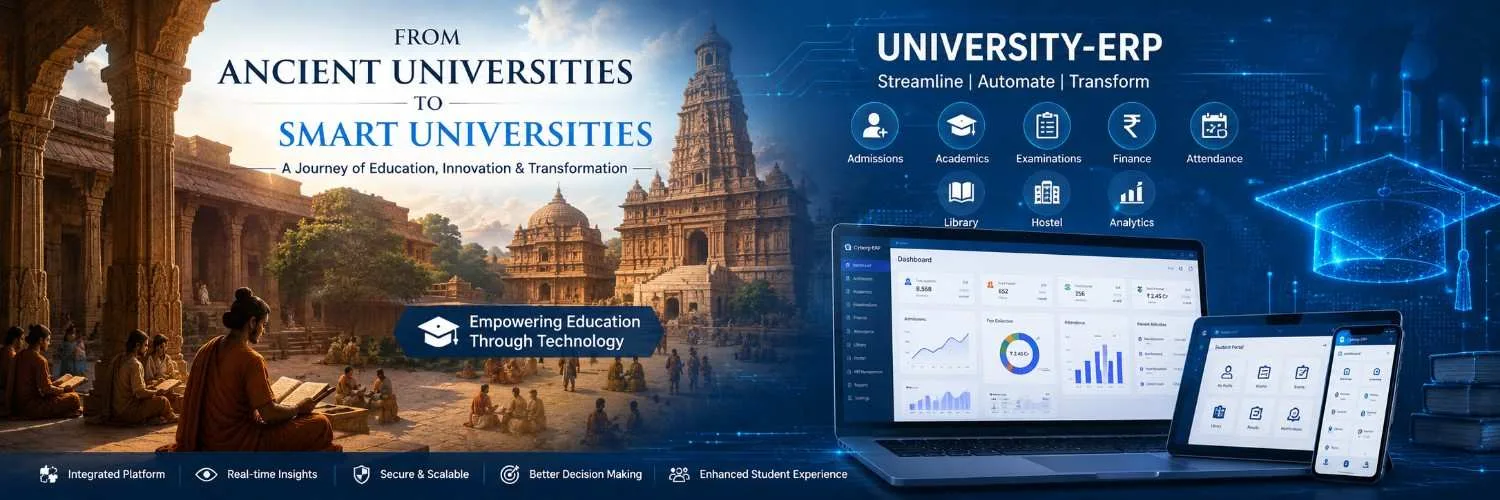
India has one of the oldest and most respected education systems in the world. From ancient universities like Nalanda University and Takshashila to modern digital campuses, higher education in India has undergone remarkable transformation. Today, the rise of University-ERP solutions is reshaping how institutions manage academics, administration, admissions, finance, and student engagement.
The journey of higher education ERP software in India is deeply connected to the historical evolution of Indian education itself.
Ancient Roots Of Indian Higher Education
The foundation of higher education in India dates back to the Vedic and Buddhist eras. Ancient institutions focused on holistic learning, philosophy, mathematics, medicine, astronomy, grammar, and logic. Universities like Takshashila and Nalanda attracted students from across Asia and became global centers of knowledge.
The education system during this period was highly organized for its time. Teachers maintained records manually, students followed structured learning paths, and institutions operated with discipline and administrative systems suited to that era.
Although technology did not exist then, the concept of centralized educational management was already visible in ancient Indian learning traditions.
Medieval And Colonial Influence On Education
During the medieval period, regional literature, arts, and Islamic education systems expanded across India. Madrasas and traditional institutions continued the legacy of knowledge sharing.
A major shift occurred during British rule in the 19th century. Western-style education was introduced through institutions such as the Calcutta Madrasa in 1781. Later, the Universities of Calcutta, Bombay, and Madras were established in 1857, creating the foundation of the modern university system in India.
Thomas Macaulay’s education policies promoted English-based Western education and administrative learning. Universities began handling larger student populations, examinations, faculty management, and academic records. However, all processes were managed manually through paperwork and physical registers.
This administrative burden would later become one of the biggest reasons for the development of ERP software in higher education.
Post-Independence Expansion Of Universities
After independence in 1947, India focused heavily on nation-building through education. The government established premier institutions including the IITs and expanded public universities across states.
Between the 1950s and 1970s, higher education saw rapid growth in science, engineering, medicine, arts, and professional studies. In 1976, education was moved to the Concurrent List, increasing the central government's role in educational policy and regulation.
As universities expanded, administrative complexity also increased. Institutions had to manage:
- Student admissions
- Examination systems
- Fee collection
- Faculty payroll
- Hostel management
- Library records
- Affiliated colleges
- Academic scheduling
Traditional manual systems became slow, error-prone, and inefficient.
Emergence Of University ERP Software In India
The late 1990s and early 2000s marked the beginning of digital transformation in Indian higher education. As computers and internet connectivity became more common, universities started adopting software-based administration systems.
Initially, institutions used standalone applications for accounting, payroll, or student records. Over time, these fragmented systems evolved into integrated University-ERP platforms capable of managing entire educational ecosystems from a single dashboard.
The demand for ERP solutions increased because universities needed:
- Faster administrative operations
- Accurate student data management
- Online admissions and examinations
- Automated fee management
- Real-time reporting
- Better communication with students and parents
- Regulatory compliance with UGC and accreditation bodies
This period became the foundation of modern educational automation in India.
Growth Of Cloud Based ERP Systems
With the rise of cloud computing in the 2010s, ERP systems became more scalable and affordable for universities and colleges. Institutions no longer needed expensive infrastructure to manage operations.
Cloud-based University-ERP platforms allowed administrators, teachers, students, and parents to access information securely from anywhere. Mobile applications further improved accessibility and communication.
Modern ERP systems now include features such as:
- Online admissions
- Attendance tracking
- Learning management systems
- Examination automation
- Digital fee collection
- HR and payroll management
- Hostel and transport modules
- Student analytics
- AI-powered reporting
The implementation of the National Education Policy (NEP) 2020 also accelerated digital adoption in higher education institutions.
Current Landscape Of Higher Education In India
India currently has the third-largest higher education system in the world, with more than 1,100 universities and over 45,000 colleges. State public universities and affiliated institutions serve the majority of students across the country.
The higher education sector is primarily regulated by the University Grants Commission along with various technical councils and accreditation bodies.
As universities continue expanding, ERP software has become an essential operational requirement rather than an optional technology investment.
Today’s institutions require centralized digital systems to ensure:
- Academic efficiency
- Transparent administration
- Better student experiences
- Regulatory compliance
- Data-driven decision-making
- Institutional scalability
The Future Of University ERP In India
The future of University-ERP software in India is expected to be driven by artificial intelligence, automation, analytics, and integrated digital learning ecosystems.
Future ERP platforms may include:
- Predictive student performance analytics
- AI-based admissions assistance
- Smart campus automation
- Integrated online learning platforms
- Blockchain-based certificate verification
- Advanced data security systems
As India moves toward a more technology-enabled education ecosystem, ERP solutions will continue playing a central role in transforming higher education administration.
Conclusion
The history of higher education in India reflects a remarkable journey from ancient gurukuls and world-renowned universities to digitally connected smart campuses. As educational institutions evolved, the need for efficient management systems gave rise to modern University-ERP software solutions.
Today, ERP technology is helping universities improve operational efficiency, enhance learning experiences, and prepare for the future of digital education.
Cyborg-ERP : Operating System For The Education Institutions
Cyborg ERP is a modern cloud-based ERP platform designed to simplify and automate educational institution management. From admissions and examinations to finance, HR, attendance, and communication, Cyborg-ERP helps schools, colleges, and universities streamline operations through a centralized digital ecosystem.